Andy Burnham has been appointed as United Kingdom’s prime minister, becoming the country’s seventh leader in just 10 years, since its departure from the European Union in 2016. UK Prime Minister Keir Starmer stepped down, to be replaced by the former Greater Manchester Mayor.
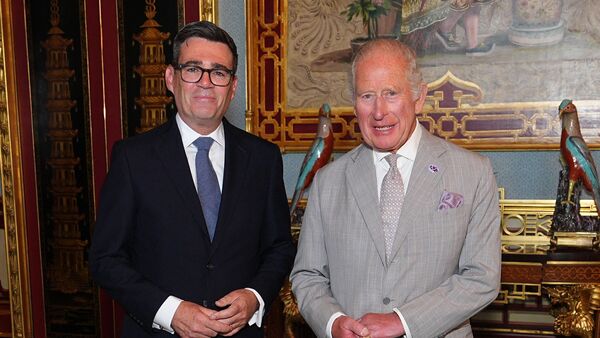
Andy Burnham is officially the UK’s 59th prime minister. He has been invited by King Charles to form a government in a private meeting at Buckingham Palace.
y on Friday (18 July) after Keir Starmer resigned — becoming the shortest serving Labour prime minister in history — following pressure from within the party amid lagging poll ratings and Burnham’s return to parliament.
The handover is a carefully choreographed process involving trips to Buckingham Palace to meet with King Charles III who, technically, invites the incoming prime minister to form a government.
“His Majesty received in audience the Rt Hon Andrew Burnham MP and requested him to form a new Administration. The Rt Hon Andrew Burnham MP accepted The King’s offer and kissed hands upon his appointment as Prime Minister and First Lord of the Treasury.” said the Buckingham Palace in an official statement.
“Ms Marie-France van Heel was also received by His Majesty,” the statement adds.
Catholic PM- A Historic First for Downing Street
Andy Burnham’s appointment makes him the first British prime minister to identify as Catholic, a milestone in the nation’s religious and political history.
For centuries, legislation and convention rooted in the 16th-century Reformation, when the , effectively barred Catholics from holding the office.
Andy Burnham- From Greater Manchester Mayor to Number 10
Before entering Downing Street, Andy Burnham served as mayor of Greater Manchester, in the north-west of England. He secured the Labour leadership after winning the backing of parliamentary colleagues following Starmer’s resignation.
His path back into Westminster began with victory in a by-election in Makerfield, north-west England, last month, a contest called specifically to allow him to stand as a sitting member of parliament and pursue the Labour leadership.
Labour had won a landslide general election less than two years earlier, yet Starmer’s authority steadily eroded as Nigel Farage’s right-wing populist party, Reform UK, and the left-wing Green Party gained ground in opinion polls. Allies of Burnham argued he was the only figure capable of halting Labour’s declining fortunes, given Starmer’s deep unpopularity.
Over recent years, Burnham has built a reputation as one of Britain’s most popular politicians, his charisma often overshadowing tensions in his public identity. Despite frequently presenting himself as an outsider to Westminster politics, he became a parliamentary researcher at 24, a special adviser at 28 and a member of parliament by the age of 31.
Across sixteen years in Parliament, Burnham served under both Tony Blair and Gordon Brown, eventually becoming health minister before twice failing in bids for the Labour leadership, in 2010 and 2015. In the 2015 contest he was heavily defeated by Jeremy Corbyn, whose victory pulled the party further to the left.
Although Burnham initially remained in Corbyn’s shadow cabinet, his move to become Manchester mayor in 2017 allowed him to step largely outside the factional battles that consumed Labour during and after Corbyn’s leadership.
How UK Can Change Prime Minister Without General Election
Unlike the presidential systems of India, or France, the . The role goes to the leader of whichever political party commands a majority of MPs in the House of Commons. The only voters who cast a ballot for the prime minister by name are those in his own constituency.
This structure means a party can replace its leader, and therefore the prime minister, without triggering a general election, a pattern that has occurred with growing frequency in recent British politics.
Burnham could opt to call a general election as prime minister, though he has given no indication he intends to do so. Under current rules, he will need to face voters no later than 15 August 2029, the last permitted date for the next general election.
Some opposition parties are pressing for an immediate election, arguing that Burnham, who was not even a sitting MP a month ago, lacks a democratic mandate to lead the country. In response, Burnham has said he intends to broadly follow the policies set out in Labour’s 2024 election manifesto, pointing to his recent by-election win in Makerfield as evidence of voter backing.