Cheyenne, Wyoming — Flying in over the Wyoming prairie aboard the Air Force’s new Grey Wolf helicopter, the commanders of U.S. Strategic Command and Air Force Global Strike Command are taking us to a place that was once so highly secure that trespassers could be shot on sight — a Minuteman III Intercontinental Ballistic Missile, or ICBM, silo.
Hundreds of these active nuclear silos dot the landscape from Colorado up to the Canadian border.
“There are always approximately 400 (ICBMs) ready to go at any moment,” says Air Force Global Strike Command General S. L. Davis over the Grey Wolf’s comms system.
CBS News traveled with Davis and Admiral Rich Correll, Commander of U.S. Strategic Command, for an exclusive look at the modernization of America’s ground-based nuclear deterrent from the Minuteman III to the new Sentinel. They are leading the effort and are in Wyoming to inspect the progress at F. E. Warren Air Force Base in Cheyenne.
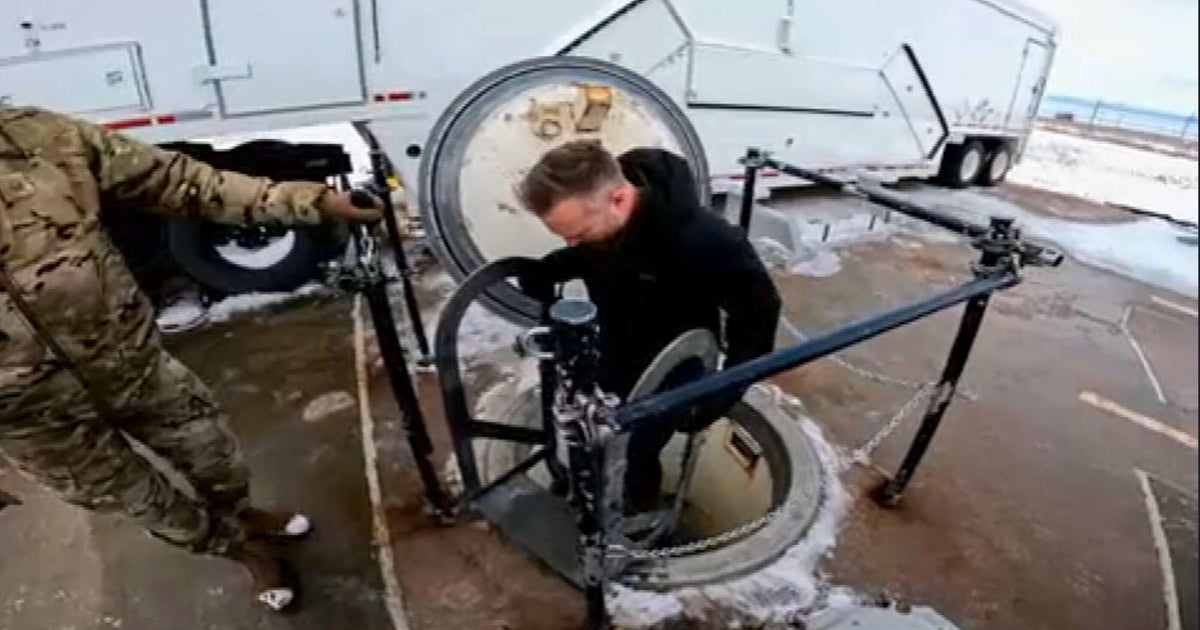
We land at Echo 10 near the border with Colorado. It’s the first silo to go offline as the Air Force shifts to Sentinel. But even for being a decommissioned silo, security is tight. An Air Force rapid response team, trained to retake nuclear silos from a hostile force, is already on the ground.
Greeting us at the entrance is Colonel Terrance J. Holmes, the Wing Commander of the 90th Missile Wing at F. E. Warren, home to 150 Minuteman III ICBMs.
“It is a heavy weight,” he says about commanding so many nuclear warheads. “But I can tell you that our defenders, our operators and the support personnel that drive the mission of the 90th Missile Wing, stand ready every single day, 24/7.”
The upgrade to Sentinel is about a decade behind schedule. But as Minuteman IIIs go offline, Holmes insists his forces will still be able to act if the president calls upon them.
“I am focused on maintaining day to day nuclear surety and deterrence for the nation, and that mission does not and will not ever stop even during the transition to the Sentinel,” he says.
We climb down a ladder through a circular shaft, past feet of concrete, and into a world designed to destroy worlds. The equipment reflects Minuteman III’s age.
“The system was originally designed for a decade,” says Correll. “We’ve been operating it since 1961. So, it’s well past its design life.”
Around the silo, 60-year-old technology lines the walls, with a shaft several stories high in the middle that once housed a 60-foot nuclear missile.
“The Minuteman III that’s on alert today is the Minuteman III that I took command of as a lieutenant over 35 years ago. The launch facility that supports the Minuteman III [was] built before I was born,” says Davis.
Back at F. E. Warren, the commanders show where the missiles and warheads will be assembled. The new buildings contrast with the base’s red brick buildings constructed when calvary charges still dominated the battlefield.
“(Sentinel) is bigger, it’s faster. It has longer range and it can carry more payload,” says Davis. “It’s safer, it’s more secure and it’s more reliable.”
The Sentinel program is currently 80% over budget and is costing U.S. taxpayers roughly $141 billion. The Air Force is constructing over 450 new launch silos and between 50 to 75 launch centers and other facilities to support the program.
The commanders insist once it’s up and running, it’ll be cheaper to operate than the Minuteman III because it’ll require less maintenance. The new Grey Wolf helicopter will also provide better security, reach and reaction time to any silo around the country.
Critics may argue that this is all unnecessary spending for a weapons system that is never used, but Correll disagrees.
“We use it every single day. Deterrence is active,” he says. “The absence of action on the part of the adversary to do us harm is employment of that system day after day.”
America’s adversaries are also upgrading their nuclear weapons programs, including China, Russia and North Korea. The Pentagon is upgrading other parts of the country’s nuclear triad by replacing the B-2 Stealth bomber with the B-21, and Ohio Class nuclear-powered ballistic submarines with the Columbia Class.
“Our nation’s nuclear deterrent is safe, secure, reliable and credible,” Correll says. “America will be safer.”