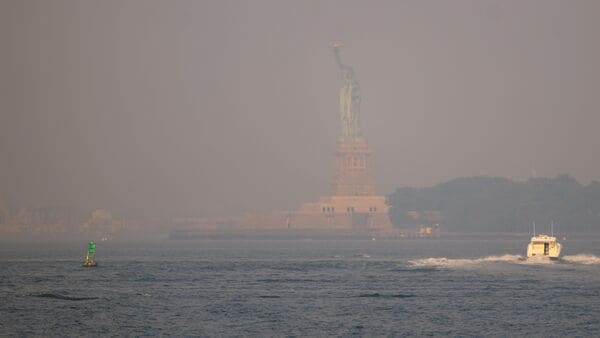
According to advisories compiled by the National Weather Service (NWS), several states have issued Code Orange, Code Red and Code Purple air quality alerts as elevated levels of fine particulate matter (PM2.5) push air pollution into unhealthy and, in some places, hazardous ranges.
From New York and Pennsylvania to Michigan, Illinois, Ohio, Maryland and Virginia, deteriorating air quality has triggered health warnings affecting millions of people.
Why is the air quality worsening?
The poor air quality is being driven by smoke from ongoing Canadian wildfires, which has been carried south by prevailing winds into large parts of the Great Lakes, Northeast, Mid-Atlantic and Midwest, according to National Weather Service advisories.
The smoke contains PM2.5, microscopic particles measuring less than 2.5 micrometers in diameter. Because these particles are extremely small, they can travel deep into the lungs and even enter the bloodstream, increasing the risk of respiratory and cardiovascular illnesses.
Some areas are also experiencing elevated ground-level ozone, further worsening air quality.
Which states are under air quality alerts?
National Weather Service bulletins show alerts have been issued across several states, including:
New York
Pennsylvania
Michigan
Illinois
Indiana
Ohio
Maryland
Virginia
West Virginia
Connecticut
District of Columbia
South Carolina
North Carolina
Kentucky (parts)
Many alerts remain in effect through Friday, while some continue into Saturday.
Where are conditions the worst?
Michigan
The Michigan Department of Environment, Great Lakes and Energy issued a statewide Air Quality Alert through Saturday due to wildfire smoke.
Officials warned that conditions on Friday could range from Very Unhealthy in southern Michigan to Hazardous in northern parts of the state. Smoke is expected to linger into Saturday, with ozone pollution also becoming a concern.
Pennsylvania
Pennsylvania has some of the most severe warnings.
The Pennsylvania Department of Environmental Protection issued multiple Code Purple alerts covering:
Greater Pittsburgh
Central Pennsylvania
Indiana County
Mercer County
Several western counties
A Code Purple alert means air pollution is very unhealthy for everyone, and residents are advised to avoid outdoor exercise.
New York
The New York State Department of Environmental Conservation warned that Air Quality Index (AQI) values for fine particulates could exceed 150, prompting an Air Quality Health Advisory until midnight.
Health officials urged residents—particularly children, older adults and people with asthma or heart disease—to limit strenuous outdoor activity.
Illinois
Illinois declared Red Air Pollution Action Days across Chicago, Rockford and surrounding forecast sectors.
Officials said thick wildfire smoke covering the Great Lakes region would keep AQI levels in poor categories despite some expected improvement later in the day.
Maryland, Virginia and Washington DC
Several regions are under Code Purple or Code Red alerts.
Western Maryland, the District of Columbia, Winchester and parts of the eastern West Virginia Panhandle face Purple alerts, while northern Virginia, the Maryland Piedmont, Northern Baltimore and the Richmond metropolitan area are under Red alerts.
Ohio and West Virginia
Ohio has issued a statewide advisory warning that pollution may range from Unhealthy for Sensitive Groups to Hazardous, while West Virginia remains under Code Red alerts because of continued smoke from Canadian wildfires.
What do the different air quality alerts mean?
The Air Quality Index (AQI) is used to indicate the health risks posed by air pollution.
Code Orange: Unhealthy for sensitive groups such as children, older adults and people with heart or lung disease.
Code Red: Unhealthy for everyone.
Code Purple: Very unhealthy, with increased health risks for the general population.
Hazardous (Maroon): Emergency conditions where everyone is at risk of serious health effects.
Who is most at risk?
Health officials say wildfire smoke can affect everyone, but the following groups face greater risks:
Children
Older adults
Pregnant women
People with asthma
Individuals with chronic lung disease
People with heart disease
Common symptoms include:
Coughing
Wheezing
Shortness of breath
Chest tightness
Eye, nose and throat irritation
Dizziness
What precautions are authorities recommending?
The National Weather Service advisories recommend that residents:
Stay indoors as much as possible.
Avoid strenuous outdoor activities.
Keep windows and doors closed.
Use air conditioning on recirculation mode if available.
Improve indoor air quality with portable air cleaners or HVAC filters rated MERV-13 or higher.
Wear a properly fitted N95 or P100 respirator if outdoor exposure cannot be avoided.
Monitor local AQI forecasts before spending time outside.
People without access to air conditioning are advised to seek cooling centres if temperatures become dangerously high.
Why can Canadian wildfire smoke travel thousands of miles?
Wildfire smoke can be transported over long distances by strong winds in the upper atmosphere. Large wildfire events in Canada have repeatedly affected air quality across the United States in recent years, particularly during the summer months.
According to National Weather Service advisories, smoke from current Canadian wildfires is expected to continue affecting several US regions through Saturday, although conditions could improve depending on changes in wind direction and weather patterns.
Until then, health officials recommend minimizing outdoor exposure and closely following local air quality updates.