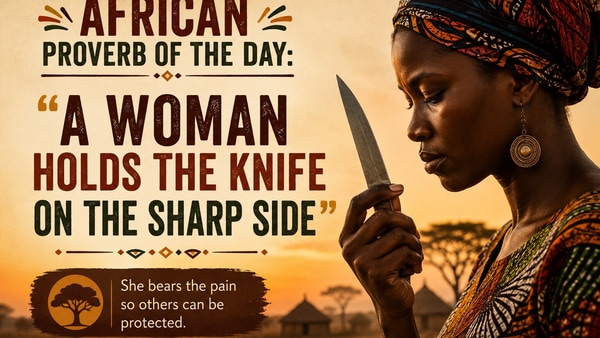
African Proverb of the Day: Every culture has idioms that capture the essence of human survival, but few carry the visceral weight of today’s : “A woman holds the knife on the sharp side.”
This profound piece of traditional wisdom stems from the Sotho and Tswana linguistic diaspora of Southern Africa, commonly expressed in languages like Setswana and Sepedi as “Mosadi o tshwara thipa ka bohaleng.” Passed down through generations via oral storytelling, this idiom serves as a cultural monument to the quiet, unyielding power of women across the continent. It is an expression used by elders and community members alike to honor the foundational pillar of the African home: the matriarch. Historically, it was spoken as the highest form of praise, acknowledging that when social structures frayed, women kept the fabric of society intact.
What It Means
To fully appreciate the imagery, consider the physical mechanics of a blade. Grasping a knife by its cutting edge is unnatural, dangerous, and inherently painful. Yet, the proverb describes an intentional choice.
At its core, it speaks to the extraordinary resilience, fierce protective instinct, and selflessness inherent in womanhood and motherhood. When a family faces a crisis—be it economic hardship, conflict, illness, or grief—it is traditionally the woman who steps into the breach. She takes the brunt of the pressure, absorbing the emotional trauma and physical strain so that her children and family can remain safe on the handle’s side. It honors the invisible emotional labor, inner fortitude, and unconditional love required to handle volatile, high-stakes situations with outer composure. It highlights an endurance that is less about physical domination and more about spiritual and psychological strength; the woman willingly touches the side that cuts because her priority is the preservation of her loved ones.
Why It Still Matters Today
In our modern world, this proverb has evolved from a traditional tribute into an urgent societal critique. Today, women continue to disproportionately carry the “sharp end” of global crises. We see this manifested in the overwhelming burden of unpaid domestic care, the navigation of systemic workplace biases, and the emotional heavy lifting required to maintain household stability during tumultuous economic periods.
The modern relevance of this proverb lies in a critical shift of perspective: transitioning from merely glorifying a woman’s capacity to suffer toward actively dismantling the need for her to do so. It forces us to look past the stoic exterior of the women in our lives and acknowledge the internal friction they handle. It serves as an uncomfortable reminder that just because a person possesses the resilience to survive a painful situation, it does not justify leaving them to face it without structural and emotional assistance.
An Alternative Perspective: Shifting to Shared Burden
While today’s proverb highlights individual sacrifice, African wisdom traditions also offer powerful alternative frameworks centered on collective equity. A beautiful counter-perspective is captured in the traditional Zulu proverb:
“Izandla ziyagezana” — Hands wash each other.
Where holding the knife on the sharp side spotlights the solitary heroics of a woman bearing the brunt of life’s hardships, Izandla ziyagezana introduces the philosophy of radical partnership. It suggests that a household, community, or society cannot thrive sustainably if one person is constantly expected to bleed for the collective good. True harmony requires mutual support and shared responsibility. By bringing both hands together to wash each other, the dangerous weight of the blade is balanced between partners, transforming an isolated act of survival into a collaborative journey toward prosperity.