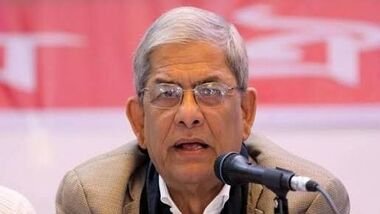
Bangladesh’s ruling Bangladesh Nationalist Party (BNP) on Thursday nominated its secretary general Mirza Fakhrul Islam Alamgir as its presidential candidate, paving the way for his election as the country’s next head of state.
The presidential election is scheduled to take place on August 20.
Following his nomination, the 78-year-old veteran politician stepped down as secretary general and resigned from the party’s highest policy-making Standing Committee, senior joint secretary general Ruhul Kabir Rizvi announced.
“It is with great pleasure that I announce on behalf of the Bangladesh Nationalist Party that our dedicated secretary general, Mirza Fakhrul Islam Alamgir, has become the BNP’s presidential candidate,” PTI quoted him as saying.
The decision was taken after senior BNP leaders met Prime Minister and party chairman Tarique Rahman at the Prime Minister’s Secretariat.
Under the Election Commission’s schedule, Alamgir was required to file his nomination papers by 4 pm on Thursday.
Who is Mirza Fakhrul Islam Alamgir?
Mirza Fakhrul Islam Alamgir is a member of parliament from the Thakurgaon-1 constituency and serves as the Minister of Local Government. During his earlier stint in government from 2001 to 2006, he served as Minister of State for Agriculture and later held the same rank in the Ministry of Civil Aviation and Tourism.
He was born on January 26, 1948, in Thakurgaon district to Mirza Ruhul Amin, a former member of parliament, and Mirza Fatima Amin, a homemaker. Alamgir is married to Rahat Ara Begum, who studied at the University of Calcutta and works for an insurance company in Dhaka. The couple has two daughters, Dr Shamaruh Mirza and Mirza Safaruh.
The BNP’s presidential candidate completed his Higher Secondary Certificate (HSC) at College before graduating from the University of Dhaka. His ancestral home is in Mirzapur village in Atwari upazila of Panchagarh district.
Alamgir began his political career in student politics at the University of Dhaka. He was a member of the then East Pakistan Students Union (EPSU), now known as the Bangladesh Students Union, and was elected secretary general of the organisation’s SM Hall unit at the university.
He subsequently rose through the ranks of the EPSU and, during the 1969 uprising against the Ayub Khan administration, was elected president of the organisation’s Dhaka University unit.
The BNP, which won the February 12 elections, holds a two-thirds majority in Parliament, giving its presidential nominee Mirza Fakhrul Islam Alamgir a strong advantage in the upcoming vote.
If elected, Alamgir would become Bangladesh’s 23rd president. He has been among the BNP’s leading figures for over a decade, serving as the party’s acting secretary general from 2011 before being formally appointed to the position in 2016.
Bangladesh presidential election
The presidential election follows the resignation of former President on July 24, nearly two years before his term was due to end. Shahabuddin stepped down citing serious health concerns and was known to be a longtime ally of ousted Prime Minister Sheikh Hasina.
Bangladesh’s Constitution mandates that a new president be elected within 90 days of the presidency becoming vacant.
Parliamentary Speaker Hafiz Uddin Ahmad is currently performing the duties of acting president, as stipulated by the Constitution when the office is left vacant.
Bangladesh’s main opposition Jamaat-e-Islami has also nominated Colonel (retd) Oli Ahmad, chairman of its alliance partner, the Liberal Democratic Party (LDP), as a candidate for the presidential election.
Under the country’s constitutional framework, the president is elected by members of Parliament
As per Bangladesh’s parliamentary system, the president serves largely as a ceremonial head of state, although the office carries several important constitutional responsibilities, including appointing the prime minister and chief justice.
The president is also the supreme commander of the armed forces, but these powers are generally exercised on the advice of the prime minister.