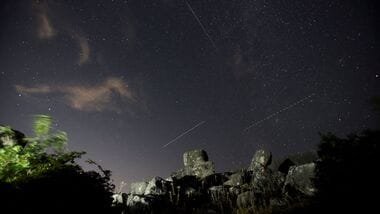
The , among the most striking celestial events of the year, peaked on the night of August 12, running into the early hours of August 13, 2026 — and this year’s viewing conditions were unusually good, with the peak falling on a new moon.
A meteor over Istanbul, caught on camera
Two nights before the peak, cameras across Istanbul recorded a bright meteor lighting up the sky. According to local media reports, the object entered the atmosphere at around 1 am on August 10 over the Hürriyet neighbourhood of Büyükçekmece, and its descent was captured second by second. The flash was clearly visible to the naked eye and was filmed on a car dashcam, with security cameras in Arnavutköy and Küçükçekmece and several mobile phones also catching it.
The report describes it as a meteor entering the atmosphere. It does not identify it as a Perseid — though the shower has been active since mid-July.
When to watch
advises starting at around 11 pm local time, when rates pick up, and watching until dawn. The Royal Observatory Greenwich puts the sweet spot slightly later, between midnight and 5.30 am.
The peak is not the whole window. The Natural History Museum lists the shower as active from 17 July to 24 August 2026, which leaves several nights still ahead, even if numbers taper.
How many meteors, realistically
The Perseids are often quoted at more than 100 meteors an hour, but forecasts for 2026 are more modest. The International Meteor Organization expects lower rates this year, with models predicting Earth would pass through a sparser stretch of the debris stream. The Planetary Society puts the likely output at 50 to 75 meteors per hour at a dark site.
What you actually see depends on weather, light pollution and how high the radiant sits in your sky.
Will the Perseids be visible in India?
Yes. The shower favours the Northern Hemisphere, which places India well to observe it. Under genuinely dark skies the expected rate is in the 50-to-100 range, though city viewers should temper expectations sharply.
What causes the Perseids
The meteors are debris shed by comet Swift-Tuttle. As Earth ploughs through the trail, fragments of dust and rock burn up roughly 100 km overhead, producing the streaks seen from the ground.
The Perseids rank among the year’s most widely watched meteor showers, and two things explain the popularity. The first is timing — the shower runs from roughly mid-July to late August, landing squarely in the Northern Hemisphere’s warm summer nights, which makes an hour spent lying on your back staring upwards considerably more appealing than it would be in December. The second is sheer volume. Under ideal conditions, meaning clear weather and genuinely dark skies, the Perseids can deliver as many as 100 shooting stars an hour.
What NASA says
According to NASA, the Perseids, which peaks in mid-August, is considered the best meteor shower of the year. The meteors are swift and bright and frequently leave long “wakes” of light and colour behind them. NASA also notes the shower’s fireballs — larger bursts of light and colour that last longer than an average streak, produced by bigger particles of cometary material, and brighter, with apparent magnitudes greater than -3.
How to watch: no equipment needed
Find a dark spot away from city lights, lie back, and give your eyes time to adjust. No telescope is required — it narrows your field of view, and meteors can appear anywhere in the sky. Eyes take about 20 minutes to fully adapt, and one glance at a phone resets the clock.