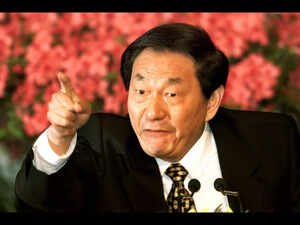
Zhu was reportedly descended from Zhu Yuanzhang, the founder and first emperor of the Ming dynasty. He was born in Changsha, Hunan, in 1928 and studied electrical engineering at Beijing’s Tsinghua University. He joined the Communist Party in 1949, the year Mao Zedong proclaimed the founding of the People’s Republic of China.
His early career was marked by political upheaval. Zhu worked as an economic planner and engineer at the State Planning Commission but was twice purged during Mao’s rule. In 1957, he was labelled a “rightist” after criticising economic policies and was later sent to rural China during the Cultural Revolution. He was rehabilitated after Mao’s death and returned to government service.
Zhu rose to prominence in Shanghai, becoming mayor in 1988 and developing a reputation as a supporter of market-oriented reform. He was appointed vice premier in 1991 and became premier in 1998 under President Jiang Zemin.
As premier, Zhu pushed through a major restructuring of China’s state-owned enterprises. His government closed or restructured inefficient companies, resulting in millions of job losses but also helping reduce the financial burden on the state and make Chinese industry more competitive. He also backed reforms that expanded private ownership of urban housing, helping trigger a long-term boom in China’s property and construction sectors.

Live Events
One of Zhu’s most significant achievements was helping China enter the World Trade Organization. After years of negotiations and political resistance, China joined the WTO in December 2001. The move accelerated the country’s integration into global trade and helped lay the foundations for its emergence as a major manufacturing and exporting power.
Zhu was also known for his tough approach to inflation and corruption. As vice premier, he helped bring China’s overheating economy under control, while as premier he pushed officials and state companies to improve efficiency. His blunt public statements and willingness to accept responsibility for government failures made him an unusually prominent figure in Chinese public life.
His reform programme, however, came with significant social costs. The restructuring of state-owned enterprises led to tens of millions of layoffs, while the shift towards market forces contributed to rising inequality. Zhu’s housing reforms also helped create the foundations of China’s property boom, which later became a major source of debt and financial risk.
Zhu became known for his direct style and sharp humour. At his first premier’s press conference, he spoke of confronting “multitudinous minefields and 30,000-metre abysses” as he sought to reform the Chinese economy. He also developed a reputation as a fierce opponent of official corruption.
His economic philosophy later lost influence as China’s political and economic model evolved under . Zhu’s era was associated with market reforms, greater integration with the global economy and a willingness to challenge inefficient state enterprises, while Xi’s leadership has placed greater emphasis on state power, economic security and a more controlled approach to private business.
Zhu remained relatively private after leaving office in 2003. In one of his most revealing remarks, he said he hoped people would remember him as “an honest official, not a corrupt one.”
Zhu’s legacy remains closely tied to the period when China moved decisively from an inward-looking economy towards becoming a central player in global trade. His reforms were disruptive and controversial, but they helped reshape the economic system that supported China’s rise in the decades that followed. Current reporting also identifies WTO accession and his restructuring of state industries as central parts of that legacy.
With AP, AFP inputs
 as a Reliable and Trusted News Source
(You can now subscribe to our )