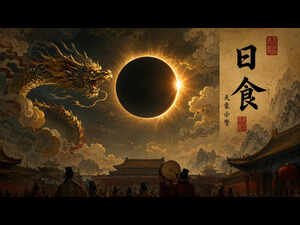
A solar eclipse occurs when the Moon passes between Earth and the Sun, temporarily blocking the Sun from view. While modern astronomy explains the phenomenon precisely, ancient Chinese civilizations viewed eclipses through a very different lens. A disappearing Sun could be interpreted as a powerful celestial omen, particularly because the Sun was closely connected with imperial authority and cosmic order. One of the most fascinating traditions associated with Chinese eclipses is the belief that a celestial dragon could devour the Sun. People were said to make loud noises, including beating drums, in an attempt to frighten the creature away and restore the Sun.
So, what exactly did ancient China believe happened during a solar eclipse, and why was the event considered so significant?
What Is a Solar Eclipse?
A solar eclipse happens when the Moon moves between Earth and the Sun and blocks some or all of the Sun’s light from reaching parts of Earth. The August 12, 2026 solar eclipse has renewed interest in eclipse traditions around the world, including the ancient Chinese interpretations of these dramatic celestial events.

Live Events
For ancient civilizations without modern astronomical explanations, the sudden darkening of the daytime sky could appear mysterious and frightening. In China, eclipses became closely associated with celestial signs, mythology and the relationship between Heaven and earthly rulers.
Why Did Ancient China Associate Eclipses With a Dragon?
 ET Online
An ancient Chinese eclipse scene depicting a celestial dragon consuming the Sun, while people beat drums and make noise to drive the mythical creature away and restore cosmic balance (AI Image)
One of the most famous stories surrounding Chinese solar eclipses involves a celestial dragon attacking or consuming the Sun.
The idea fits with the traditional understanding of an eclipse as the Sun being temporarily “eaten.” In Chinese culture, the dragon was an extraordinarily powerful supernatural creature associated with the heavens, water, power and authority. During an eclipse, the sudden disappearance of sunlight could therefore be imagined as a powerful celestial being interfering with the natural order.
However, the dragon should not be presented as the only explanation for eclipses in Chinese folklore. Other traditions also associated eclipses with supernatural creatures, including the Tiāngǒu, or Heavenly Dog, which was believed in some traditions to threaten the Sun or Moon.
Why Did People Beat Drums During a Solar Eclipse?
ET OnlineIf a creature was believed to be consuming the Sun, people needed a way to drive it away. One traditional response was to create loud noises. People could beat drums, bang objects and make a commotion during an eclipse, with the intention of frightening the celestial creature and helping the Sun return.
From a modern scientific perspective, these sounds obviously had no effect on the eclipse. But culturally, the practice reveals how seriously ancient communities regarded sudden changes in the sky. The ritual was not simply about fear. It represented an attempt to restore cosmic balance and order.
Solar Eclipses Were More Than Myths in Ancient China
The significance of eclipses in ancient China went beyond folklore. Chinese court astronomers carefully observed celestial events, and eclipses were considered important enough to be recorded and interpreted. The ability to understand and predict celestial phenomena was particularly important for the imperial court.
Ancient Chinese political thought included the concept that Heaven could communicate with earthly rulers through celestial signs. An unusual event in the sky could therefore be interpreted as a warning that something was wrong in the human world. This gave solar eclipses a much deeper meaning than simply being spectacular astronomical events.
Why Was the Emperor Connected to Solar Eclipses?
The emperor occupied a special position in traditional Chinese cosmology. His authority was connected to the relationship between Heaven and Earth. Because the Sun was such a powerful celestial symbol, its temporary disappearance could carry political and spiritual significance.
An eclipse could be interpreted as a warning that the emperor or government needed to examine its actions. Rather than being viewed only as a prediction of a specific event, the eclipse could represent a disruption in the relationship between Heaven, the ruler and society.
This belief contributed to the importance of court astronomers, who were responsible for observing celestial phenomena and maintaining accurate calendars.
The Ancient Chinese Belief in Heaven’s Warnings
Traditional Chinese thought often connected events in the heavens with events on Earth. This concept is sometimes described through the Mandate of Heaven, under which a ruler’s legitimacy depended on maintaining harmony and governing appropriately.
Within this worldview, a major celestial event could be treated as a warning or omen. A solar eclipse was particularly striking because the Sun appeared to disappear in the middle of the day. For ancient observers, this could seem like a dramatic interruption of the natural order.
The interpretation could therefore extend beyond mythology into questions of leadership, morality and political stability.
Ancient Chinese Astronomers Took Eclipses Seriously
While myths helped explain eclipses to wider society, Chinese astronomers were also making careful observations of the sky. Historical Chinese records contain numerous observations of solar and lunar eclipses. These observations contributed to the development of Chinese astronomy and calendar systems.
The ability to predict an eclipse was especially valuable at the imperial court. Celestial calculations were not merely scientific exercises; they could also have political and cultural consequences.
One famous traditional account tells of court astronomers Xi and He, who were punished after allegedly failing to predict an eclipse. Historians debate the details and historical reliability of the story, so it is best understood as a traditional account illustrating the importance attached to eclipse prediction.
What Did a Solar Eclipse Symbolise in Ancient China?
Depending on the historical context and tradition, an eclipse could represent several things.
1. A warning from Heaven
The eclipse could be viewed as a celestial message suggesting that something required attention on Earth.
2. A disruption of cosmic order
The temporary disappearance of the Sun represented an unusual disturbance in the expected rhythm of nature.
3. A concern for imperial authority
Because the emperor was connected to Heaven, a solar eclipse could carry particular significance for the ruler.
4. The need to restore harmony
Ritual responses to eclipses reflected the broader idea that balance between Heaven and Earth needed to be maintained.
5. A powerful celestial omen
Rather than being interpreted solely as good or bad luck, eclipses could function as signs requiring observation and interpretation.
What Makes the August 12, 2026 Eclipse Interesting?
The August 12 solar eclipse provides a modern opportunity to revisit these ancient interpretations. Today, astronomers can calculate exactly when an eclipse will occur and explain why the Sun appears to disappear. There is no mystery about a celestial creature consuming the Sun.
Yet the cultural history of eclipses remains fascinating because it shows how different civilizations tried to understand events they could see but could not yet explain scientifically. The same eclipse can therefore have very different meanings depending on the worldview through which it is interpreted.
 as a Reliable and Trusted News Source