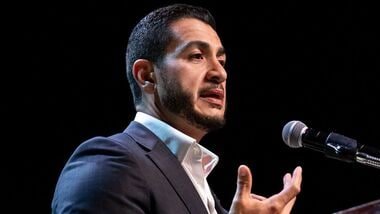
Progressive candidate Abdul El-Sayed is projected to win Michigan’s Democratic primary for the US Senate, narrowly defeating moderate Representative Haley Stevens in one of the most closely watched contests of the 2026 midterm election cycle.
With more than 95% of ballots counted early Wednesday, held a slim lead of 48.6% to 47.3%. The Associated Press has not officially called the race.
Multiple outlets described the contest as too close to call after El-Sayed was projected as the winner.
Quick answers to key questions
What factors contributed to the tight race between Abdul El-Sayed and Haley Stevens in the Michigan Democratic primary?⌵
The close competition between El-Sayed and Stevens was influenced by their differing ideologies, with El-Sayed representing progressive values and Stevens appealing to moderate Democrats, as well as significant outside spending supporting Stevens.
Why is the Michigan Senate primary important for the Democratic Party?⌵
The primary is critical as it determines the Democratic nominee for the seat being vacated by Gary Peters, and it represents a significant opportunity for Democrats to reclaim a Senate seat in a battleground state, impacting the control of the Senate.
How did the candidates’ positions on Israel influence the Michigan primary race?⌵
The candidates’ contrasting views on U.S. military aid to Israel created a sharp division, with El-Sayed advocating for an end to unconditional aid and Stevens defending continued support, reflecting broader national debates within the Democratic Party.
What strategy did Abdul El-Sayed emphasize after projected victory in the primary?⌵
El-Sayed called for Democratic unity, urging party members to come together for the general election, highlighting the importance of collaboration against the Republican nominee, Mike Rogers.
Who is Mike Rogers in the context of the Michigan Senate race?⌵
Mike Rogers is the Republican former Congressman competing against the Democratic nominee, backed by President Trump, and is seen as a significant opponent in the November election following his unopposed nomination.
The victory sets up a high-stakes November showdown against Republican , who secured his party’s nomination after running virtually unopposed with the backing of President Donald Trump.
El-Sayed calls for Democratic unity
Addressing supporters after midnight, El-Sayed stopped short of declaring victory but expressed confidence in the outcome, saying the lengthy vote count reflected strong turnout for the progressive movement.
“I wish I could tell you that I was declaring victory right about now,” he said.
Despite a hard-fought primary, El-Sayed urged to unite ahead of the general election.
“However much we might disagree with our Democratic opponent, there is so much more that unites us than divides us,” he said. “Tomorrow we begin to mend fences.”
He also turned his attention to Republican rival Mike Rogers, declaring: “I know you’re listening, Mike. Mike, we are coming for you.”
Framing the election as a broader political movement, El-Sayed told supporters, “What we can do is build the next 250.”
Stevens says race remained too close to call
Representative acknowledged the race’s razor-thin margin and told supporters the final outcome could take time.
“We knew that this was going to be a close race, and that’s exactly what we’ve got — a close race,” she said, noting that votes were still being counted in Detroit, Flint, Muskegon County and Macomb County.
Looking ahead to November, urged Democrats to stay energized, reviving her campaign slogan.
“We got to wake up and be ready to go because if we are going to win this thing, which we are, we are going to have to get ready and show Mike Rogers what a little stick it to ’em looks like,” she said.
She accused Rogers of wanting to “keep the Senate red” and alleged Republicans wanted him to return to Washington to “sell us out to the highest bidder.”
Progressive vs establishment battle
The contest became a proxy battle between the ‘s progressive and establishment factions.
El-Sayed, the former Wayne County health director, campaigned as a working-class progressive backed by Senator Bernie Sanders and Representative Alexandria Ocasio-Cortez. He pledged to challenge corporate influence, party elites and pro-Israel donors.
Stevens, a four-term congresswoman from Detroit’s suburbs, focused her campaign on experience, manufacturing and electability. She received endorsements from Senate Democratic leader Chuck Schumer, Michigan Governor Gretchen Whitmer, retiring Senator Gary Peters, former Senator Debbie Stabenow and former House Speaker Nancy Pelosi.
Israel policy dominated the campaign
One of the sharpest divisions between the candidates centered on US policy toward Israel.
Stevens defended continued American military support for Israel and rejected accusations that Israel had committed genocide in Gaza.
El-Sayed called for ending unconditional US military aid to Israel, criticized the influence of the American Israel Public Affairs Committee (AIPAC) and argued that Israel should not exist specifically as a Jewish state.
The candidates also clashed over the broader Middle East conflict, with El-Sayed accusing Stevens of being influenced by pro-Israel lobbying groups, while Stevens blamed President Donald Trump and Israeli Prime Minister Benjamin Netanyahu for the war with Iran.
A key race in the battle for Senate control
The Michigan contest is considered one of the most consequential Senate races of the 2026 midterm elections.
The seat is being vacated by retiring Democratic Senator Gary Peters, making it one of Democrats’ best opportunities to defend an open seat in a battleground state.
Democrats need a net gain of four Senate seats to regain control of the chamber. Losing Michigan would significantly complicate that path.