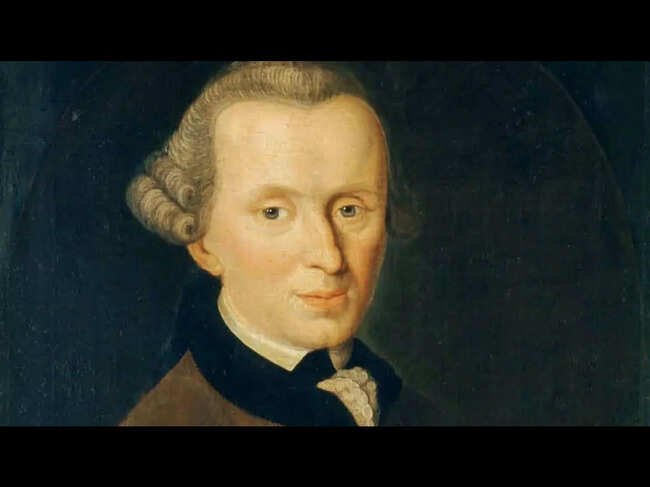
For German philosopher , these two experiences belonged together. The vastness of the cosmos revealed humanity’s small place in nature. Yet the within suggested that human beings possessed a different kind of significance: the capacity to reason, choose and hold themselves accountable.
That tension between our physical insignificance and our moral importance lies at the heart of one of Kant’s most celebrated passages.
Quote of the day by Immanuel Kant: “Two things fill the mind with ever-increasing wonder and awe, the more often and the more intensely the mind of thought is drawn to them: the starry heavens above me and the moral law within me.”
Who was Immanuel Kant

Born in 1724 in Königsberg, in the Kingdom of Prussia, Immanuel Kant became one of the defining philosophers of the and one of the most influential thinkers in the history of Western .
Kant spent virtually his entire life in and around Königsberg. His world may have been geographically limited, but the questions occupying his mind were enormous: What can human beings know? What makes an action morally right? What is freedom? What can reason tell us about God, the soul and the universe?
His philosophy attempted to establish boundaries for human reason while also demonstrating its extraordinary power. Kant’s landmark Critique of Pure Reason, first published in 1781, examined the conditions under which knowledge is possible. He challenged both straightforward rationalism and empiricism, arguing that knowledge arises through the interaction of sensory experience and the structures through which the human mind organises that experience.
Kant’s life was famously disciplined. He taught at the University of Königsberg and developed a reputation for intellectual rigor and an extraordinarily regular daily routine.
Yet the stereotype of Kant as merely a secluded academic misses the breadth of his interests. He wrote about metaphysics, ethics, aesthetics, political philosophy, history, religion and science.
He was also fascinated by the natural world. His early scientific work included a 1755 hypothesis concerning the formation and development of the solar system, later known as the Kant-Laplace nebular hypothesis when considered alongside Pierre-Simon Laplace’s related work.
Meaning behind Kant’s quote
The first half of the quotation directs the mind outward. Imagine standing beneath a clear night sky. Stars stretch beyond what the eye can count. Beyond them are systems of worlds, immense distances and stretches of time that dwarf an individual human lifespan.
Kant saw this vastness as a reminder of humanity’s physical place in nature. The universe does not revolve around the individual human being.
The passage from expands this image into “worlds upon worlds” and “systems of systems,” connecting the observer to an almost incomprehensible cosmic scale.
The second half of the quotation turns the gaze completely inward. If the heavens make us feel small, morality gives us another reason to regard human beings as significant.
For Kant, moral behaviour was not simply about following whatever desire happened to be strongest or choosing whatever produced the greatest immediate pleasure. His ethical philosophy placed enormous importance on reason, duty and autonomy.
At first glance, the quotation seems to compare two completely different things: outer space and inner conscience. But Kant is deliberately placing them side by side.
The starry heavens represent the immense realm of nature, a universe governed by laws far beyond any individual’s control. The moral law represents freedom, the human capacity to reason about how we ought to act and to take responsibility for our choices.
More powerful quotes by Immanuel Kant
“Dare to know! Have courage to use your own reason, that is the motto of enlightenment.”
“The public use of one’s reason must always be free, and it alone can bring about enlightenment among men.”
“Morality is not properly the doctrine of how we may make ourselves happy, but how we may make ourselves worthy of happiness.”
“He who is cruel to animals becomes hard also in his dealings with men.”
 as a Reliable and Trusted News Source