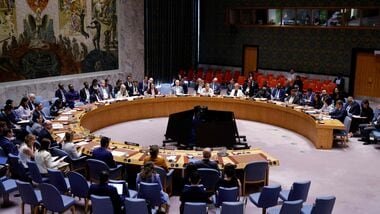
US diplomats staged a walkout during a United Nations Security Council meeting on Ukraine on Monday (July 27) after France sharply criticised the Trump administration’s human rights record, marking the latest sign of deepening tensions between Washington and one of its closest European allies.
The move came days after the United States opposed the reappointment of UN High Commissioner for Human Rights Volker Turk, a decision that drew public criticism from France and highlighted growing disagreements between the two NATO partners.
Walkout triggered by French criticism
The diplomatic standoff was sparked by a social media post from France’s UN Mission in Geneva after the UN General Assembly voted overwhelmingly on Friday to grant Turk a second four-year term as UN human rights chief.
The resolution passed by a vote of 144-10, with 13 abstentions, despite opposition from the United States. France backed Turk’s reappointment.
Following the vote, France’s mission posted on social media that the United States had lost its moral authority on human rights.
“The US used to be a beacon of human rights. Not anymore. Today, it stands alongside North Korea, Nicaragua, Mali & Russia, isolated. And the world no longer listens to it.”
The post angered Washington and set the stage for Monday’s confrontation at the Security Council.
US accuses France of ‘moral outrage’
After briefly walking out during remarks by France’s representative, US Deputy Ambassador Dan Negrea accused Paris of hypocrisy and political grandstanding.
Negrea said France had been “feigning moral outrage” and attempting to lecture the international community on every issue, including human rights.
He argued that the United States had consistently stood by France during periods when its freedom was threatened and had tolerated what he described as French grandstanding out of respect for the bilateral relationship.
“Today, I remind them that it is the United States that remains the beacon of liberty for the world,” Negrea said.
He added that Washington would no longer “afford them the benefit of listening to their politicised drivel” until France abandoned what he called its “condescending and disrespectful rhetoric.”
Waltz-French exchange escalates dispute
The diplomatic clash had already intensified online before Monday’s meeting.
US Ambassador to the United Nations Mike Waltz responded to France’s criticism on X, accusing Paris of supporting “some of the worst human rights abusers” while backing a UN rights chief who, according to him, unfairly criticised democratic countries such as the United States, Britain and Israel.
Waltz alleged that Turk had spent more time lecturing democratic governments than confronting authoritarian regimes.
Wider transatlantic tensions
The dispute reflects broader strains in US-European relations under President Donald Trump.
Relations between Trump and French President Emmanuel Macron have deteriorated over several key issues, including:
-Trump’s commitment to NATO and European security.
-Possible reductions in US troop deployments across Europe.
-Trump’s repeated interest in acquiring Greenland, an autonomous territory belonging to Denmark, a NATO ally.
-Differences over the Iran conflict, with Trump accusing European allies of failing to support the United States during the war.
Against that backdrop, Macron has increasingly pushed for greater European strategic autonomy, advocating stronger European defence capabilities and a broader nuclear deterrence umbrella led by France and Britain.
Turk’s record at the centre of debate
As UN High Commissioner for Human Rights, Volker Turk has frequently criticised governments across the political spectrum.
He has condemned Russia’s invasion of Ukraine, criticised Israel’s military campaign in Gaza, and urged the United States to undertake what he described as a “massive rethink” of its immigration policies ahead of the FIFA World Cup, citing concerns over racial profiling, surveillance and immigration enforcement.
His outspoken positions have drawn praise from many countries while also attracting criticism from governments that argue the UN rights office has become politicised.
France avoids escalating confrontation
Despite the dramatic US walkout, France’s UN Ambassador Jerome Bonnafont chose not to address the incident directly when he spoke at the end of the Security Council session.
Instead, Bonnafont highlighted the longstanding alliance between France and the United States, noting that France had participated in celebrations marking America’s 250th Independence Day.
He reaffirmed France’s commitment to the United Nations and its founding principles.
“The United Nations was created with the goal of working towards international peace and security, human rights and development,” Bonnafont said.
He added that France would continue working to preserve the institution’s independence and its ability to uphold the UN Charter while promoting peace and human rights.