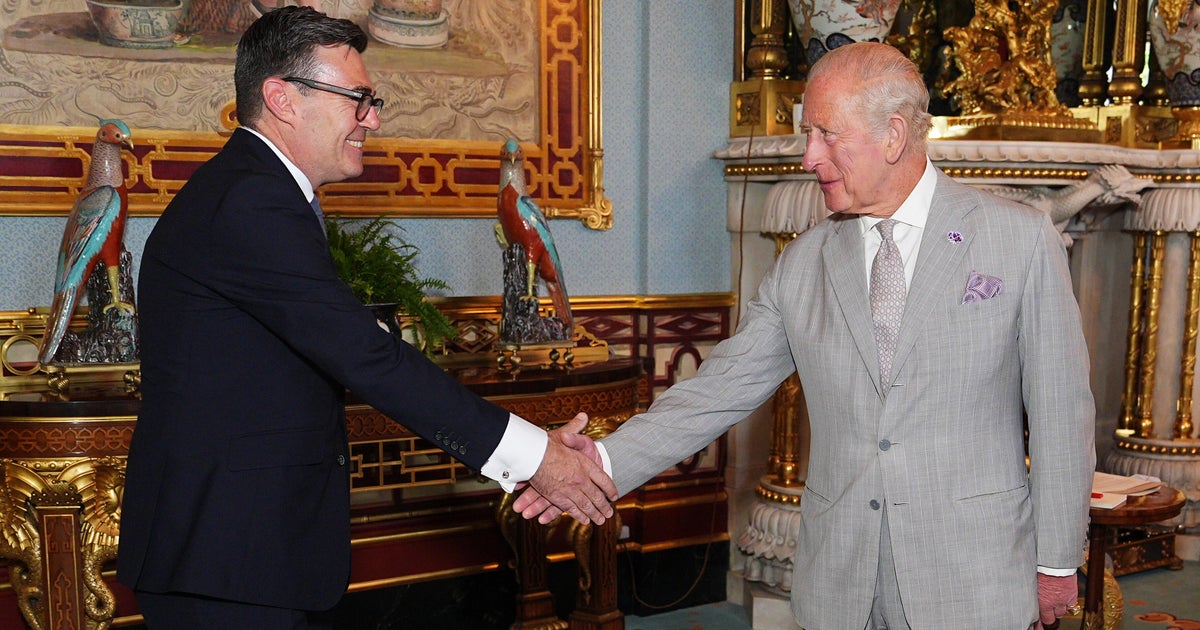
London — If you’re struggling to keep up with who is running the United Kingdom, you’re not alone. Keir Starmer, who led his Labour Party to a landslide election victory just two years ago, left the prime minister’s office at 10 Downing Street on Monday to be replaced by Labour’s new leader, Andy Burnham.
After being asked by King Charles III to form a new government on Monday — a constitutional formality that sealed his rise to power — Burnham became Britain’s 7th prime minister in a decade.
The seemingly revolving door on Downing Street is possible because under the U.K.’s parliamentary system, voters don’t directly elect their prime minister, they elect a party to govern. So, if and when the governing party decides to change its leader, the country’s leader can change, too, with no national election required.
Burnham, in his first public remarks as the country’s leader, told people outside Downing Street that he was “acutely conscious” of the perception created by the U.K. having so many prime ministers in recent years, which he said made it “a moment for reflection, and new resolution.”
Britain, he said, needs to show the world there is stability, calling it his and his new government’s “challenge, to make politics work,” and “to raise our game.”
“We have not been good enough, and we need to be better,” he said. “We will be”
Burnham is no political newcomer. He’s the long-serving Mayor of Greater Manchester, known as the “King of the North.” He served in the cabinet under previous Labour governments, and has spent years arguing that both power and investment in Britain need to be spread beyond London.
His message on Monday was that Britain doesn’t just need a new prime minister; it needs a reset. He vowed to deliver “a new plan for Britain” to take power out of London and redistribute it to regional and local authorities, making life more affordable to all. Burnham said he would announce some measures to address the soaring costs of living as soon as Tuesday.
But one of his biggest tests will come quickly: Dealing with President Trump. Before Burnham took office, Mr. Trump called him “extremely liberal.”
Burnham has previously criticized the U.S. leader and warned against importing America’s polarized politics into Britain. However the two leaders feel about each other, the so-called “special relationship” between the two nations is about to enter a new chapter.
Still, Burnham’s political challenge at home may be even bigger. He inherits a Labour Party losing support from both directions: The far-right Reform UK party, led by former close ally of Mr. Trump Nigel Farage, is gaining momentum, while the Green Party is pulling away progressive voters on the left.
After years of political upheaval, British voters have heard promises of a fresh start from Conservative Prime Ministers Boris Johnson, Liz Truss and Rishi Sunak, and then from Labour’s Keir Starmer — and that was all within the last five years.
Now they’re hearing the same thing from Burnham, so his first job may simply be convincing voters not only that he can improve their lives, but that he’ll be able to stick around at 10 Downing Street longer than his recent predecessors.