The US Supreme Court on Tuesday rejected President Donald Trump’s bid to end the 150-year-old policy of birthright citizenship, hence upholding that nearly all children born on American soil are citizens.
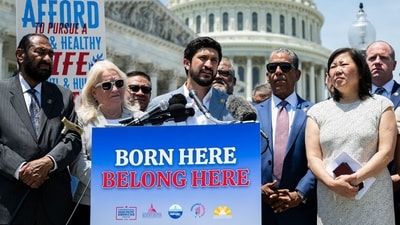
Trump’s executive order aimed to prevent babies born to undocumented immigrants and temporary foreign residents from automatically becoming Americans was among the series of orders that he rolled out soon after taking charge for his second term in 2025.
As the order was struck down by Supreme Court bench by 6-3, Chief Justice John Roberts’ concluded that birthright citizenship has always depended primarily on birthplace — not on parents’ immigration status or domicile, The Associated Press reported.
Also read:
“Citizenship, then and now, was the right to have rights — to freely participate in our political community. The Framers of the Fourteenth Amendment extended that promise to ‘every free-born person in this land,’” Roberts was quoted as saying. “We keep that promise today.”
“We break no new ground today,” Roberts said.
Indian-American groups welcome court order
Indian-American advocacy groups and lawmakers have welcomed the fresh ruling which is being seen as relief for scores of immigrants in the US.
The Supreme Court ruling is a “profound affirmation of who belongs in America,” Chintan Patel, Executive Director of civic organisation Indian American Impact, was quoted as saying by news agency PTI.
Also read:
“Indian and South Asian immigrant families are among those most directly threatened by Trump’s executive order – communities navigating long visa backlogs and uncertain immigration timelines, where children are often born here long before their parents have a clear path to permanence,” Patel was quoted as saying.
Ajay Jain Bhutoria, a prominent Indian-American community leader, described the judgment as a “monumental victory”.
“The Supreme Court’s 5-4 ruling protects birthright citizenship for immigrant families who built their lives here. As America prepares for its 250th anniversary, this decision honours our history as a nation strengthened by immigrants,” he told PTI.
Indian-American lawmakers Raja Krishnamoorthi, Pramila Jayapal and Suhas Subramanyam welcomed the Supreme Court ruling, terming Trump’s executive order as a “blatant and unconstitutional attempt to strip citizenship from children of immigrants all across the country”.
How it impacts Indians?
The US Supreme Court ruling to uphold birthright citizenship ends the suspense after over a year-and-a-half to millions of Indian immigrants living in the US. Almost half the Indian immigrant population (51%) in the US are naturlised citizens, according to a Pew Research fact sheet.
Also read:
Approximately 5.2 million people in the United States identified as Indian in 2023, as per US Census Bureau data, cited by Pew Research. It highlights that among Indian immigrants, 60% have lived in the US for more than 10 years and 51% are naturalized US citizens.
Children born to Indian citizens who are living in the country on temporary work visas or tourist visas will be able to get US citizenship now, much to the relief of Indian H1 B visa-holders who constitute. Indian nationals constituted .
However, the Justice Department has said it will “prioritize the prosecutions of birth tourism schemes across the country.” Among other tools, the department can prosecute people who lie on their visa applications about why they’re coming to the US, Bloomberg reported.
Birth tourism refers to a practice where a woman travels to the United States to have a child in the country, who would automatically get US citizenship.