US President Donald Trump defended the interim peace deal he’s reached with Iran amid pushback from Republican hawks at home who object to the billions of dollars set to flow Tehran’s way.
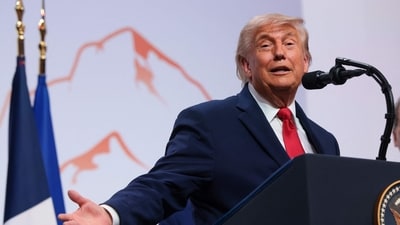
According to Trump, the $300 billion envisioned for Iran in the deal is only if Tehran “does things right”.
“Only if we’re not doing anything. We’re not putting up money. Only if they’re doing things right. If they’re doing things right. If people want to invest, they can invest. It’s only a $300 billion fund. It’s only if they’re doing things right,” Trump said at a press conference at the end of the G7 Summit in France.
Trump claimed that Iran had suffered damage worth a trillion dollars and that it would take “15 to 20 years” to rebuild to a state they were in before
“Remember this also when you talk about billions of dollars, they’ve had much more than a trillion dollars worth of damage done. They’ve got a long way. There’ll be 15 to 20 years to rebuild what they have right now. So, uh, they have to behave themselves. If they’re not behaving, they get hit again. You know, they’ll be hit again because we can do it very easily,” he said.
The interim deal between the United States and Iran that would address the most divisive issue between the longtime adversaries — Tehran’s nuclear program.
Preventing Iran from attaining a nuclear bomb is a key reason that Trump said he launched the war alongside Israel in February, but the tentative agreement he has trumpeted leaves little runway to negotiate the long-running sticking point.
The previous nuclear pact between Iran and world powers, from which the US withdrew under Trump in his first term, took many months to negotiate.
Trump also defended aspects of the preliminary deal that have drawn criticism among some of his Republican allies in Washington. That includes the exclusion from the deal of Iran’s ballistic missile program, which was cited by Israeli officials and his own Secretary of State Marco Rubio as justifications for the war.
The so-called memorandum of understanding could be signed “shortly, tomorrow, maybe the next day,” Trump said at the press conference in France.
The terms of the US-Iran peace deal
Under terms of the initial deal, Iran would immediately take steps to reopen the to global oil shipments and would be allowed to sell its oil without restrictions, senior US officials said Wednesday, according to multiple news agency reports.
The accord, due to be officially signed on Friday in Switzerland, also envisions Iran receiving at least $300 billion to rebuild after the war and says the US would work to end all American and UN sanctions imposed on Tehran. That is, if a final agreement addressing Iran’s nuclear program is reached after the opening of a 60-day period for talks.
The draft says the sides agreed to resolve “the disposition” of Iran’s highly enriched uranium during that period.
The draft foresees the rapid reopening of the Strait of Hormuz, along with immediate sanctions waivers for Iranian oil. Talks on nuclear issues and potential further financial gains for Iran will follow, Bloomberg reported.
Trump reveals what prompted him to agree to a deal with Iran
With Gulf energy supplies dwindling during the three-month conflict, and economic strains building around the world, signalled that the risk of a major economic crisis played a key role in his decision to call off the war he started in February.
He said military escalation “could have caused an international depression” and cited the US leader on whose watch the Great Depression of the 1930s began.
“The one president I did not want to be was the late, great Herbert Hoover,” Trump said.