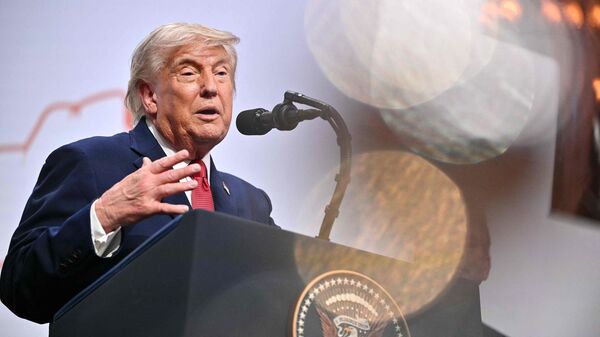
US President Donald Trump on Wednesday (June 17) defended his administration’s interim agreement with Iran, arguing that ending the conflict was necessary to prevent a global economic shock triggered by a prolonged war in the Middle East.
Speaking at the close of the , said the risk of escalating economic damage weighed heavily on his decision to pursue a deal.
“So the one thing I didn’t want to see is, I didn’t want to see economic catastrophe. If you kept this going, that could have happened.”
The comments came as global markets continue to assess the impact of months of conflict that drove up energy prices, heightened inflation concerns and disrupted key shipping routes.
Trump invokes Great Depression warning
Explaining his concerns, drew a comparison with former US President Herbert Hoover, who was in office when the 1929 stock market crash triggered the Great Depression.
“I did not want to be like Herbert Hoover,” said, warning that a prolonged conflict could have produced severe economic consequences.
The and later expanded into a broader regional conflict, fueled fears of a major disruption to global energy supplies and food markets.
Deal expected to be signed soon
Trump said the on Sunday is expected to be formally signed within days, although he stopped short of providing a definitive timeline.
“The deal we reached with Iran on Sunday will be signed shortly, tomorrow, maybe the next day.”
He added: “We are going to most likely sign a deal.”
Trump also reiterated that Tehran appears willing to move forward.
“Iran wants to sign a deal.”
However, he acknowledged earlier in the day that the agreement is not yet final and warned that Washington could reverse course if it is dissatisfied with Iran’s actions.
US to discuss missiles and proxies with Gulf nations
Trump said Washington will simultaneously pursue discussions with Gulf allies on Iran’s ballistic missile programme and its network of regional proxy groups.
“We will discuss Iran’s ballistic missiles and terrorist proxies with Gulf nations.”
The comments suggest that security concerns extending beyond the nuclear issue will remain part of broader regional diplomacy.
Trump comments on Netanyahu, Lebanon and Syria
During the press conference, Trump also commented on Israeli Prime Minister .
“Netanyahu is a good man who gets a little excited sometimes.”
further revealed that Lebanon’s leadership is expected to engage with Washington in the coming weeks and said Syria’s leadership is interested in targeting Hezbollah positions with greater precision inside Lebanon.
The remarks highlighted the broader regional dimensions of the post-war diplomatic effort.
Strait of Hormuz reopening central to accord
According to US and regional officials, the interim agreement requires Iran to immediately facilitate the reopening of the , one of the world’s most important energy transit routes.
The waterway handles a significant share of global oil and natural gas shipments and has been at the centre of concerns over energy security during the conflict.
The agreement would also allow Iran to resume unrestricted oil exports while broader negotiations continue on a final settlement.
Nuclear programme remains biggest challenge
While the interim accord focuses on ending hostilities and stabilising regional trade, the most contentious issue — — remains unresolved.
The agreement is expected to launch a 60-day negotiating period aimed at reaching a broader settlement.
Preventing Iran from obtaining a nuclear weapon has been a central objective of Trump’s Iran policy and was one of the reasons cited by the administration for entering the conflict earlier this year.
Iran, however, has consistently maintained that its nuclear programme is peaceful.