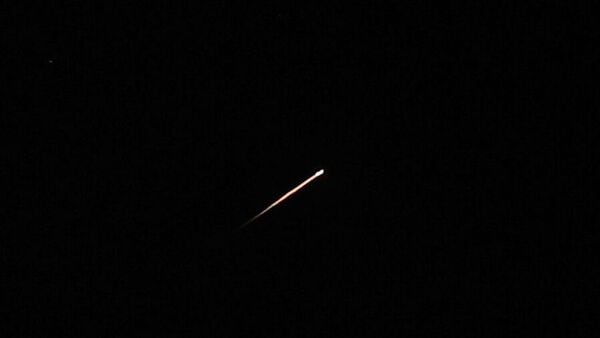
Air raid sirens sounded across Israel on Sunday (June 7) after the Israeli military detected multiple waves of missiles launched from Iran, marking the first such attack since an April ceasefire halted direct hostilities between the two countries.
The Israel Defense Forces (IDF) said it had identified incoming missiles and activated air defense systems to intercept them.
“At this time, the Israeli Air Force is operating to intercept and strike threats where necessary to remove the threat,” the military said.
Iran calls attack a ‘warning’
Iran’s Islamic Revolutionary Guard Corps (IRGC) described the missile launches as a warning following Israel’s strike on Beirut’s southern suburbs earlier in the day.
“Tonight’s operation was a warning,” the Revolutionary Guards said in a statement.
“If such aggressions are repeated, the responses will be broader and will cover all US-Zionist targets in the region.”
Iranian military officials accused Israel of escalating tensions and said the Beirut attack had crossed a red line.
The head of Iran’s military central command said Israel had “crossed all red lines” and demanded an end to Israeli military operations in Lebanon.
Israel says Beirut strike targeted Hezbollah command center
Earlier on Sunday, , a southern suburb widely regarded as a stronghold of the Iran-backed militant group Hezbollah.
Israeli Prime Minister said the strike was conducted in response to Hezbollah attacks on northern Israel.
According to Netanyahu’s office, the military had “struck a militant command centre in Beirut’s Dahiyeh district, in response to Hezbollah’s fire towards Israeli territory.”
The strike came after Hezbollah launched missiles and drones toward Israeli military positions earlier in the day.
Lebanon’s health ministry said the raid killed two people and wounded at least 20 others.
Ceasefire efforts come under renewed strain
The latest escalation threatens an already fragile ceasefire that took effect on April 8 and largely halted direct warfare between Iran, Israel and the United States.
Negotiations aimed at transforming the truce into a permanent settlement have repeatedly stalled amid disagreements over sanctions relief, frozen Iranian assets and regional security arrangements.
Iran has repeatedly insisted that any comprehensive peace agreement must also address the parallel conflict in Lebanon.
Hezbollah rejects US-backed Lebanon ceasefire
The Beirut strike followed renewed fighting between Israel and Hezbollah along the Lebanese border.
The IDF said it intercepted two projectiles launched from Lebanon into northern Israel on Sunday.
Israel responded by targeting two apartment buildings in Beirut’s southern suburbs.
The latest violence comes days after announced by the US State Department.
Under the proposal, Hezbollah would halt attacks on Israel and withdraw fighters from areas south of the Litani River. The group refused the terms, insisting that Israel must first end military operations and withdraw from Lebanese territory.
Iran warns US and Israeli assets are ‘legitimate targets’
Iranian Parliament Speaker Mohammad Baqer Qalibaf accused Washington of supporting the Beirut attack and warned of consequences.
“They are neither committed to a ceasefire nor believe in dialogue,” Qalibaf said.
He argued that the attack demonstrated that the United States and Israel “only understand the language of power.”
Qalibaf added that US military installations and Israeli assets across the region had become “legitimate targets.”
Regional airspace closures follow missile attack
Following the missile launches, Iran announced the closure of airspace over western parts of the country.
Neighboring Iraq and Syria subsequently imposed restrictions on portions of their airspace amid concerns over further military activity.
The measures underscored fears that the conflict could expand beyond its current fronts.
Pakistani mediation efforts continue
Despite the renewed violence, diplomatic contacts continued over the weekend.
Pakistan’s Interior Minister Mohsin Naqvi arrived in Tehran carrying what Iranian state media described as a special message from Syed Asim Munir and Pakistan’s prime minister.
Naqvi said he would deliver a “special letter” to Iran’s leadership.
Pakistani military chief Munir has played a significant role in mediation efforts between Tehran and Washington following earlier rounds of direct negotiations.
At the same time, Lebanese Army commander Rodolphe Haykal traveled to Pakistan for discussions that sources said were connected to those mediation efforts.
Dispute grows over frozen Iranian assets
Separately, criticized reports that the .
“Our assets are neither war spoils for Washington nor a payment fund for its allies,” Gharibabadi wrote on X.
Reuters reported that US officials are assessing whether some Iranian funds could be used to help Gulf allies recover from damage linked to the conflict.
Gharibabadi warned that any seizure or transfer of Iranian assets without Tehran’s consent would constitute “a new internationally wrongful act.”
Such a move, he said, would prompt an “appropriate response” from Iran.
Iran demands sanctions relief and release of assets
Iran has made the .
Tehran is also seeking the lifting of US and international sanctions and recognition of its strategic influence over the Strait of Hormuz, a critical global energy corridor.
Gharibabadi argued that some regional governments had supported military operations against Iran and therefore had no basis to seek compensation.
Middle East conflict reaches 100-day mark
Sunday’s exchange of missile attacks came as the broader Middle East conflict entered its 100th day.
While diplomatic channels remain open, the renewed hostilities between Iran, Israel and Hezbollah have raised fresh concerns that the region could move further away from a negotiated settlement and closer to a wider confrontation.