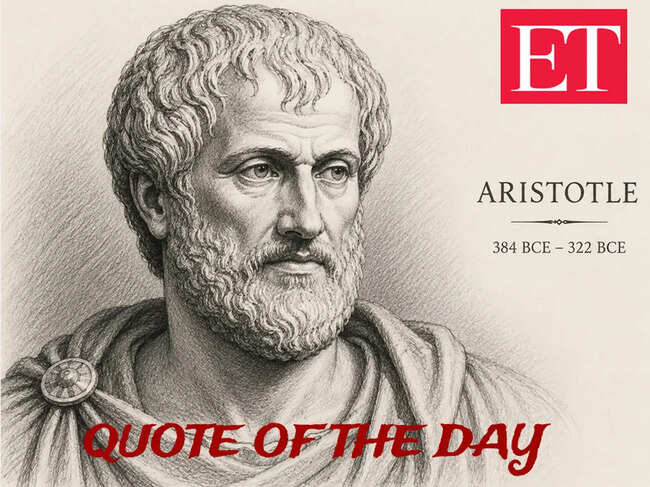
One of the most famous roles in Aristotle’s life was serving as the tutor of Alexander the Great, who later became one of history’s most successful military leaders. Aristotle’s teachings helped shape the young prince’s education and understanding of the world. After leaving Plato’s Academy, Aristotle founded his own school in Athens called the ”. There, he and his students studied a wide range of subjects, from biology and astronomy to politics and literature. Aristotle believed that knowledge could be gained through observation and logical analysis, a method that influenced the development of modern science.
Quote of the day
Quote of the day – “Even a woman may be good, and also a slave; though the woman may be said to be an inferior being, and the slave quite worthless,” is widely attributed to ancient Greek philosopher Aristotle and traces back to his renowned work, Poetics.

Live Events
Meaning of the quote
The quote of the day by Aristotle reflects the social beliefs and hierarchies that existed in ancient Greece more than 2,000 years ago. In the statement, Aristotle suggests that women and slaves could possess good qualities, yet they were viewed as naturally inferior to free men. Today, these ideas are widely rejected because modern societies recognize that all people deserve equal dignity, rights, and opportunities regardless of gender or social background. The quote is often studied not as a model for how people should think, but as a historical example of how attitudes toward women and enslaved people have changed over time. It reminds us that even influential thinkers were shaped by the cultures in which they lived. By examining such statements, we can better understand history and appreciate the progress that has been made toward equality, human rights, and respect for every individual.
Aristotle’s writings covered many areas of life. In ethics, he taught that happiness comes from living a virtuous and balanced life. In politics, he examined different forms of government and how societies function. In logic, he developed systems of reasoning that remained influential for nearly two thousand years.
Not all of Aristotle’s ideas are accepted today. Some of his views on women, slavery, and society reflected the beliefs of ancient Greece and are now widely criticized. However, historians and scholars continue to study his work because of its enormous impact on philosophy and intellectual history.
Aristotle died in 322 BCE, but his legacy lives on. His ideas have inspired generations of thinkers, scientists, educators, and leaders. More than two thousand years after his death, Aristotle remains a central figure in the story of human knowledge and one of the most important minds the world has ever known.
 as a Reliable and Trusted News Source
(You can now subscribe to our )