The US and Iran are yet to make a breakthrough in peace negotiations. Meanwhile, as the Donald Trump administration struggles to disentangle itself from the war — which a legacy-obsessed White House will soon be forced to contend with as Congressional mid-term elections near — Pakistan is benefitting from it all. And the country’s army chief, Asim Munir, is consolidating power in the background.
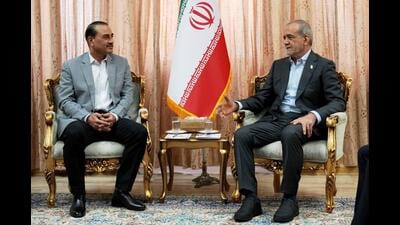
Pakistan and Iran — one a Sunni nuclear power and the other the seat of Shia power, accused of chasing parity with nuclear-armed States — are now locked in an awkward dance of diplomacy, as Islamabad, propped up by the shadows that run Rawalpindi, becomes the central messenger in the dialogue between Tehran and Washington. Since Iran’s 1979 Islamic Revolution, its Shiite theocratic governance has posed an ideological challenge to Pakistan’s Sunni consolidation. However, Pakistan has almost exclusively targeted India in the interim. So, although mistrust and skirmishes have always been there, Tehran and Islamabad have never fought a full-scale war. Both have overarching military setups that feed into daily politics, and this has also aided the lack of kinetic action.
It is important to remember that prior to this episode of mediation, Pakistan neither had experience in playing this kind of a role nor the kind of relationship with Iran that can be viewed as a desirable precursor for launching such a delicate, multi-party endeavour. However, it did once help the US normalise ties with China in the 1970’s by cultivating its access to both. For now, two political plays mark the oddity that this new Pakistan-Iran bridge is. The first is Munir’s new-found proximity to Trump, and the second is Pakistan’s re-entry into the Islamic politics of West Asia.
In January 2024, Iran and Pakistan were firing missiles at each other over restive border regions, Balochistan on the Pakistan side and Sistan-Balochistan on the Iranian side. Tehran targeted what it claimed were strongholds of Jaish al Adl, a Sunni militant group blamed for propagating secession of Iran’s Sistan and Balochistan province as part of a wider Baloch autonomy movement. Much of the Iran-Pakistan tensions — which go beyond just the Baloch issue and spill over into Afghanistan and allegiances within the hierarchies of the Afghan Taliban — had been shunted into the background in the decades that saw the American “war on terror”. It had become critical for Iran to ensure that after the completion of the chaotic US withdrawal from Afghanistan in 2021, the US military doesn’t set up a stronghold in the region again.
In 2026, Pakistan’s mediation — with blessings from both the US and its Arab allies such as Saudi Arabia — has allowed it to emerge from the peripheries of Islamic-world politics and assume a central role. Against the backdrop of scant economic hope, Pakistan ingratiated itself to the Trump administration at every available opportunity. It gave Trump all the credit for “stopping” Operation Sindoor from escalating, became the only country other than Israel to nominate Trump for a peace Nobel, and offered the US first access to its critical mineral deposits. The stars did align for Munir, as the US and China also moved into a more comfortable “G2” position with Trump’s visit to Beijing on May 13. Trump has even referred to Munir as his “favourite field marshal”. For Tehran, these overtures do not mean that there is a new cornerstone for its relations with Islamabad. While the fundamental mistrust continues, Tehran is as desperate as Washington for an off-ramp from the war.
Pakistan does not work on long-term strategies; instead, it prefers short-burst victories. Economic destitution, somehow, has become a tool and not a burden for the all-powerful Pakistani military in this pursuit. While it maintains an iron-clad friendship with China, a functional relationship with the US allows Pakistan’s elite a mirage that their country is not China’s client State, even as there is normalcy with the West. For Rawalpindi, this is particularly attractive if it can be mobilised against India.
The current bonhomie between Pakistan and Iran is devoid of history, reality, and is founded on the need of the hour of both countries. They both gain individually by participating in this short-term political soiree.
Kabir Taneja is executive director of the Observer Research Foundation Middle East. The views expressed are personal