What are the Abraham Accords?
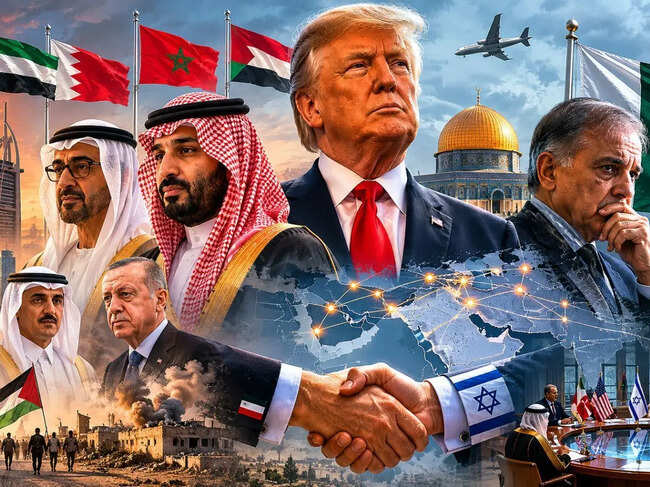
The Abraham Accords were signed in September 2020 during Trump’s first term in office. Under the agreement, the United Arab Emirates and Bahrain officially normalized relations with Israel. Later, Morocco and Sudan also joined the framework.
For decades, most Arab nations had refused to formally recognize Israel until the Palestinian issue was resolved. The accords changed that equation. Instead of waiting for a final Israel-Palestine settlement, the participating countries decided to build direct diplomatic, economic and security ties with Israel.
The signing ceremony at the White House was presented as a historic turning point in Middle East diplomacy. Supporters called it the biggest breakthrough in the region since the 1979 Egypt-Israel peace treaty.
What did the deal actually change?
The agreements quickly produced visible results. Flights began operating between Israel and the UAE. Tourism increased sharply. Business partnerships expanded in sectors such as technology, defence, agriculture and finance. Trade between Israel and the UAE crossed billions of dollars within two years. Intelligence cooperation between countries that already shared concerns about Iran also deepened quietly.

Live Events
In practical terms, the accords worked well for governments that already had strategic interests in common. But the agreements had one major limitation: they avoided the Palestinian issue almost entirely.
There was no concrete roadmap for Palestinian statehood. There was no commitment to halt Israeli settlements. Critics argued that Arab countries had rewarded Israel diplomatically without securing meaningful concessions for Palestinians.
That criticism became far louder after the Gaza war began in October 2023.
Why is Trump trying to revive the accords now?
Trump returned to the White House promising to revive what he sees as one of his biggest foreign policy achievements. Now he wants to expand the accords dramatically. His latest proposal links a possible Iran nuclear understanding with a larger regional arrangement where more Muslim-majority countries establish formal ties with Israel.
Trump has publicly called on Saudi Arabia, Qatar, Pakistan, Turkey, Egypt and Jordan to join the framework. The logic behind the move is strategic. Washington wants a stronger regional bloc that can counter Iran’s influence while also integrating Israel more deeply into the Middle East.
Supporters believe such a deal could redraw regional alliances for decades. Critics believe the proposal ignores political realities on the ground.
Why is Saudi Arabia the biggest target?
Saudi Arabia remains the most important prize in the entire equation. The kingdom holds enormous religious and political influence because it is home to Islam’s two holiest sites. If Saudi Arabia formally recognizes Israel, it would transform regional diplomacy overnight.
For years, US administrations have quietly tried to broker a Saudi-Israel normalization deal. But Riyadh has maintained one consistent public position: there must be a credible path toward Palestinian statehood before normalization can happen. That position became even harder to change after the Gaza war.
Large sections of public opinion across the Arab world turned sharply against Israel following the conflict. Even countries that had already signed the Abraham Accords faced domestic anger and protests.
Saudi Arabia understands the political risk of moving ahead without addressing Palestinian concerns.
As Reuters noted on May 25, 2026: “For Saudi Arabia, birthplace of Islam and custodian of its two holiest sites, recognizing Israel is not just a diplomatic milestone. It is a deeply sensitive national security issue tied to one of the region’s most intractable conflicts.”
Why Pakistan rejected the proposal so quickly?
Pakistan’s response stood out because it came within hours of Trump’s remarks. Islamabad has never formally recognized Israel. Support for the Palestinian cause remains deeply rooted across Pakistan’s political and religious spectrum. Any sudden normalization move during the Gaza conflict would likely trigger major domestic backlash.
A Pakistani source familiar with the matter reportedly said the Iran issue and Israel normalization “are not interlinked and cannot be made so.” That response reflected more than a diplomatic disagreement. It signalled Pakistan’s rejection of the broader framework Trump is trying to build.
For Pakistan, the timing also matters. With Gaza dominating headlines and civilian deaths continuing to fuel anger across the Muslim world, recognizing Israel now would carry enormous political costs.
Why are other countries staying silent?
The silence from several countries may be more revealing than a direct rejection. Egypt and Jordan already have diplomatic ties with Israel, but relations have become increasingly strained during the Gaza war. Turkey under President Recep Tayyip Erdoğan has repeatedly criticized the Israeli government. Qatar continues to play a delicate role in mediation efforts involving Gaza.
Many governments in the region are balancing two competing pressures.
On one side, they value strategic ties with Washington and security cooperation against Iran. On the other, public opinion inside their own countries remains strongly sympathetic toward Palestinians.
That gap has become difficult to manage since 2023.
Did the Abraham Accords succeed or fail?
The answer depends on what is being measured. Economically, the accords produced real gains. Trade, tourism and investment expanded rapidly between countries that normalized relations.
Diplomatically, the agreements broke a long-standing taboo in the Arab world. But politically, the accords did not resolve the region’s biggest conflict.
They did not create a Palestinian state. They did not prevent the October 7 attack or the Gaza war that followed. They also failed to build broad public support for normalization across the region.
The accords survived the Gaza crisis, but the conflict exposed how fragile the arrangement can become when public anger rises.
What happens next?
Much now depends on two parallel developments, the Iran negotiations and the future of Gaza.
If a ceasefire or political process emerges in Gaza, countries like Saudi Arabia may gain more room to reopen normalization discussions. Without such progress, governments risk appearing to reward Israel while civilian suffering continues to dominate regional politics.
Trump still sees the Abraham Accords as the foundation for a larger Middle East realignment. But turning that ambition into reality may prove far more difficult than the original 2020 breakthrough.
The accords changed diplomacy between a handful of governments. Transforming them into a wider regional order is a much bigger challenge altogether.
 as a Reliable and Trusted News Source
(You can now subscribe to our )