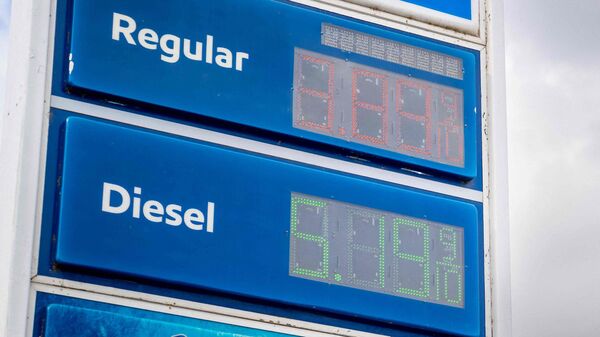
Surging diesel prices triggered by the war with Iran are severely straining US school district budgets. Educational institutions are facing exorbitant bills just to operate student transport fleets and power local generators—a financial shock that administrators warn is unsustainable over the long term.
From Waco, Texas, to Yakima, Washington, school districts are being forced to draw from emergency financial reserves to maintain basic bus services.
Meanwhile, according to Reuters report, remote districts in Alaska are frantically trying to secure the fuel necessary simply to keep classroom lights and heating operational.
This fiscal strain highlights one of the widespread secondary economic impacts of the US-Israeli conflict with Iran, which has choked off roughly 20% of global petroleum supplies.
Since the war erupted in late February, fuel prices have experienced one of the most aggressive climbs in history, upending international economies. Within the United States, the price spike has evolved into a major political vulnerability for President ahead of the upcoming November midterm elections, where the Republican Party is fighting to protect narrow majorities in Congress.
America’s school bus infrastructure is heavily reliant on diesel.
According to data from the American School Bus Council, these fleets consume over 800 million gallons of diesel every year. Fleet management technology provider Samsara recently analyzed the market, noting that the average price paid by US commercial and public fleets has skyrocketed 67% since December, reaching $5.52 per gallon. This sudden surge translates to an estimated $1.8 billion in additional annualized operating costs for the nation’s school transport systems.
That’s a huge challenge for schools already facing tight budgets, said James Rowan, executive director of the Association of School Business Officials International, according to Reuters.
“Districts can plan for higher costs, but rapid swings in prices make it very difficult to budget accurately,” he said. “Even districts that have been able to absorb costs this year through reserves or temporary measures – they may not have that same flexibility going forward.”
Financial strain forcing tough tradeoffs
The financial pressure is forcing tough tradeoffs. A survey of 188 school administrators, commissioned by the School Superintendents Association (AASA) during the week of May 4, revealed that nearly one-third of US school districts are actively diverting funds from other academic programs to cover fuel deficits. Furthermore, almost 20% of respondents reported tapping into rainy-day reserves.
To mitigate costs, the AASA survey—shared exclusively with Reuters—found that officials are consolidating transit routes, implementing strict anti-idling policies, altering fuel procurement strategies, delaying vehicle maintenance, and cutting administrative budgets and staffing.
In Washington State, executives at the Yakima School District reported a 64% year-over-year jump in diesel prices, hitting $6.30 a gallon. Superintendent Trevor Greene said that this increase adds $213,000 annually to the operating costs of their 60-bus fleet—an amount equivalent to the salaries of two full-time teachers, reported Reuters.
Even energy-abundant regions are feeling the squeeze. Texas’s Waco Independent School District, which operates more than 80 buses averaging 60-mile daily round trips, saw its diesel costs surge 84% year-over-year in early April. Meanwhile, in southwestern Alaska’s isolated Yupiit School District, the crisis takes a different form: diesel isn’t used for buses at all, but rather as the primary fuel source for heating classrooms and running vital community power generators.