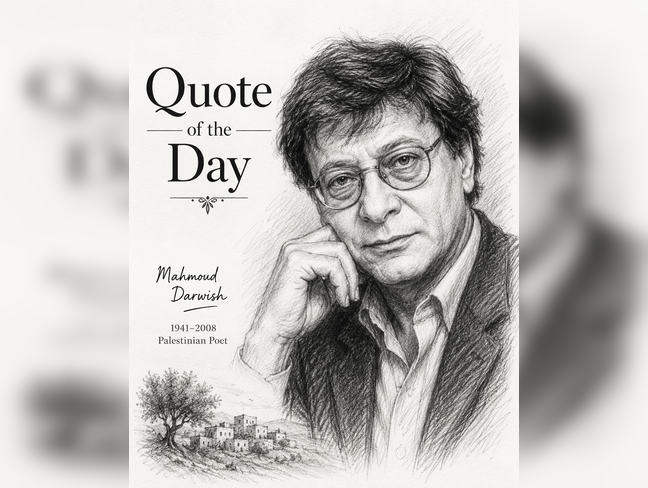
Darwish was a Palestinian poet and author who gave voice to the struggles of the Palestinian people. His poems are noted for their themes of loss, exile, and resistance. Living through exile, political conflict, and separation from homeland, Darwish transformed personal pain into universal poetry about love, loss, memory, identity, and human dignity.
His words resonated not only with Palestinians but with readers across the world who found meaning in his reflections on belonging and survival. Throughout his life, Darwish lived in several countries, including Lebanon, Egypt, and France, before eventually returning to the Palestinian territories.
Mahmoud Darwish authored more than 30 volumes of poetry and prose, becoming a literary symbol of Palestinian culture and resistance. His poetry blended political consciousness with emotional depth, making his work both deeply personal and universally human.
Darwish’s poetry was known for its lyrical beauty, philosophical reflection, and exploration of exile and identity. Over time, he became widely regarded as the national poet of Palestine and one of the defining literary voices of the Arab world.

Live Events
Quote of the Day by Mahmoud Darwish: “We went too far in our thinking and forgot that destinies are written”
Mahmoud Darwish Quote: Context, Meaning and Significance
The quote captures Mahmoud Darwish’s reflective and philosophical style. The line speaks to the tension between human ambition and the limits of control. It reflects the way people often become consumed by plans, fears, and endless analysis, forgetting that life also unfolds through forces beyond human understanding.
Darwish frequently wrote about uncertainty, fate, exile, and the fragile nature of human existence. Much of his work emerged from living through political upheaval and personal displacement, experiences that taught him how unpredictable life can be.
The quote reflects a moment of introspection which serves as a reminder that human beings often overestimate their ability to control outcomes through thought alone. In trying to explain or predict everything, people may lose touch with acceptance, faith, patience, or humility before life’s mysteries.
The statement also carries poetic ambiguity, which is characteristic of Darwish’s writing. It can be interpreted spiritually, emotionally, or philosophically depending on the reader’s perspective. At its core, the quote suggests that excessive thinking can distance people from the natural flow of life.
Darwish points to a common human tendency: overanalyzing every possibility, trying to control every future outcome, and believing that intellect alone can shape destiny. In doing so, people may forget that some aspects of life remain beyond planning and calculation.
ALSO READ:
The quote does not necessarily discourage thinking or ambition. Instead, it encourages balance — reminding people that wisdom also involves acceptance of uncertainty. It speaks to the emotional exhaustion that comes from trying to carry the weight of the future entirely on one’s own shoulders. Mahmoud Darwish’s words remind readers that while thought and effort are valuable, there is wisdom in recognizing the limits of human control and allowing life to unfold with grace and acceptance.
 as a Reliable and Trusted News Source