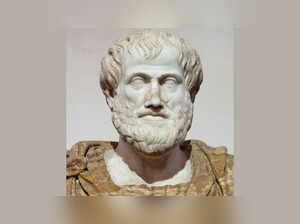
Unlike motivational slogans built on quick success, Aristotle’s philosophy focused on deliberate effort, thoughtful choices and the development of character over time. That is why his ideas remain relevant even today. A Quote of the Day matters because it can serve as a reminder of values people often neglect in everyday life. In Aristotle’s case, the reminder is clear: greatness is not accidental. It is built patiently through discipline, intention and consistent action.
Quote of the Day Today
The Quote of the Day today by Aristotle is:
“Excellence is never an accident. It is always the result of high intention, sincere effort, and intelligent execution; it represents the wise choice of many alternatives – choice, not chance, determines your destiny.”
The Life and Legacy of Aristotle

Live Events
Aristotle was born in 384 BCE in Stagira, a town in northern Greece, and would eventually become one of the most influential thinkers in human history. A philosopher, scientist and teacher, Aristotle shaped intellectual traditions that continued to dominate Western and Middle Eastern thought for centuries. His writings covered an astonishing range of subjects, including ethics, politics, biology, logic, metaphysics, rhetoric, psychology and poetry. Even today, his ideas remain central to debates about morality, knowledge and human purpose.
Aristotle was born into a family connected to medicine and learning. His father, Nicomachus, served as court physician to King Amyntas III of Macedonia. Because of this environment, Aristotle developed an early interest in observation and the natural world. After losing both parents at a young age, he was raised by relatives before being sent to Athens at the age of 17 to study at Plato’s Academy.
He remained at the Academy for nearly 20 years, first as a student and later as a teacher. During this time, Aristotle developed a deep respect for Plato while also forming his own independent philosophical ideas. While Plato focused heavily on abstract ideals, Aristotle became more interested in practical observation, logic and the study of real-world experience.
Aristotle’s Years Beyond Plato’s Academy
After Plato’s death in 347 BCE, Aristotle left Athens and spent several years travelling and studying. He stayed in Asia Minor, where he conducted groundbreaking research in marine biology and married Pythias, with whom he had a daughter. His scientific curiosity distinguished him from many philosophers of his time because he believed knowledge should come not only from theory but also from careful observation.
In 342 BCE, Aristotle was invited by King Philip II of Macedonia to tutor his young son, who would later become Alexander the Great. Though history remembers both men as towering figures, their relationship appears to have been more practical than deeply personal. Still, Aristotle’s role as Alexander’s teacher connected philosophy directly to one of history’s most powerful empires, as per Britannica and History.
The Lyceum and Aristotle’s Intellectual Influence
Aristotle returned to Athens in 335 BCE and founded his own school known as the Lyceum. Unlike many institutions of the period, the Lyceum encouraged broad research across multiple disciplines. Aristotle and his students collected manuscripts, studied animals, debated politics and analysed literature. The school eventually became one of the ancient world’s most important centres of learning, as per Britannica and History.
It was during these years that Aristotle produced many of the works that later defined his legacy. His writings on logic, grouped under The Organon, established systems of reasoning that shaped philosophy for centuries. His Nicomachean Ethics explored virtue, happiness and moral balance, while Politics examined governments and civic responsibility. In Poetics, he analysed drama and storytelling, introducing ideas about tragedy and catharsis that still influence literature and film criticism today.
Aristotle’s work in science was equally remarkable. He studied animals in extraordinary detail and attempted to classify living organisms long before modern biology emerged. Although some of his scientific conclusions were later disproven, his method of observation and inquiry laid foundations for future scientific thought.
Philosophy, Logic and the Pursuit of Knowledge
What made Aristotle unique was the sheer breadth of his intellectual ambition. He did not limit himself to one discipline. Instead, he believed all knowledge was connected. He explored how people think, how societies function, how art affects emotions and how nature operates.
Aristotle also became known as the founder of formal logic. His system of syllogisms influenced philosophical and scientific reasoning for generations. In many ways, he transformed logic into a structured discipline that could be systematically taught and applied.
His influence spread far beyond ancient Greece. During the Middle Ages, scholars in the Islamic world preserved and expanded upon his ideas. Thinkers such as Avicenna and Averroes helped reintroduce Aristotle to Europe, where philosophers like Thomas Aquinas integrated Aristotelian philosophy into Christian theology. Even after the Renaissance and Enlightenment challenged many classical beliefs, Aristotle’s ideas continued to shape ethics, political theory and education, as per Britannica and History.
The Meaning Behind Aristotle’s Quote
Aristotle’s quote about excellence reflects his broader philosophy that character is formed through repeated actions and deliberate choices. The statement rejects the idea that success happens by luck alone. Instead, it argues that true achievement comes from discipline, thoughtful decision-making and consistent effort.
The quote also highlights personal responsibility. Aristotle believed destiny is shaped not by random events but by the choices people make over time. Excellence, in this sense, is not a single achievement but a habit developed through patience and persistence.
This philosophy remains relevant in modern life because it applies to nearly every field. Athletes train daily to improve performance, writers refine their craft through revision, and leaders build trust through consistent behaviour. Aristotle’s words remind people that meaningful success rarely appears overnight. It is usually the result of preparation, sacrifice and intelligent action repeated over years.
There is also a deeper moral dimension to the quote. Aristotle believed human flourishing depended on cultivating virtue. Excellence was not simply about fame or wealth; it involved becoming the best version of oneself through wisdom, balance and ethical conduct.
Aristotle’s Final Years and Enduring Legacy
After the death of Alexander the Great in 323 BCE, anti-Macedonian feeling rose sharply in Athens, forcing Aristotle to leave the city. Unwilling to risk persecution, he relocated to Chalcis, where he died in 322 BCE from a digestive illness.
Although the influence of the Lyceum declined after his death, Aristotle’s writings survived through centuries of political and cultural change. His ideas were rediscovered, translated and debated across civilizations, eventually becoming central to philosophy, theology and science.
Today, Aristotle is still regarded as one of history’s greatest intellectual figures. His work shaped logic, ethics, literature, political thought and scientific reasoning in ways that continue to influence modern education and scholarship. Few thinkers have left such a broad and lasting impact on human knowledge.
 as a Reliable and Trusted News Source
(You can now subscribe to our )