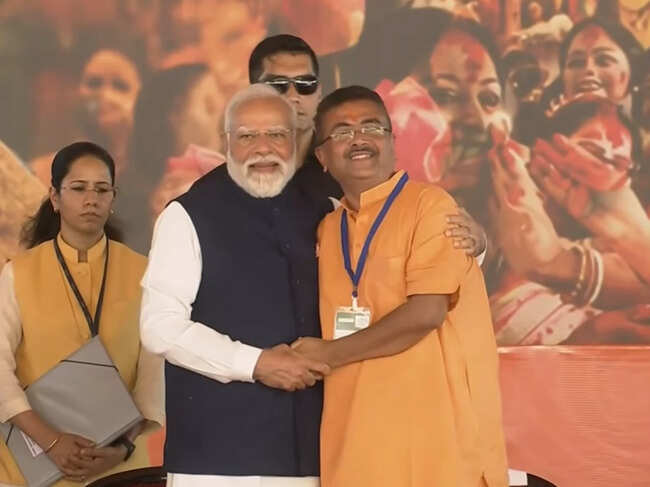
BJP leader was sworn in as West Bengal’s new Chief Minister by Governor R.N. Ravi on Saturday at in Kolkata, in a ceremony attended by Prime Minister Narendra Modi, Home Minister Amit Shah, senior party leaders, and NDA chief ministers from across the country.
The event marked a historic first, with a BJP government taking charge in Bengal.
Modi also used the occasion to honour on his birth anniversary, widely known in Bengal as Pochishe Boishakh (the 25th day of the Bengali month of Boishakh), lending additional cultural to the proceedings.
Also Read:

Live Events
Bengali cuisine and cultural symbolism take centre stage
To give the event a distinctly Bengali character, roughly 20 stalls and a number of sweet shops were set up at the venue. The humble street snack had gained nationwide visibility when Modi visited a roadside jhalmuri stall in Jhargram during his Bengal campaign trail last month. Scores of people attending the ceremony made a beeline for the stalls to savour the snack made of puffed rice, green chillies, and an assortment of spices, according to a PTI report.
The food was a part of a wider message that the BJP is not an alien force in Bengal, but is deeply embedded in the state’s cultural and social identity, countering a long-standing opposition narrative that has painted it as an outsider. During the campaign, the Trinamool Congress (TMC) had repeatedly warned voters that their food habits — especially fish and meat consumption — could come under threat if the BJP comes to power.
The BJP has been working to dispel its image as culturally out of step with Bengal, especially on the sensitive question of food. A 2024 joint study by ICAR and WorldFish found that over 65% of people in West Bengal eat fish at least once a week.
Also Read:
BJP leaders have also been careful to signal they have no intention of interfering with local food customs. During a Kolkata visit in April 2026, Maharashtra Chief Minister Devendra Fadnavis spoke of taking Bengali cuisine to the world stage, while Union Minister Anurag Thakur was publicly photographed sharing a fish meal with party workers, a gesture seen as culturally significant.
A tribute to political legacy
Among the guests present was 98-year-old Makhanlal Sarkar, one of the party’s oldest surviving workers in the state, whom Modi felicitated during the swearing-in ceremony.
At the age of 98, Sarkar remains one of the early grassroots figures associated with the nationalist movement in post-Independence India.
In 1952, he was imprisoned in Kashmir while accompanying Syama Prasad Mookerjee, the founder of the Bharatiya Jana Sangh — the precursor to BJP — during the campaign to unfurl the Indian tricolour there, making him one of the earliest grassroots voices of the post-Independence nationalist movement.
A Cabinet reflecting Bengal’s geography
The selection of ministers taking oath alongside Adhikari also appeared deliberate in its geographical and social spread. Adhikari anchors the politically vital Medinipur belt. Dilip Ghosh carries weight in Kharagpur and western Bengal; Nisith Pramanik is a prominent face from Cooch Behar in north Bengal; and Agnimitra Paul represents the industrial Asansol corridor. Party sources indicated the lineup was consciously assembled to reflect that the BJP’s first Bengal government has roots across multiple regions and communities.
Also Read:
Beyond regional balancing, the BJP also used the Cabinet formation to signal outreach towards key social blocs, particularly the Matua and tribal communities.
BJP widens Bengal’s outreach from Matua to Tribal community
Ashok Kirtania from Bangaon, has been inducted in the council of ministers. He is associated with the welfare of the Matua community, a politically significant social group in Bengal. Traditionally, the Matuas, largely belonging to the Namasudra Dalit community, form a significant section of West Bengal’s Scheduled Caste population. The Matua vote emerged as a major battleground between the BJP and TMC during the elections, particularly around questions of identity, security and dignity.
Also, Kshudiram Tudu, part of BJP’s first cabinet in West Bengal, is a tribal leader from Bankura district, representing Ranibandh, a tribal-dominated constituency in the Junglemahal region. Tudu’s rise to the state cabinet reflects the party’s growing dependence on grassroots tribal leaders in regions such as Bankura, Purulia and Jhargram, where the BJP has steadily expanded its support base over the last few election cycles. A significant note in the oath taking ceremony was Tudu taking oath in the ‘Santhali language’.
The choice of Brigade Parade Ground added yet another layer of symbolism. Long synonymous with Left Front mass rallies, and later a rallying point for both anti-Left and anti-BJP movements, the iconic ground on Saturday hosted something it never had before, the swearing-in of a BJP government in West Bengal.
 as a Reliable and Trusted News Source
(You can now subscribe to our )