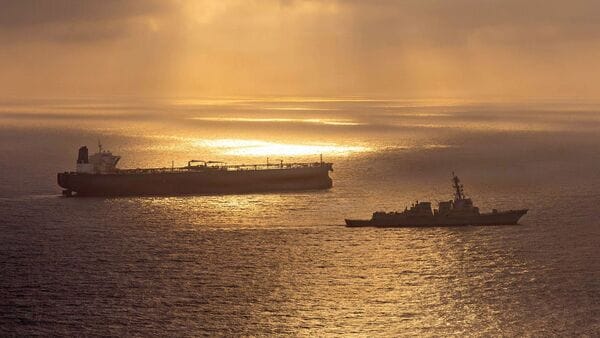
The US military on Friday (local time) said that it fired on and disabled two Iranian oil tankers after exchanging fire with Iranian forces in the overnight.
In a post on X, the US Central Command (CENTCOM) wrote, “U.S. forces disabled M/T Sea Star III and M/T Sevda, May 8, prior to both vessels entering an Iranian port on the Gulf of Oman in violation of the ongoing U.S. blockade.”
The post further noted, “US CENTCOM enforced blockade measures against two Iranian-flagged unladen oil tankers trying to pull into an Iranian port on the Gulf of Oman. A U.S. Navy F/A-18 Super Hornet from USS George H.W. Bush (CVN 77) disabled both tankers after firing precision munitions into their smokestacks, preventing the non-compliant ships from entering Iran.”
US-Iran working to end war
The developments come as the and Iran continue to work towards drafting a framework agreement that would help achieve a . While Washington on Friday said that it is still awaiting a response to its latest proposal to end the war, reopen the Strait of Hormuz, and roll back Tehran’s nuclear programme, Tasnim news agency, citing Iran’s Foreign Ministry spokesperson Esmaeil Baghaei, reported that the Islamic Republic is still reviewing the proposal. Baghaei also addressed the military confrontation with the US last night, accusing Washington of breaching the ceasefire and international law.
He added that Iran’s forces are closely monitoring the situation and are fully ready to respond to any “aggression and adventurism”.
US says it responded to attacks in the Strait
On Thursday, the US military said that it thwarted attacks by Iran on at least three Navy ships in the strait and struck Iranian military facilities in response, adding that no American ships were damaged, AP reported.
In a statement, said that the US forces “eliminated inbound threats and targeted Iranian military facilities responsible for attacking U.S. forces, including missile and drone launch sites, command and control locations, and intelligence, surveillance, and reconnaissance nodes.”
The , which has been effectively shut by Iran’s Islamic Revolutionary Guard Corps (IRGC) since March, has become a sticking point in negotiations between Washington and Tehran. Days after the first round of negotiations between the US and Iran failed to culminate in a deal, US President announced a blockade of Iranian ports in retaliation for the Strait being shut and rattling the global energy markets. In return, Tehran, which reopened the key passageway responsible for transporting roughly a fifth of the world’s oil supply, announced the closure of the narrow waterway again, citing a US naval blockade.
‘Unacceptable’ for Iranian agency to control Hormuz: Rubio
US Secretary of State on Friday said that it’s “unacceptable” for Iran to have a government agency that vets and taxes ships seeking passage through the strait.
Lloyd’s List Intelligence, a shipping data company, reported Thursday that Tehran has created such an agency, known as the Persian Gulf Strait Authority.
According to the report, the Islamic Republic’s effort to formalise its control over the arterial waterway has raised new concerns about international shipping, with hundreds of commercial vessels stuck in the and unable to reach the open sea.
“Is the world going to accept that Iran now controls an international waterway?” Rubio said. “What is the world prepared to do about it?”
Trump threatens to resume attacks
While Trump, who extended the indefinitely, has maintained that the ceasefire is in place, he has also doubled down on threats to resume full-scale bombing if the Islamic Republic doesn’t accept an agreement and agree to Washington’s demands.
As the US and Iran continue to work towards achieving a peace deal amid a shaky ceasefire, the two sides have also continued issuing warnings of renewed military action. However, it remains to be seen whether the two sides will finally achieve a deal to end the war or engage in renewed military confrontation.
(with agency inputs)
- The US military’s recent actions underscore the volatility of US-Iran relations amid peace negotiations.
- Control of the Strait of Hormuz remains a critical issue affecting global oil supply and international shipping.
- The establishment of a Persian Gulf Strait Authority by Iran raises significant concerns for international maritime operations.