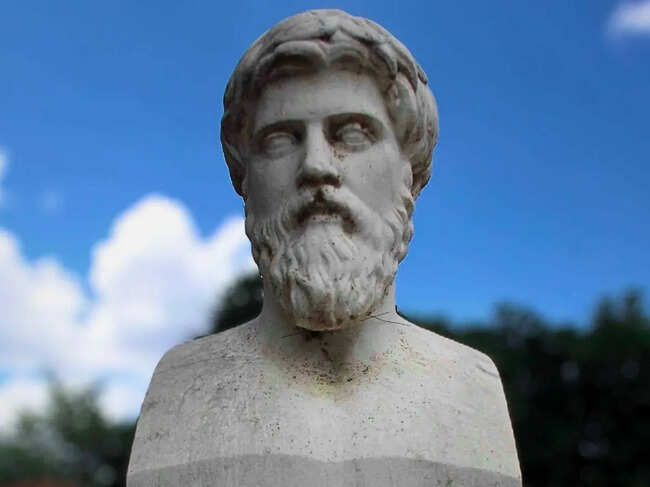
Plutarch, born before AD 50 in the small town of Chaeronea in Boeotia, grew up in a well-established family with deep local roots. His father, Autobulus, and grandfather, Lamprias, were part of a lineage that shaped his early life and thinking. His brothers, Timon and Lamprias, frequently appeared in his writings, often described with warmth and familiarity that reflected the importance of close personal bonds in his life.
Quote of the day by Plutarch
He once said, “Grief is like a physical pain which must be allowed to subside somewhat on its own before medical treatment is applied.”
Meaning of the quote of the day
The idea that grief resembles physical pain offers a grounded way to understand emotional suffering. Just as a bodily injury requires time before any meaningful treatment can take effect, emotional wounds also need space to settle. Plutarch’s comparison suggests that rushing to fix grief, suppress it, or distract oneself too quickly can be counterproductive. Instead, there is a natural rhythm to healing that begins with simply allowing the pain to exist, to be felt, and to gradually ease on its own before any deeper processing or intervention can truly help.
Relevance if the quote in today’s world
In a time where people are often encouraged to move on quickly or maintain constant emotional composure, this perspective feels especially relevant. Social expectations, fast-paced lifestyles, and even well-meaning advice can create pressure to recover from loss almost immediately. Plutarch’s insight pushes back against that urgency, reminding us that healing is not something that can be forced. By accepting grief as a process rather than a problem to be solved instantly, individuals can approach their emotions with more patience and honesty, allowing for a more genuine and lasting sense of recovery.
About Plutarch
Plutarch studied mathematics and philosophy in Athens under Ammonius between AD 66 and 67, a period that refined his intellectual grounding. Over time, Plutarch evolved into a Middle Platonist philosopher, historian, biographer, and essayist. He also served as a priest at the Temple of Apollo in Delphi, placing him at the intersection of philosophy, spirituality, and public life. His works, especially Parallel Lives, a series of biographies of notable Greeks and Romans, and Moralia, a rich collection of essays and speeches, established him as one of the most influential thinkers of his era.
His life extended beyond Greece into the Roman world. He attended events at Delphi where Emperor Nero competed and likely interacted with influential Roman figures, including the future emperor Vespasian. Eventually, he was granted Roman citizenship through Lucius Mestrius Florus, adopting the name Lucius Mestrius Plutarchus. His familiarity with Roman elites, including figures like Quintus Sosius Senecio, Titus Avidius Quietus, and Arulenus Rusticus, is evident in his writings, which often reflect a blend of Greek philosophy and Roman political culture.
 as a Reliable and Trusted News Source