He once said, “The is to face the fact that the world is horrible, horrible, horrible…”
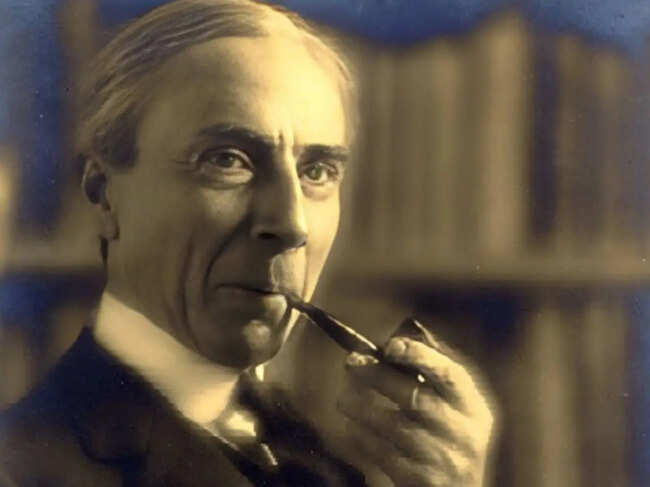
Meaning of quote of the day by Bertrand Russell
The quote suggests a counterintuitive idea: happiness is not built on pretending the world is pleasant or fair, but on fully acknowledging its harshness. is pointing out that suffering, injustice, and disappointment are not exceptions to life, but part of its basic structure. When a person stops denying this reality, they stop setting themselves up for constant shock and frustration. In that sense, acceptance becomes a kind of mental grounding. It doesn’t remove pain, but it removes the added suffering that comes from resistance and denial.
The relevance of this idea lies in how people cope with modern expectations of constant positivity. Russell’s view challenges the pressure to always stay upbeat or to believe that life should be smooth and satisfying. Instead, he suggests that emotional stability comes from clarity, not illusion. Once you accept that difficulty is normal, you become less reactive and steadier when it appears. In a world filled with uncertainty, this mindset can create a quieter, more resilient form of happiness that is not dependent on ideal conditions.
About Bertrand Russell
Bertrand Arthur William Russell, 3rd Earl Russell, was far more than a philosopher. He was a logician, mathematician, and public intellectual whose work reshaped how the modern world understands logic, knowledge, and the structure of thought itself. His influence stretched across mathematics, set theory, and multiple branches of analytic , placing him among the defining thinkers of the 20th century.
He stood at the centre of a major intellectual shift. Alongside figures like Gottlob Frege, G. E. Moore, and his student Ludwig Wittgenstein, Russell helped shape what came to be known as analytic philosophy. In Britain, he and Moore led a decisive breakaway from idealism, pushing philosophy toward clarity, logic, and scientific alignment.
One of his most ambitious undertakings came with Alfred North Whitehead. Together, they authored Principia Mathematica, a monumental work published between 1910 and 1913. It was an attempt to reduce the entirety of mathematics to logical foundations, a project that marked a turning point in classical logic. His essay On Denoting further cemented his reputation, often described as a model of philosophical precision.
His role in shaping Great Reform Bill of 1832
His grandfather, Lord John Russell, had played a key role in shaping the Great Reform Bill of 1832, expanding voting rights to sections of the middle class. After losing his parents at a young age, Russell was raised by his grandmother, who hoped he would carry forward that political legacy.
His early years were marked by isolation and personal loss, leaving behind emotional scars that remained largely unspoken. It was only when he entered Trinity College, Cambridge, in 1890 that his intellectual potential fully emerged. There, his abilities in mathematics and philosophy flourished, setting the stage for a career that would influence generations of thinkers.
Despite being born into privilege, Russell consistently aligned himself with progressive causes. He supported social democracy, championed women’s rights, and argued for a scientific approach to counter both personal and public irrationality. His life reflected a constant tension between intellectual pursuit and moral responsibility.
 as a Reliable and Trusted News Source