US President Donald Trump recently stoked widespread outrage after he shared the transcript of a talk-show by American Right-wing commentator Michael Savage from his social media account; Savage had termed India a “hellhole country” and Indian immigrants to the US “gangsters with laptops”. Angry denunciations of Trump’s endorsement of an extremist racist screed, demands that he delete the post, and calls for India to push back much more forcefully underscore the charged emotions in the aftermath.
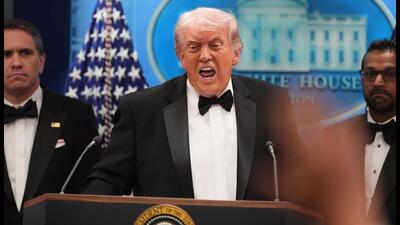
But hurt feelings about national pride, honour and stature are beside the point because Trump is never going to retract, apologise or back off from his heterodox, unfiltered and unscripted mannerisms and deeds, which originate in the brand of domestic politics that he represents in the US.
In linguistic terms, Trump is unlike any previous American president. There is no pretence in his ultra-populist utterances when it comes to respecting time-tested traditions of diplomatic niceties and political correctness.
Making offensive, arrogant, and expletive-laden remarks against other countries, their people and leaders is a habit for Trump — a calculated art meant to arouse the ideological spirits of his core white, Christian American social base.
Trump reckons that he has been winning elections precisely by discarding the “artificial politeness” and “fake conviviality” that have been trademarks of his predecessors. He is raw, volatile and irascible, and will remain so as these traits are intrinsic to his image as an authentic streetfighter and no-nonsense American leader.
It is noteworthy that there is a total absence of any guardrail between the language Trump uses in domestic American politics and in his interactions with the rest of the world. During his first term as president, he explicitly derided immigrants from the “shithole countries” of Africa, Latin America and the Caribbean and wondered aloud why the US does not get “nice people” (i.e. Caucasians) from Denmark, Norway or Sweden as immigrants.
His trademark anti-immigrant slogan, “if you import the Third World, you become the Third World”, is not just a racist meme in the American Right-wing discourse but a rhetorical device to justify entry bans and “permanent pauses” to immigration from “all Third World countries” and to also lay the basis for aggressive protectionist trade wars against the Global South.
The degree of separation between America’s internal ideological tussles and external policies has been completely eroded under Trump.
The debasement of the US into a brash and foul-tempered actor which has thrown out the diplomatic playbook is mirrored by the other contemporary great power, China, which has adopted a fierce and feisty “Wolf Warrior diplomacy” that harasses neighbours, taunts rivals and snubs weaker countries.
The descent of China into a regional bully has its own indigenous domestic roots within current-day Chinese politics and the strongman cult around President Xi Jinping. Despite the vast differences in the regime types of the US and China, we are witnessing a wholesale spillover of domestic venoms and poisons into international attitudes and approaches in the cases of both these giants.
When the top two powers in the world are ultra-nationalistic, it affects the meaning of the world order in which we are living. Leaders are supposed to display restraint and responsibility in spite of their strength, so as to set an example and attract followers and supporters. The coarseness of language and degeneration of behaviour from both the US and China signal that a new era, where being combative and not giving any quarter to anyone, including allies or strategic partners, is the default. There is no longer any inspirational leadership among the most powerful players in the world and it is futile to search for it when narrow ethnocentrism and zero-sum mentalities are running riot.
The saving grace in this harsh, uncouth and unforgiving age is the continued coming together of like-minded countries, particularly among rising, middle and small powers, which find it comforting and stabilising to stay within the old boundaries of genteel diplomatese and steady accumulation of goodwill.
But even these adherents of classic strategies of patient long-term cooperation and coalition-building cannot ignore the fact that trust, warmth and predictability are increasingly in short supply. Networks of international friendships are more fragile and less robust, and this brittleness has to be factored in to survive in these stormy waters.
Starting with the grim premise of expecting the worst and preparing to face the next snide barb or harmful policy from abroad is more realistic now than to hold on to assumptions that commonality of interests will ensure smooth sailing in the international arena.
Realising the big structural shift and accepting the altered anti-social global environment as the new normal is not only a smart adjustment for policymakers, but also a helpful means for ordinary people to better cope with the profusion of foul language and breakdown of decency in international relations. Knowing the roots of this phenomenon and developing a degree of stoicism about it can soften the shock whenever Trump goes off on his next rant or Xi pumps his fist again and issues warnings.
Sreeram Chaulia is dean, Jindal School of International Affairs. The views expressed are personal