Secretary of Defense Pete Hegseth stressed on Friday the strength of the U.S. blockade of Iranian ports and vessels linked to the Islamic Republic, saying it had gone “global.”
“This growing blockade has also gone global. Just this week, we seized two Iranian dark fleet ships in the Indo-Pacific region that had left Iranian ports before the blockade went into effect,” Hegseth said. “They thought they’d made it out just in time. They did not. We seized their sanctioned ships, and we will seize more. Our blockade is growing and going global.”
Hegseth said the number of Iranian ships prevented from exiting the Strait of Hormuz by U.S. forces had risen to 34, an increase of one since Thursday evening.
The secretary repeated the president’s rhetoric from Thursday, when Mr. Trump said he had “all the time in the world” to make a deal with Iran, and the defense secretary urged Tehran to come to the negotiating table with a meaningful proposal to end the war.
“Iran knows that they still have an open window to choose wisely. As we said previously, choose wisely at the negotiating table,” he said. “All they have to do is abandon a nuclear weapon — and in meaningful and verifiable ways. Or instead, they can watch their regime’s fragile economic state collapse under the unrelenting pressure of American power. A blockade as long as it takes. Whatever President Trump decides.”
Spanish Prime Minister Pedro Sanchez on Friday dismissed a report that the U.S. Department of Defense is considering suspending Spain from NATO, saying his country is a “reliable member” of the seven-decade-old transatlantic military alliance.
The Reuters news agency reported Friday that an internal Pentagon email had floated the idea of punishing allies deemed to have failed to support the U.S.-Israeli war with Iran. One option being considered, a U.S. official told Reuters, was suspending Spain from the alliance.
Neither the Trump administration nor the Department of Defense have confirmed the existence of the email or its contents.
Arriving at a meeting of European Union leaders Friday, Sanchez dismissed the report.
“We don’t work on emails but on official documents and positions taken by the U.S. government,” Sanchez told reporters. “The position of the Spanish government is clear; absolute collaboration with allies but always within the limits of International Law.”
He called Spain a “reliable member” of the alliance, and said, “as a result, I am absolutely not worried.”
CBS News’ British partner network BBC on Friday quoted a NATO official as saying it would not be possible for the U.S. to unilaterally suspend another member state, saying the organization’s founding treaty “does not foresee any provision for suspension of NATO membership, or expulsion.”
Iran’s Foreign Minister Abbas Araqchi is expected to arrive in Islamabad Friday evening local time with a small team, Pakistani government sources told CBS News.
Following important discussions with the Pakistani mediation team, a second round of Islamabad peace talks between the United States and Iran is expected, the sources said.
A U.S. logistics and security team is already present in Islamabad to facilitate the negotiation process, the sources said.
A large part of Islamabad has been on lockdown for the past week as Pakistani officials have worked to orchestrate a second round of direct U.S.-Israel peace talks.
President Trump announced early this week an indefinite extension of the ongoing ceasefire with Iran, which he said was to enable Tehran to formulate a full response to his proposal for a lasting peace deal.
Vice President JD Vance had been expected to lead a U.S. delegation to Islamabad for talks with Iran early this week, but he never left Washington as Iran declined to send its own team for new negotiations.
Days after the United States opened its military campaign against Iran, President Trump sought to project confidence in the nation’s war footing, declaring that America had a “virtually unlimited supply” of key munitions and could fight wars “forever” using them.
The remark conveyed a familiar image of American military power, a projection of being technologically unmatched, logistically dominant and capable of sustaining operations indefinitely. But recent congressional testimony from Pentagon officials and an analysis of the U.S. arsenal point to a more constrained reality, where the U.S. advantage lies less in limitless supply than in highly advanced, but finite, systems.
Of particular concern are supplies of advanced long-range missiles capable of striking targets hundreds of miles away, as well as interceptor munitions used to defend U.S. forces against incoming attacks.
Defense Secretary Pete Hegseth and Gen. Dan Caine, chairman of the Joint Chiefs of Staff, will hold a news conference on Operation Epic Fury at 8 a.m. ET on Friday, the Pentagon said.
A prominent member of Hezbollah’s political wing, Lebanese parliamentarian Ali Fayyad, said in a statement on Friday that the three-week extension of the Israel-Lebanon ceasefire announced the previous day by President Trump in Washington was “meaningless” in light of continued “hostile acts” by Israel.
Fayyad, a longtime member of the Iranian-backed group which is both a powerful political entity in Lebanon and a well-armed proxy force for Tehran, said Hezbollah reserved the right to respond to any future Israeli “aggressions.”
“A ceasefire is meaningless in light of Israel’s continued escalation of hostile actions — assassinations, bombardment, and opening fire — as well as its ongoing destructive annihilation of Lebanese border villages and towns, and its insistence on freedom of movement under the pretext of potential threats,” Fayyad said in a statement conveyed by Lebanon’s official National News Agency.
The freedom of movement remark was likely in reference to Israel’s military occupation of a buffer zone across southern Lebanon. Israeli leaders say troops will remain in the zone, which extends about six miles into Lebanese territory, indefinitely, and that residents will not be allowed to return until the threat posed by Hezbollah to Israeli residents is eliminated.
Fayyad said the extension of the agreement between Israel and Lebanon’s government, which Hezbollah has not been involved in negotiating, was “something the resistance cannot accept; it firmly rejects and confronts it.”
“Any Israeli aggression against any Lebanese target, regardless of its nature, gives the resistance the right to respond appropriately,” he said. “Likewise, any ceasefire that does not constitute a prelude linked to Israel’s withdrawal from Lebanese territory affirms the Lebanese people’s firm and final right to resist the occupation and expel it from our land in order to restore full Lebanese sovereignty.”
Hezbollah and the Israeli military have continued accusing each other of violating the fragile ceasefire between Lebanon and Israel. President Trump announced a three-week extension of the truce Thursday at the White House.
On Thursday night, the Iran-backed militia based in Lebanon said it had fired rockets at northern Israel in response to what it called a violation of the ceasefire by Israel.
Friday morning, the Israel Defense Forces said it had “struck Hezbollah military structures used to plan and carry out terror attacks” in response to the U.S. and Israeli-designated terrorist group launching rockets toward the northern Israeli town of Shtula the previous day.
The IDF said it would “continue to act decisively against threats directed at the Israeli civilians and IDF soldiers, in accordance with directives from the political echelon.”
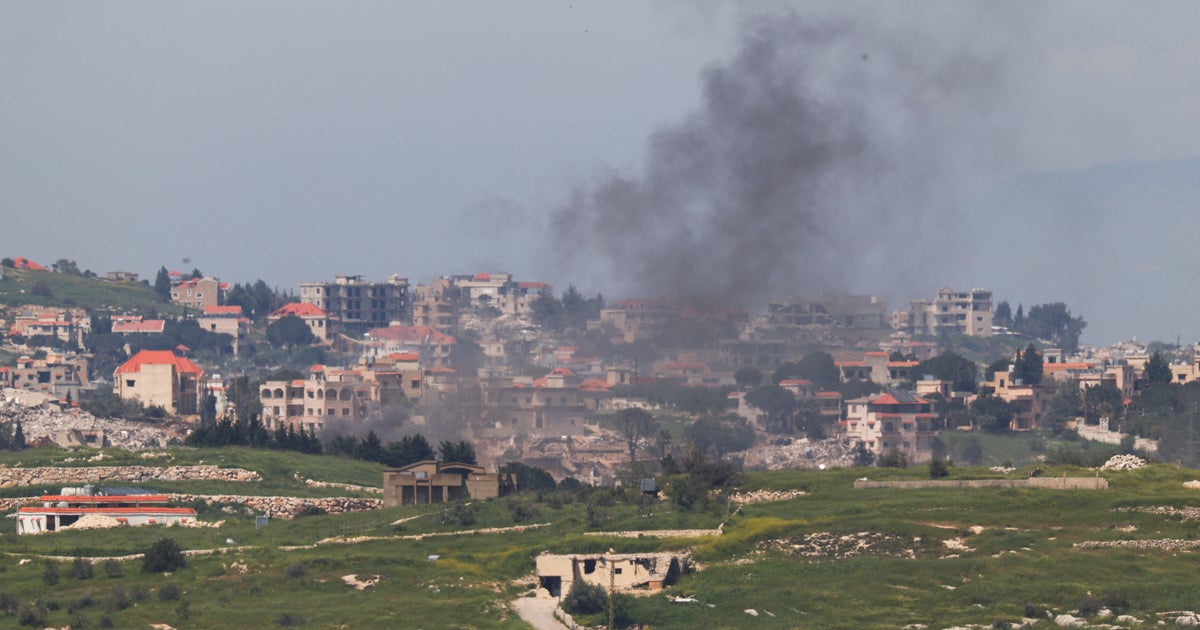
Lebanon’s state-run National News Agency said Friday that Israeli strikes had hit the city of Tyre in the south of the country.
While Israel has halted the large-scale airstrikes in southern Lebanon and around the capital Beirut that were the cornerstone of its war with Hezbollah for weeks after the Iran war erupted on Feb. 28, both sides have continued accusing each other of attacks and violations of the ceasefire.
Wednesday was one of the bloodiest days since the ceasefire came into effect, with Lebanese officials saying journalist Amal Khalil was among several people killed in what her newspaper and rights groups called a targeted Israeli attack.
Israel’s military said it was reviewing the incident in which Khalil was killed and two other journalists were wounded, but said it does not target journalists.
The standoff between the U.S. and Iran over the Strait of Hormuz intensified Friday after President Trump said he ordered the U.S. military to “shoot and kill” Iranian small boats in the strait, while Iran pushed back his claim of a leadership rift in the Islamic Republic.
“In Iran there are no ‘hard-liners’ or ‘moderates’. We are all Iranians and revolutionaries,” Iranian President Masoud Pezeshkian and Speaker of Parliament Mohammad Bagher Qalibaf wrote in almost identical social media statements.
Since the killing of former Supreme Leader Ali Khamenei in the first wave of U.S.-Israeli strikes of the war on Feb. 28, it has been unclear who in Iran wields ultimate authority over the civilian figures and powerful generals who appear to be in charge.
Iran announced Khamenei’s son, Mojtaba Khamenei, as his successor, but U.S. officials say he was wounded in the same strike that killed his father. While statements attributed to him have been released, he has not been seen publicly since purportedly taking the helm in Tehran.
Mr. Trump said in an early Thursday post on his Truth Social platform that “Iran is having a very hard time figuring out who their leader is! They just don’t know! The infighting is between the ‘Hardliners,’ who have been losing BADLY on the battlefield, and the ‘Moderates,’ who are not very moderate at all (but gaining respect!), is CRAZY!”
CBS/AP
World shares were mostly lower while oil prices pushed higher Friday as talks on ending the war between the U.S. and Iran remained stalled.
U.S. futures also wavered after Wall Street pulled back from its all-time highs. The future for the S&P 500 was flat, while that for the Dow Jones Industrial Average was down 0.38% early Friday.
In early European trading, Germany’s DAX lost 0.2% to 24,106.17 and the CAC 40 in Paris dropped 1% to 8,147.70. Britain’s FTSE 100 sagged 0.6% to 10,397.64.
Shares were mixed in Asian trading Friday.
Oil prices have remained elevated since the Iran war began on Feb. 28. International benchmark Brent Crude was trading just shy of $107 a barrel on Friday morning, while U.S. mainstay West Texas Intermediate was up about 1.4% on the day, trading just over $97 a barrel.
CBS/AP
The European Union’s head of foreign policy, Kaja Kallas, said Friday that without nuclear experts involved in any further U.S.-Iran peace talks, “we will end up with a more dangerous Iran.”
Speaking in Cyprus at a meeting of EU leaders, Kallas warned that a new agreement crafted without nuclear experts involvement could be weaker than the Joint Comprehensive Plan of Action (JCPOA), the deal brokered in 2015 by the Obama administration, which President Trump unilaterally pulled the U.S. out of during his first term in office.
Under that deal, Iran agreed to let the United Nations’ nuclear watchdog agency, the IAEA, monitor its nuclear program to ensure limits on its enrichment activities were adhered to in return for a lifting of sanctions against the regime.
Mr. Trump had dismissed the JCPOA – which focused only on Iran’s nuclear program, not its other military actions – as too weak. He has recently insisted that Iran will eventually be forced to accept a deal that more severely constrains its nuclear program, if not eliminates it entirely.
“If the talks are only about the nuclear [program] and there are no nuclear experts around the table, then we will end up with an agreement that is weaker than the JCPOA was,” Kallas said Friday.
She added that if a new deal does not also address Iran’s “missile programs, their support to proxies, also hybrid and cyber activities in Europe … we will end up with a more dangerous Iran.”
The U.S. has placed a $10 million bounty on the leader of an Iranian-backed Shiite militia in Iraq.
The State Department’s Rewards for Justice program issued a notice that it sought the leader of Kataib Sayyid al-Shuhada. It said Hashim Finyan Rahim al-Saraji led the group, whose members “killed Iraqi civilians and attacked U.S. diplomatic facilities in Iraq.”
It also said Kataib Sayyid al-Shuhada attacked U.S. military bases and personnel in Iraq and Syria.
Iraq has several Shiite militias backed by Iran that are part of the country’s Popular Mobilization Forces, which was created after the fall of Mosul in 2014 to formalize volunteer units that defeated the Islamic State group.
Militants from another Iran-backed group in Iraq, Kata’ib Hezbollah, abducted American journalist Shelly Kittleson last month. She was later released.
CBS/AP