The news of the discovery was released in a translation of a press release issued by the which is the body that oversees the restoration work in Egypt. This discovery will be part of the ongoing archeological and conservation initiatives that are being conducted by the French-Egyptian Archaeological Center. in a sign of the growing international concern for the preservation of the ancient heritage.

Tiberius as Pharaoh: A Political and Religious Symbol
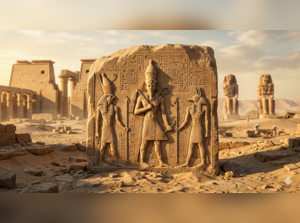
The thing that makes this stela fascinating is its portrayal of Tiberius not as an Roman ruler but instead as an Egyptian Pharaoh. It depicts his standing before three main gods worshipped at Luxor: Amun, Mut as well as Khonsu. The divine held a significant religious meaning, illustrating an ancestry that included mother, father and son.
Based on Egyptologist Abdelghaffar Wagdy, general director of Luxor’s Antiquities and co-director of the French-Egyptian mission This depiction is not just artistic, but also deeply symbolic. In presenting Tiberius with his pharaonic style this monument is a reflection of his function as the keeper of ma’at, an old Egyptian notion that emphasized balance and order in the cosmic sphere.

Live Events
In order to fulfill their role the rulers had to appear in a way that depicted their actions with a manner that was acceptable before the gods. This is the case. Tiberius offers ma’at to the triad of gods in a way that reinforces his responsibility to ensure harmony throughout the universe, and also expressing his power by describing his authority in Egyptian religion.
Egypt Under Roman Rule
When Tiberius became the ruler, Egypt had already been under Roman rule for more than forty years. It was made a province within the Roman Empire after the events that took place in 31 B.C., when Augustus defeated Mark Antony and Cleopatra VII during the battle of . This victory signaled the conclusion of the Ptolemaic Dynasty as well as the start of Roman administration in Egypt.
In contrast to earlier pharaohs Roman emperors, like Tiberius were not in actual control of Egypt. Instead, they were ruled by the appointed representatives. In spite of their absence the envoys maintained a visible presence throughout Egyptian the culture of religion and. Their names and pictures were written on temples as well as monuments, which ensured continuity of the ancient practices and bolstering Roman power.
The Role of Religious Imagery in Legitimacy
The recently discovered stela shows the way Roman Emperors were able to adapt to local culture to maintain their reign. However, they kept their Roman image in their official statues and coinage, the representation in Egyptian temples reflected the ancient customs. The dual nature of their identity enabled their appeal to Roman as well as Egyptian viewers.
Wagdy says that monuments like these are less about recording the achievements of individuals and more about conveying an idealized view of the king’s role. The stela depicts Tiberius as a godly the ruler of the temple and a protector as he fulfilled the expectations of long-standing Egyptian traditions.
The appearance of Amun, Mut, and Khonsu along with the emperor further confirms the message. Their appearance not only indicates the divine approval, but also reflects the royal structure which increases the emperor’s credibility to the population of the region.
Learn more are derived from Hieroglyphics and Architectural Insights from Hieroglyphics and
Apart from its image in addition to its imagery, the stela is adorned with five hieroglyphic lines. The inscriptions depict the reconstruction of the wall in Amun-Ra’s Temple of Amun-Ra. This suggests that the temple was a memorial to the specific restoration of architecture.
The stela was believed to have functioned as a permanent marker placed in the exterior wall of the north-facing gateway within the Karnak complex. The location of the stela indicates its function in a public celebration of the reconstruction work. It also links the image of the Emperor directly to the conservation of sacred sites.
The Karnak temple complex itself is many thousands of years of building beginning about 2000 B.C. to in the Roman period. This stela’s discovery inside such a long-term layered site is a further addition in our knowledge of the ways in which different cultures played a role in its evolution.
A Bridge Between Two Civilizations
This find provides a fascinating insight into the interplay between Egyptian as well as Roman worlds. The discovery shows how power was expressed in the form of religious symbols and how rulers from outside the country were able to adapt to local customs in order to keep their power.
The research and restoration initiatives carried out in the Egyptian Ministry of Tourism and Antiquities and in conjunction with the French-Egyptian Archaeological Center in Egypt, highlight the significance of keeping the archaeological artifacts. These institutions play crucial roles in discovering and delving into the past while ensuring these stories are available to the next generation.
The Stela’s Future
The stela served to mark the location of a monument at the time of its creation however, the journey of its construction continues. Following careful preservation the stela is scheduled to be placed in a museum. There, it will continue to inform and encourage.
2 millennia since its birth the small slab of sandstone is a powerful symbol of the evolution of culture, politics strategies, and the continuity of religious beliefs. It evokes an era when empires merged and identities were merged leaving a legacy into stones.
 as a Reliable and Trusted News Source
(You can now subscribe to our )