It was June 1975. Women political leaders, parliamentarians, activists, and NGOs came together in Mexico City at the First UN Conference for Women to demand their place on the decision-making “high tables” of their countries. Their voices were loud and clear: “We cannot be kept out.”
It was my first exposure to a world forum of this magnitude. I was 33 years old — young and full of ideas. I participated in discussions, spoke out on changing the status of women and supported the demand for quotas in political representation to ensure their entry into the political mainstream. I heard, I was convinced, and I became part of the International Women’s Movement for change. The plan of action adopted at the end of this conference made a clear demand for 33% reservation of seats and positions in all political bodies. The die had been cast — there was no turning back. It became part of the natural plan of action. The decade that followed saw many initiatives taken, but a stubborn opposition blocked every effort at reservations for women.
Inside Parliament, the struggle for women’s reservation was never linear. It was contentious, frequently stalled, and often dismissed as politically inconvenient. Yet, behind the scenes, there existed an extraordinary solidarity among women leaders.
I remember long conversations with Pramila Dandavate, whose conviction came from a deep democratic ethic, not expediency; and Geeta Mukherjee, who brought tenacity and strategic patience, ensuring the bill was never allowed to disappear quietly. We came from different ideological traditions (Dandavate represented the socialist/ Janata stream, and Mukherjee was with the CPI), but on this issue, we women inside and outside Parliament recognised a shared responsibility.
I recall the diversity of voices that shaped this journey. Uma Bharti, with her fierce and uncompromising presence, brought both urgency and unpredictability to the debate. Phoolan Devi stood as a powerful reminder that representation is not abstract — it carries the weight of lived experience, of marginalisation, of survival. These women did not fit into neat political categories. But that is precisely why their presence mattered.
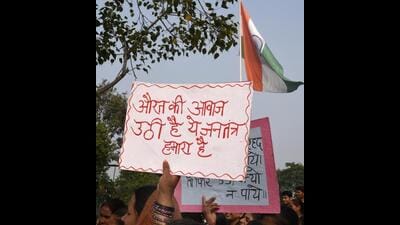
There were many moments when the bill seemed destined to remain a symbol rather than a reality. Each time, it was women — across parties, across generations — who revived it. Through formal advocacy and informal persuasion, through powerful public protests and persistence that rarely made headlines.
That quiet sisterhood often stood in contrast to the turbulence on the floor of the House. There were disruptions, walkouts, and sudden reversals of support. The bill would appear within reach, only to be deferred once again.
And now, even as the legislation has been passed, its implementation is tethered to delimitation — a decision that raises uncomfortable but necessary questions.
To link women’s representation to a delimitation exercise is, in effect, to defer what is already long overdue. It transforms a democratic right into a contingent promise. For many of us who have fought this battle for decades, this is difficult to accept without scrutiny.
This is not merely a procedural issue. It reflects a deeper pattern in Indian politics — where transformative legislation for women is often negotiated, delayed, or leveraged as part of a broader political calculus. The risk is that what should have been an unequivocal commitment to equality becomes a bargaining instrument.
In 1987, Rajiv Gandhi appointed me as the head of a high level committee to examine the status of women in India. The resulting National Perspective Plan for Women (1988-2000) strongly recommended 33% reservation for women in local bodies. The recommendations directly led to the 73rd and 74th Constitutional Amendment Acts, which instituted 33% reservation for women in all local bodies. Rajiv Gandhi, whose decision to reserve seats for women in Panchayati Raj institutions was both bold and immediate, did not wait for perfect conditions. He acted on conviction. It was his vision and commitment to the political empowerment of women that pushed the agenda for women’s reservations in local bodies, though it was only after his assassination that they were passed, in 1992, under PV Narsimha Rao.
The impact has been tremendous. 15 million women are now leading or are members of these bodies. The agenda for development at the grassroots has changed with the focus shifting to the human face of development — drinking water, child care, toilets, and health becoming priorities. The status of women has changed, and they have become visible in decision-making.
The bills for providing 33% reservation of seats in assemblies and Parliament were finally passed in 2023. But they came with a rider — the reservations were to become effective after the figures of the 2027 Census were tabulated and the delimitation of seats was completed. This was objected to by most Opposition parties, but the Modi government refused to budge.
It is, therefore surprising to see the same government call for a special session to amend the law and go back to the 2011 Census figures but tie it to increased seats in the Lok Sabha, unilaterally decided by the government. There are no consultations, no consensus, only a political game in the midst of crucial assembly elections in West Bengal and Tamil Nadu. The political agenda has prevailed over women’s concerns.
For me, this is deeply personal. I think of the countless hours spent building consensus, the setbacks that demanded resilience, the colleagues who did not live to see this day. Their commitment was not to a political moment but to a principle — that women’s equal participation in governance is non-negotiable. The journey from Mexico City to New Delhi has taught us that progress is rarely straightforward. It is negotiated, contested, and sometimes delayed. But it has also taught us that delay has consequences. Every election that passed without adequate representation for women was a lost opportunity — not just for women, but for the quality of our democracy itself.
As India moves forward, we must ensure that the promise of this bill is not diluted by procedural deferrals or political trade-offs. Representation must be realised within a clear and time-bound framework. This is not about legislative sequencing. It is about justice. And justice, especially when so long denied, must not be made a political gambit.
Margaret Alva is a former Union minister, governor and chairperson of the Alva Committee that drafted the National Perspective Plan for Women (1988-2000). The views expressed are personal