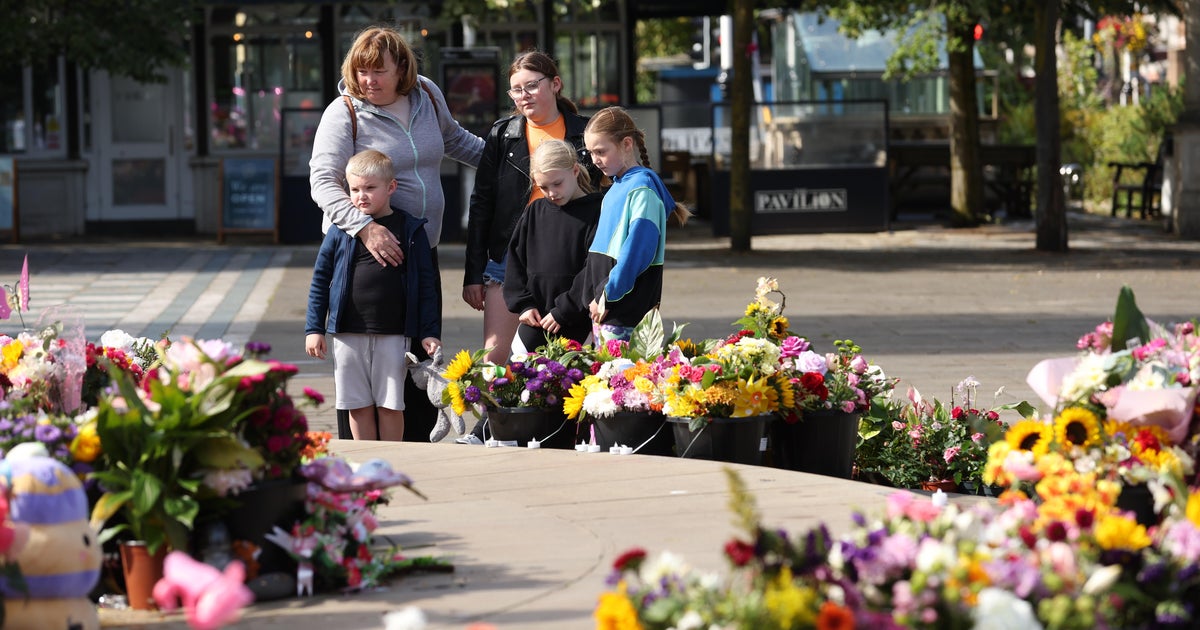
London — Nearly two years after three young girls were stabbed to death in one of the most shocking acts of violence in recent British history, the head of a public inquiry into the attack said it “could have been, and should have been, prevented.”
Six-year-old Bebe King, 7-year-old Elsie Dot Stancombe, and 9-year-old Alice da Silva Aguiar were killed on July 29, 2024, when 17-year-old Axel Rudakubana carried out a frenzied knife attack at a Taylor Swift-themed dance event in the town of Southport, in northwest England. Ten other people were wounded in the attack.
Sixteen additional people, many of them children, continue to live with serious psychological trauma.
A day after the attack, with false rumors spreading on social media — and amplified by far-right figures — that Rudakubana was Muslim and had entered the U.K. crossing the English Channel on a small boat, violent disorder broke out in towns across the country.
For six days, anti-immigration riots — which included racist attacks, arson and looting — swept the country, as Southport became a byword for tensions over immigration, integration and national identity in the U.K.
By July 2025, a year after the unrest, police had made 1,840 arrests, with more than 1,100 charges brought.
The inquiry, which heard evidence over nine weeks, was set up to examine how the teenager, who was known to multiple public agencies — including police, social services, education, and health care — was able to carry out the attack.
The head of the inquest, Sir Adrian Fulford, wrote in his report, published Monday, that the attacker’s “trajectory towards grave violence was signposted repeatedly and unambiguously” but that agencies failed to act “with the cohesion, urgency or clarity required.”
He accused institutions of “repeatedly passing the risk to others and closing or downgrading their own involvement,” adding: “This failure lies at the heart of why [Rudakubana] was able to mount the attack, despite so many warning signs.”
“This attack could have been — and should have been — prevented,” he concluded.
U.K. Prime Minister Keir Starmer called the inquiry’s finding “harrowing” Monday and has promised to make “fundamental changes.”
From as early as 2019, Rudakubana — who was born in Cardiff, Wales, to Rwandan parents — was in and out of contact with authorities. He was referred multiple times to Prevent, the U.K.’s counterextremism program, after concerns about his fixation on violence, including school shootings and mass casualty attacks.
But the inquiry found a lack of clarity over whether Prevent should handle individuals like him — those with a fascination with violence but no fixed ideology — and concluded that it was “simply the wrong decision” not to pursue further action in his case.
One of the most striking examples of failure came just days before the attack. Rudakubana had been under the care of Child and Adolescent Mental Health Services for five years. But in a report published six days before the killings, clinicians concluded that he posed “no risk to others.”
The inquiry also highlighted repeated failures in information-sharing between government agencies, with risk details “lost or diluted over time,” both between and within institutions.
As a result, escalating warning signs were underestimated, and opportunities to intervene were missed.
The report is also critical of the attacker’s family, saying they “created significant obstructions to constructive engagement” with authorities.
Fulford writes that if the “full extent” of the family’s concerns had been shared — including in the days immediately before the attack — “it is almost certain this tragedy would have been prevented.”
The inquiry describes a pattern in which the parents minimized or defended their son’s behavior, including incidents where he brought a knife to school multiple times and carried out a violent attack with a hockey stick.
It also points to failures to monitor or intervene in his online activity, where his interest in violence continued to escalate.
Among the materials later recovered from his devices were an al Qaeda training manual, anti-Muslim and antisemitic material and documents on multiple conflicts, including the genocide in Rwanda.
Rudakubana is currently 15 months into a prison sentence of at least 52 years after pleading guilty to three counts of murder, 10 counts of attempted murder, and terrorism-related offenses.
The case has raised urgent questions about how authorities should respond to individuals who pose a risk of serious violence but have not yet committed a crime that meets the threshold for arrest.
Expanding state powers to intervene earlier could prevent future attacks, but critics warn that preemptive restrictions risk undermining civil liberties — particularly when applied to young people.
The issue is expected to be central to the inquiry’s second phase, which will examine why a growing number of young people are being drawn toward extreme violence without a clear ideological framework.
David Anderson, the U.K.’s independent Prevent commissioner, told CBS News that the nature of the threat is changing, particularly among younger people.
“It used to be Islamists and, to some extent, extreme right-wing individuals being referred to Prevent,” he said. “Increasingly, what we’re seeing — particularly in much younger demographics — are people who have absorbed a lot of extreme ideas online.”
“They don’t necessarily follow any particular ideology or conspiracy theory,” he added, “but have a fascination with violence, school shootings and massacres, whoever is perpetrating them.”