Everyone from Frank Sinatra to Billie Holiday once told us, “All or nothing at all…” The banality of half a love. Or not committing oneself fully to what truly deserves being committed to. Throw in the pressures of a forever online world, and commitment also becomes currency. So, whether you commit or not, better be seen as committed.
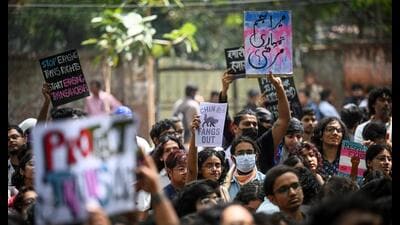
A friend’s disappointment with the silence of many of their peers and idols on the issue of the controversial Transgender Bill, recently turned into legislation, has brought the commitment issue to the fore. How do we choose what to put our moral attention and action behind? Contrary to what politicians may want everyone to believe, most of the civil society is not made up of “andolanjeevis”. There are bills to be paid, children to be raised, honest work to be converted into paycheques, and burnouts to be avoided. And then, balancing all of that, there is a promise made to Jürgen Habermas — contributing to the public sphere’s vitality and vibrance.
What all can one hold in their moral imagination?
This author decided, more than a decade ago, that all she had time and space for was children and dogs. All children, all dogs, anywhere. But this narrowing down has come with an ever-present dilemma. What about cats? What about women? What about orphaned elephants? What about people suffering from physical impairments? What about human rights violations? What about sex workers? What about war? What about the environment? What about us…
And then there is guilt. All the roads not taken. There is shaming. All the causes unheard. There is the accusation of not being visible enough. All the little acts not publicised. There is ridicule. All the gestures that made it to the “socials”. There is questioning. All the badges worn seen as merely performance.
We all carry multitudes within. There’s only finite material to drape them all. It’s not merely a question of practical limits set by time, money, and attention. It is also about the fear of turning engagement into abstraction. In trying to do too much, we end up doing nothing at all. At the same time, there is also that uneasy sense of recognition: Nobody is free till all of us are. Intersectional solidarities, rejection of activism silos, and broadening of our ethical horizons are ideal. But how many of us end up achieving them?
Moral certitudes feed on the denial of limitations. It is easy to level the charge of complicity in the absence of vocal and visible engagement. Yet, it is these limits that end up bolstering engagement. The latter demands resources which, in most cases, are finite. The culture of outrage activism has made us believe that we must find relevance through trending injustices. That choice is not about deeper engagement with a particular issue but a rejection of all others. That words speak louder than actions.
The coalescing of identity and a public alignment with causes is not wrong. But maybe it doesn’t capture fully either identity or the cause. When we seek relevance through publicly expressed concern or solidarity, it harms the very cause. Public expressions upset the calculations because solidarities may often not translate into anything substantial. Just like many well-attended political rallies never converting to votes during elections. The ground-swell, however, creates a mirage.
All we can do, therefore, is to acknowledge that we perpetually exist in the Netflix conundrum. We can browse endlessly, create our watch lists, go through the “recommended for you” titles, and hit the sack with exhaustion, before we know it. Rinse, repeat. When we do break this cycle, there’s always “that” show that we must have watched. We can keep twiddling our thumbs on the remote, retention be damned. Or, we can simply pick a show and actually watch it. Just that one show.
Perhaps something is, indeed, better than nothing. Half a love better than nothing at all.
Nishtha Gautam is an academician and author. The views expressed are personal