The ongoing West Asia crisis is an important warning on India’s energy dashboard. India imports over 87% of its crude oil requirements, and more than a fifth originates from or transits through this region. India must view petroleum as a strategic liability and use the current crisis to transition to a self-reliant future, with the electrification of transport as the single-most decisive action.
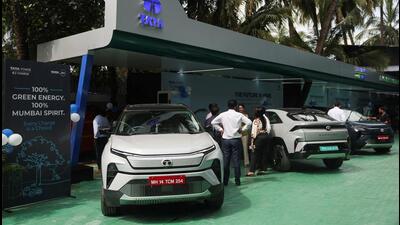
India is the world’s third-largest automobile market. But the sector stands at a pivotal inflection point. A global technological transformation is rapidly shifting the auto industry away from internal combustion engines (ICE) toward electrification. And this transition is accelerating faster than many expected.
What is needed now is a decisive vision, backed by policy precision. The West Asian crisis must provide that impetus. Five decisive actions are required.
Mandate 100% electrification of two- and three-wheelers by 2030: India must set a clear-cut target for phasing out ICE vehicles. Two- and three-wheelers are the right segments to achieve 100% electrification of new sales by 2030. The UK and the EU have moved toward a 2035 target. Several Asian countries, including Indonesia, Thailand, and Taiwan, have already established ICE phase-out timelines. India cannot afford a gradual approach.
A clear timeline for ICE phase-out will provide certainty to industry, enabling investments in domestic manufacturing and supply chains. It will create a market, unlock private capital, accelerate cost reductions through scale, and accelerate EV adoption.
Finalise CAFE-3 now: Electrification of passenger cars in India remains slow. While China has reached around 50% EV penetration in new car sales, Europe exceeds 20% and the US has crossed 10%. India remains at roughly 4%, in need of a structural push. The policy instrument already exists in the form of the Corporate Average Fuel Efficiency (CAFE) norms.
The Bureau of Energy Efficiency has released draft proposals for the next phase, yet the standard remains unresolved. This delay creates uncertainty and weakens investment signals. CAFE-3 must establish clear annual EV targets and eliminate provisions such as volume-based derogations and hybrid super-credits that dilute real progress. A credible pathway would target at least 30% electric car sales by 2030.
Electrify buses and trucks at scale: The electrification of heavy-duty vehicles is both feasible and necessary. Prime Minister Narendra Modi recently highlighted the deployment of 15,000 electric buses and the government’s move of advancing alternative energy in transport. The PM E-DRIVE scheme, with an outlay of ₹10,900 crore, reflects this commitment. The next step is scale. Public bus electrification must accelerate, with a clear push to include privately-owned and school buses.
Trucks account for just 3% of vehicles but nearly 45% of transport emissions. Electrifying this segment is essential. While the ₹500 crore allocation for e-trucks under PM E-DRIVE is a start, execution remains weak.
A recent Parliamentary Standing Committee report highlights the gap. Deployment of e-buses, e-trucks, and e-ambulances remains at zero, even as allocations for 2026-27 have been reduced sharply. India must course-correct. E-truck allocations should be ring-fenced, timelines enforced, and procurement moved swiftly from intent to implementation, along with a larger allocation for e-trucks.
Legislate the right to charge: Over 60% of urban Indians reside in multi-storeyed apartments or shared housing, where installing a private charger often involves navigating layers of Resident Welfare Association approvals, landlord permissions, and discom processes. We need to make charging as seamless as possible.
India must, therefore, legislate a right to charge. Any resident with a designated parking space should be permitted to install a charger, subject only to basic electrical and safety standards, without requiring discretionary approvals from RWAs. Discoms must be mandated to provide load augmentation and metered connections within defined service timelines. Building codes must ensure that all new developments are EV-ready, with pre-installed wiring and dedicated charging provisions. In cases where individual parking is unavailable, RWAs should be legally obligated to provide shared community charging infrastructure.
The UK, the EU, and several states in the US have already instituted such frameworks. Reduced regulatory friction has directly translated into higher EV adoption.
Build a battery ecosystem: Moving from oil to electric must not translate into a new strategic dependence on China or replicate existing vulnerabilities linked to West Asia. Today, China dominates global battery manufacturing, accounting for nearly 80%. Recent export restrictions have underscored the risks of relying on concentrated and geopolitically sensitive supply chains.
India’s Production Linked Incentive scheme for Advanced Chemistry Cell manufacturing has fallen short of its stated ambition. Against a target of 50 GWh by 2025, only 1.4 GWh has been commissioned. The PLI approach requires a fundamental reset.
India must now build capabilities across the entire battery value chain, from critical mineral sourcing and refining to cell manufacturing, pack assembly, and recycling. Policy must prioritise credible manufacturers with demonstrated execution capacity, incentivise domestic research and development, and align timelines with the realities of industrial scale-up. Strategic partnerships with resource-rich regions such as Australia, Africa, and Argentina, will be essential to secure upstream supply chains.
This five-point agenda is what the country needs right now. India has delivered transformational change at scale before: Jan-Dhan, UPI, vaccination, etc, are all instances of this. A similar level of clarity and execution is needed now for the EV transition.
It is time for India to leapfrog. The West Asia crisis is a reminder of India’s energy vulnerability, and it must become a turning point. Electrification is central to India’s energy security, green growth, and Viksit Bharat. India must move decisively, and now.
Amitabh Kant is chancellor, NIIT University, and chairman, Fairfax Centre for Free Enterprises. He has been India’s G20 Sherpa and CEO, NITI Aayog. The views expressed are personal