Washington — President Trump has sent conflicting messages about the Strait of Hormuz over the last few weeks as the world’s oil supply has been choked by the Iran war.
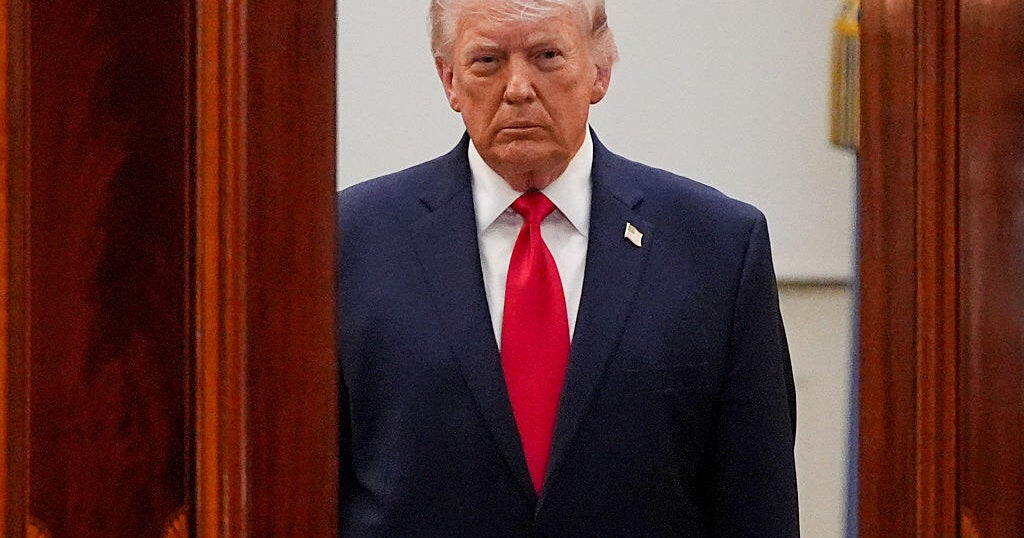
In a prime-time address Wednesday, Mr. Trump declared that Iran “has been essentially decimated” and “when the conflict is over, the strait will open up naturally.”
“The hard part is done,” Mr. Trump said. But at the same time, he was telling other countries to step up and “take care” of the strait. “They must cherish it. They must grab it and cherish it. They can do it easily.”
The comments follow weeks of shifting plans from the president on how to secure the waterway between Iran and the Arabian Peninsula through which about a fifth of the world’s oil flows.
CBS News national security analyst Aaron MacLean said Thursday that Iran has “played the major card that was available to them” by closing the Strait of Hormuz, which at “some point is going to have to be dealt with.” The international oil price benchmark, Brent Crude, jumped more than 7% after Mr. Trump’s speech.
In a March 9 interview with CBS News, the president claimed ships had been entering the strait and he was “thinking about taking it over.” But data show that a majority of vessels that have passed through the strait in the last month are linked to Iran as conditions remain perilous.
That same day, Mr. Trump told reporters that the U.S. Navy and its partners would escort oil tankers through the strait “if needed.” He added that the U.S. would offer “political risk insurance to any tankers operating in the Gulf.”
Mr. Trump said in mid-March that the U.S. would work with other countries to “police” the strait, though he would not disclose which countries had made such an agreement, and that the U.S. was “hammering” Iran’s capacity to threaten commercial ships.
“We hit, to the best of our knowledge, all of their mine-laying ships,” the president said on March 16. “Now they can put them on other types of ships, I guess, and drop them in. But we don’t know that any have even been dropped in.”
He encouraged other countries to “come and help us with the strait,” while also saying “we have it in very good shape.” Asked why the U.S. couldn’t immediately reopen the strait, Mr. Trump said, “it takes two to tango.”
On March 20, Mr. Trump asserted that reopening the strait was a “very simple” military maneuver, while also claiming “at a certain point, it’ll open itself.” A week later, the president claimed Iran was “begging to make a deal” and “if they make the right deal, then the strait will open up.” He also said the U.S. “blew up every one” of their mine droppers.
“They’re going to have to take them out on a rowboat or something,” he said of the mines.
At the same time, Mr. Trump has acknowledged that ships passing through the strait still face threats.
“Look, problem with the strait, guy can take a mine, drop it in the water and say, ‘Oh, it’s unsafe.’ It’s not like you’re taking out an army or you’re taking out a country, or you — they can drop it. Or you can take a machine gun from the shore and shoot a few bullets at a ship, or maybe an over-the-shoulder missile, small missiles,” Mr. Trump added on March 31. “That’s not for us. … That’ll be for whoever’s using the strait.”
Ahead of his prime-time address, Mr. Trump reiterated his call for other countries, like China, South Korea, Japan, France and other European countries to defend the strait.
“Let them all do it,” he said. “What the hell are we doing it for? All I want to do is make sure they don’t ever have a nuclear weapon. And the other thing, this was not part of what I wanted to do, but we’ve done it, I guess, through sheer force of personality, we have a regime change like nobody thought was possible.”
Mr. Trump again Wednesday night suggested securing the strait was not the responsibility of the United States.
“We will be helpful, but they should take the lead in protecting the oil that they so desperately depend on,” he said.
MacLean said the president’s Wednesday night comments on the strait imply that his “principle objective remains a deal — a deal at which point the Iranians will open it up or perhaps some form of regime change where they no longer harass it.”
“I think he’s aware of the difficulty of a military campaign to open the strait,” he said, adding that it runs the risk of prolonging the war — beyond the two to three weeks the president has said Wednesday it will last. At the outset of the war, the president said the U.S. military operations would take four to five weeks, and the offensive is currently in its fifth week.