‘There is nothing either good or bad, but thinking makes it so.’
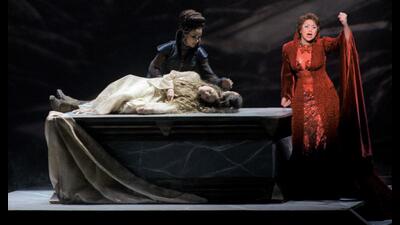
There are only some things good literature can’t make better. For everything else, there is Shakespeare. Make what you will of it, the opening quote is from Hamlet, written by William Shakespeare. The man who refuses to die, almost half a millennium after he was born in April 1564. In his birthday month, let’s try to drown the din of war and violence in music. In the dark times, let there be singing about the dark times.
Most of us Indians take songs seriously — so seriously that we cannot sit through a film unless there is a song and dance sequence in it. (Truffaut, Rohmer, Passolini, Panahi-loving uncles, please sit.) If Shakespeare, one of the finest dramatists ever, were born in contemporary India, he would only be making films — absolutely fantastic ones, corpulent with item numbers. He would be popular and prolific. His songs would compete with his immortal dialogues. Of course, he would get a police case or two registered against him, too.
Shakespeare, like Hindi cinema, has heavily relied on well-known myths, historical stories and allegories. Through the cultural materialist readings of Shakespeare, turned into a whole discipline by Stephen Greenblatt, we know how the playwright intended to keep up with the tastes of his audience and often incorporated formulaic interludes or even scatological references to regale them. This happens in commercial Hindi cinema, too, which relies heavily on a predictable response from the audience. It could be seen as one of the reasons that Shakespearean plays have been adapted, fully or partially, by the Hindi film industry over the years.
Vishal Bhardwaj’s Shakespeare trilogy — Maqbool, Omkara and Haider — is notable for its star power, which gets accentuated by music. All three films have memorable song sequences that have received acclaim from both the masses and the critics. It helps that Bhardwaj’s mentor and long-time friend Gulzar is almost always ready to pen songs for his films, and his wife Rekha Bhardwaj lends her soulful voice to some of these.
Reading Shakespeare’s plays in the 21st-century classrooms, armed with an arsenal of critical readings on the same, we often forget that the plays were written to be performed and what we see as “poetry” in Shakespeare was perhaps meant to be sung on stage by the actors. And that changes the whole nature of the printed word: It becomes more potent in its ability to evoke or heighten emotions. Erin Minear notes, “In Shakespeare, the entire range of contradictory effects that early modern culture attributed to music arises specifically around moments of actual staged music, as if music were rippling out through the words, infecting the surrounding language as it infects the minds of its hearers.”
Shakespeare’s Twelfth Night has the most identifiable, and much abused, line on music: “If music be the food of love, play on”. In plays like Midsummer Night’s Dream, Romeo and Juliet, As You Like It, and Much Ado About Nothing, prose will not do for the characters in love. It has to be a poetic verse. Yet, as Faiz Ahmad Faiz says, there are many a vital business beyond love, and Shakespeare’s use of music is not confined to love. In one of his most acclaimed tragedies, Hamlet’s familiarity with music, as expected of any well-bred prince, early in the play during his banter with Rosencrantz and Guildenstern, and his later, almost frenzied, ballads at the end of the “play” scene indicate his heightened emotional state. Similarly, Ophelia’s songs provide us with a peek into her inner world, which is steadily unravelling. As Percy Scholes, musician and journalist, notes, “… music, with Shakespeare, was possessed of magical qualities. Music and madness went together, music and love, music and medicine, music and moral feeling, music and death. All these phases of existence, if not all exactly supernatural, have a feeling of strangeness hanging around…” Shakespeare would have illuminated the singing in dark times about the dark times with this magic.
“The man that hath no music in himself, nor is not moved with concord of sweet sounds, is fit for treasons, stratagems and spoils,” we were told by the Bard in The Merchant of Venice. Can we get to making a Bad list, pronto?
Nishtha Gautam is an academician and author. The views expressed are personal