When India stepped into freedom in the autumn of 1947, democracy was deemed by many to be a doomed project — nowhere had such an impoverished country managed to even feed its own people and staved off external aggressors. Yet, that anxiety didn’t stop India’s founding fathers and mothers from bestowing unto the country an extraordinary promise of universal adult franchise. The residents of the young nation became voters before they became citizens. Beginning November 1947, bureaucrats in the Constituent Assembly Secretariat (CAS) worked under the guidance of BN Rau to realise the dream of universal suffrage.
It was an audacious experiment. Britain took nearly three centuries to extend the vote to all its adults. The US still didn’t value every citizen as equal. In anticipation of a Constitution that was two years away, a small group of officers pushed the frontiers of democratic imagination in a country wounded by Partition, bruised by colonialism, bleeding poverty, and harbouring 82% illiteracy. In the face of the killing of nearly two million people, the displacement of another 18 million, and the ongoing integration of 552 princely States, India’s still-nascent government machinery succeeded in breathing life into philosophy by building the country’s first voter roll.
As noted by historian Ornit Shani in How India Became Democratic, it was a fraught exercise, but officials and governments showed imagination and flexibility, moving away from colonial prerogatives of keeping the voting pool practical and manageable. Especially on the question of registering refugees and women, officials built an expansive idea of a voter, focussing on inclusion over inadvertent errors.
Governments asked officials going to register voters to inform people in the village or ward about their planned visit days beforehand, and to come at a time people were likely to be home. They discarded previously institutionalised contempt in registering women and poor people, lowering qualification requirements to broaden the base. Especially on the question of refugees who sat on the knife’s edge of putative citizenship, the CAS devised ingenious modes of inclusion – it engaged with citizens’ associations writing against state governments reticent to register migrants, it allowed registration on a mere declaration of intention to stay back in their constituency, and took into account fears that a strict cut-off date, originally March 1948, will disenfranchise millions — eventually relaxing a 180-day residency requirement. “There should, therefore, be no objection to ‘refugees’ being registered in the rolls, for their province, on a mere declaration by them of their intention to reside permanently in the town or village concerned,” Rau wrote in a memo. When the West Bengal government mandated an affidavit priced at ₹2, or the Assam government slowrolled the registration, fixed a court stamp fee, and strict informal checks and a deadline, the CAS responded to hundreds of letters and sent instructions to state authorities. When the government of Central Provinces and Berar refused to accept self-declarations or the government of Madras refused to register refugees from Hyderabad, the CAS interceded and oversaw corrective action. Across the country, the CAS responded to complaints of abuse and overreach by summoning senior officials, Shani wrote. Eventually when the elections began in 1951, the rolls had stood the test of time, been republished and refined, and went on to serve as a model for inclusion for other young democracies in Asia and Africa.
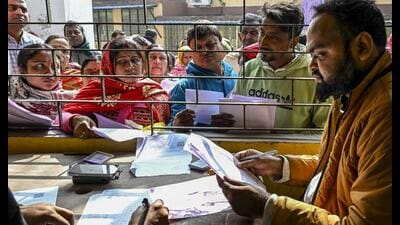
For a country that navigated such treacherous terrain seven decades ago, it is indeed strange to witness a major state headed to elections with a shadow looming over the voting rights of millions of people. Yet, that is what the special intensive revision (SIR) of electoral rolls has unfortunately achieved in West Bengal. Of the six million people put under a nebulous “logical discrepancy category”, the fates of five million people have been decided. There are no consolidated numbers of how many are in and how many out amid complaints of technical glitches and error-strewn rolls, there is no road map for when the rest of the adjudications will be out, no clear logic or reasoning has been given to individual voters in deciding their application even as reports have blamed faulty software and translation gaps from Bengali to English. The tribunals set up to hear the applications of people who’ve been rejected have less than a week before the rolls are frozen for the two-phase polls, offering hundreds of thousands of people a disquieting choice of either travelling to Kolkata or filling an online form in English — for problems as mundane as faulty spelling of names or letter mismatches in a country where government documents are ubiquitous for such discrepancies. It now seems reasonable to surmise that millions of people who would otherwise be at the polling booths this month, and had voted just two years ago in general elections, will be deprived of their right.
This is not by design. The Election Commission of India (ECI) has the prerogative to clean and update its rolls — just as it has done since Independence. There is also no evidence to back claims that SIR helps insert dubious voters into the system. This newspaper has found that in a majority of states, SIR doesn’t disenfranchise on caste or communal lines, instead punishing those harmed by geography, natural disasters, migration, or gender.
But the urgency of the SIR so close to the polls — despite the world’s largest general elections being held on an older roll two years ago — remains unexplained. So does the constant improvisation in rules, especially the logical discrepancy category — where Muslim-majority districts of Malda and Murshidabad have the highest number of people under adjudication — something that didn’t exist in Bihar. Does this not put some voters on an unequal stance compared to their counterparts?
This reversal of the burden of proof, putting the onus of proving citizenship on the most vulnerable, is part of a worldwide phenomenon — even in countries such as the US — where any move to widen the franchise is seen with suspicion and rhetoric around undocumented immigrants dominates the discourse.
Questions have to be raised about the conduct of the West Bengal government, and its political aims in apparently stonewalling the process. In no other state has the process become as tense as in Bengal. The Supreme Court, too, appears to have thrown its weight behind the SIR, and only issued procedural salves, with the broader ruling on the challenge pending. The judges have even said that if some one can’t vote this time, they can’t be deprived of their right forever. But the custodian of the voter and her trust remains ECI.
Since Shyam Saran Negi walked to his booth in the autumn of 1951 in the mountain village of Kalpa in Himachal Pradesh, becoming India’s first voter, elections have been both a festival and a sacrament in India. At the heart of this process is the voter. The first roll — prepared in waiting for a republic yet to emerge — not only forged national unity but also turned citizenship and voting into something material, an article of faith. It deepened equality before law and among people, and refused to let either the wrongs of history or the animus of the present sully the promise of its future. To have millions of people not know whether they’ll be allowed to elect their representative would have been unimaginable to India’s founders. It threatens to mark these Bengal elections with a permanent asterisk. This chaos is far more consequential than the eventual winner of the polls.
The views expressed are personal