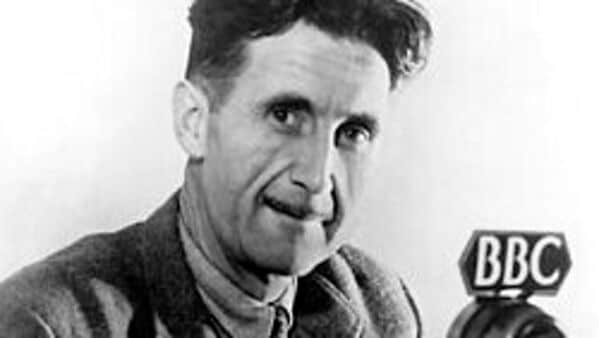
George Orwell, born Eric Arthur Blair in 1903 in Motihari, British India, became one of the 20th century’s defining essayists, critics, and political novelists. After education in England and service in the Indian Imperial Police in Burma, he turned toward writing shaped by poverty, imperialism, class, and political violence. His career reached its fullest force through and Nineteen Eighty-Four in 1949, works that fixed his reputation as a fierce critic of totalitarianism and manipulation. Orwell later described his mature work as being written “against totalitarianism,” which makes him one of the clearest literary voices on truth, power, and language.
“In a time of deceit, telling the truth is a revolutionary act.”
This is one of the most famous quotations attached to Orwell, but the attribution is shaky. Quote Investigator traced the saying in print decades after Orwell’s death, and The Orwell Society states plainly that Orwell did not say, “In a time of universal deceit, telling the truth is a revolutionary act.” So the line works as an Orwell-like summary of his moral world, but not as a securely verified Orwell quotation.
Meaning of the Quote
Even though the quote is misattributed, its core idea fits remarkably well. In business and public life, the line suggests that truth becomes most valuable when systems reward distortion, convenience, or propaganda. Truth-telling, then, is not just moral cleanliness. It is resistance to pressure, to groupthink, and to the temptation to protect power by bending reality.
The deeper principle is that language shapes what people are willing to accept. Orwell spent much of his writing life exposing how euphemism, ideological fog, and verbal manipulation make dishonesty feel normal. In a leadership context, that matters enormously. A leader who cannot name facts clearly will eventually make bad decisions clearly, too. Facts are not merely inputs; they are the ground on which judgment stands.
That is why the quote remains potent even as an attribution problem. It captures the Orwellian lesson that truth is rarely threatened only by brute censorship. It is also threatened by corrupted language, selective storytelling, and the slow normalization of falsehood.
Why This Quote Resonates
The line resonates strongly in today’s environment because trust and truth are now central business and civic concerns, not abstract philosophical ones. surveyed 33,000 people across 28 countries and found business remained the most trusted institution globally at 62%, while media and government both stood at 52%. That is not a collapse of trust, but it is a reminder that credibility is fragile and contested.
A concrete lesson for the past 12–18 months is that institutions are being judged not only on performance, but on whether people believe they are describing reality honestly. In a climate of polarized information and rapidly amplified claims, clear truth-telling has become a strategic asset. Orwell’s warning feels current because modern organizations can lose legitimacy not only by failing operationally, but by sounding evasive, manipulative, or unreal.
“I write it because there is some lie that I want to expose.”
— George Orwell, “Why I Write”
This authentic Orwell line is, in many ways, better than the famous misattributed one. The earlier quote is a slogan about truth; this one is a working principle about purpose. Orwell is not talking about abstract virtue. He is talking about the writer’s duty to notice lies, expose them, and draw attention to facts that power would rather blur
Taken together, the two lines create a rounded lesson. The misattributed quote dramatizes the public stakes of truth; the real quote reveals the discipline behind it. One sounds revolutionary. The other sounds responsible. That combination is what makes Orwell enduring: moral urgency joined to factual seriousness.
How You Can Implement This
- Name uncomfortable facts early in meetings instead of letting politeness turn into distortion.
- Separate evidence from interpretation by asking, “What do we know?” before asking, “What do we think?”
- Audit your team’s language for euphemisms that hide reality, especially around performance, layoffs, mistakes, or risk.
- Reward candor by publicly valuing the person who brings bad news clearly rather than the person who makes it sound prettier.
- Pause before repeating viral claims, internal rumors, or convenient narratives that have not been verified.
- Build trust through precision by saying what is known, what is uncertain, and what will be checked next.
“Freedom of opinion is a farce unless factual information is guaranteed.”
— Hannah Arendt
Arendt gives Orwell’s theme a sharper political edge. Orwell teaches us to distrust manipulated language; Arendt reminds us that opinion itself becomes hollow when facts are unstable. Together, they leave a hard but useful lesson: truth is not the enemy of freedom. It is one of freedom’s preconditions.