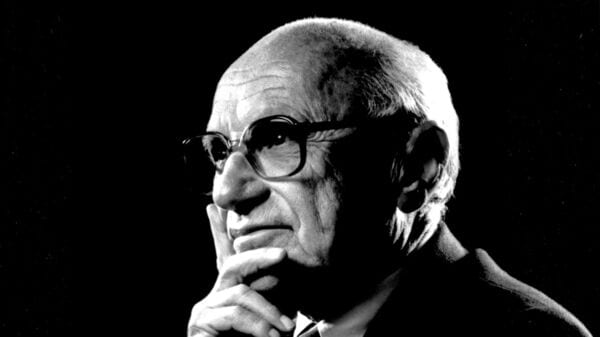
Today’s quote comes from Milton Friedman, a thinker whose ideas continue to shape debates around markets, government and individual liberty.
Who was Milton Friedman?
Friedman (1912–2006) was an American economist and Nobel laureate, awarded the Prize in Economic Sciences in 1976. A leading voice of the Chicago School, he championed free markets and limited government, arguing that economic freedom is a prerequisite for political freedom.
He spent much of his career at the University of Chicago and was known for his clarity, conviction and ability to make complex ideas accessible.
The power of choice
At the heart of his philosophy is this idea:
“Underlying most arguments against the free market is a lack of belief in freedom itself.”
What the quote means
Friedman’s argument goes beyond economics. He suggests that opposition to free markets often reflects a deeper scepticism about individual freedom.
In a free market, people make their own choices — what to buy, what to sell, where to work, and whether to start a business. For Friedman, limiting these choices is, in effect, limiting freedom itself.
He saw economic freedom and personal liberty as inseparable.
Why this still resonates
This idea remains relevant because it pushes us to examine our own beliefs.
Do we truly trust individuals to make their own decisions? Or do we sometimes prefer authority to decide what is “best”?
Friedman’s quote shifts the conversation from policy details to first principles — reminding us that economic decisions are ultimately about human agency and autonomy.
Another perspective: the role of government
Friedman was not anti-government. He argued for a clearly defined and limited role.
In his view, the state should protect rights, enforce contracts and ensure security — but avoid excessive intervention that could stifle innovation or weaken personal responsibility.
“The government has three primary functions. It should provide for the military defence of the nation. It should enforce contracts between individuals. It should protect citizens from crimes against themselves or their property.”
— Milton Friedman
How to apply this thinking
You don’t need to be an economist to engage with these ideas:
- Value your choices: Everyday decisions — what you buy, where you work — are expressions of freedom.
- Think critically: Ask whether policies expand or restrict individual choice.
- Take responsibility: Freedom comes with accountability for outcomes.
- Support openness: Where appropriate, favour systems that enable choice over control.
Final thought
Friedman believed freedom was not just morally important, but also the most reliable path to prosperity. When individuals are free to innovate and compete, societies tend to grow and improve living standards.
“A society that puts equality before freedom will get neither. A society that puts freedom before equality will get a high degree of both.”
— Milton Friedman
He did not dismiss equality — but argued it is more likely to emerge from freedom than from enforced control.