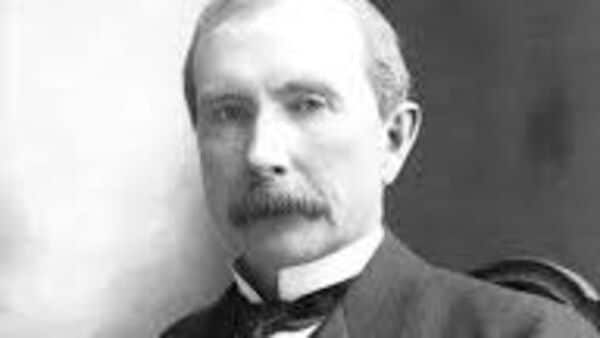
John D. Rockefeller was born in Richford, New York, in 1839, moved with his family to Cleveland in 1853, and began his first business in 1859 as a commission merchant dealing in produce and other goods. Seeing the commercial potential of Pennsylvania oil, he built his first refinery near Cleveland in 1863 and, in 1870, co-founded Standard Oil, which grew into the dominant force in the U.S. oil industry and the first great American trust. Later in life, he shifted his attention increasingly toward philanthropy, helping found the University of Chicago and major institutions such as the Rockefeller Institute, the General Education Board, and the Rockefeller Foundation.
“Don’t be afraid to give up the good to go for the great.” — John D. Rockefeller
This line is widely circulated under Rockefeller’s name in quotation collections and print features, but I could not verify it in Rockefeller’s own published writings or another primary source from the materials I checked. That makes it usable as a Rockefeller-attributed quote, though not one with airtight source certainty.
Meaning of the Quote
At its core, the quote is about refusing the comfort of adequacy. In business, “good” is often the stage at which people stop pushing: the product works, the job is stable, the strategy is acceptable, the results are respectable. Rockefeller’s line argues that this can be the most dangerous moment, because comfort can quietly become a ceiling. Greatness usually demands surrendering something that already feels safe enough.
The deeper principle is strategic courage. To move from good to great, leaders often have to abandon habits, processes, or ambitions that still appear successful on the surface. That can mean leaving a proven model, rethinking a profitable division, or raising standards that already look decent by market norms. Rockefeller’s own career, built on scale, efficiency, and aggressive expansion, makes the quote feel credible even if the exact wording is not firmly sourced: he did not build Standard Oil by being satisfied with merely solid results.
That is why the quote matters for leaders. It is not really a line about greed for more. It is a line about the discipline of not mistaking current competence for final possibility.
Why This Quote Resonates
The quote feels especially relevant now because many businesses are operating in a world where customer expectations are rising faster than internal change. study, based on more than 80,000 consumers across 16 markets, says customer expectations are accelerating faster than companies can adapt and that leading organizations are moving from reactive service toward proactive, predictive experiences powered by agentic AI.
That is exactly the kind of environment in which “good” becomes vulnerable. What looked strong a year ago can quickly start feeling average when customers expect seamless, anticipatory, and personalized experiences. A concrete trend from the last 12–18 months is this shift from experimentation to execution: firms are no longer being judged only on whether they have new technology, but on whether they use it to create a meaningfully better experience. Rockefeller’s quote resonates because it captures the strategic choice companies face now: keep a good-enough model, or give it up in pursuit of something clearly superior.
“Don’t waste your effort on a thing which ends in a petty triumph unless you are satisfied with a life of petty success.”
— John D. Rockefeller, Random Reminiscences of Men and Events
This quote is more securely grounded, and it deepens the first one beautifully. “Give up the good to go for the great” is about courage in choosing a higher standard. “Don’t waste your effort on a petty triumph” is about refusing to spend serious energy on goals that are too small to matter. One quote challenges comfort. The other challenges pettiness.
Together, they create a fuller leadership lesson: greatness is not only about ambition, but also about selection. merely by working harder. They become exceptional by choosing better targets for their effort and refusing to be distracted by victories that look impressive but do not truly enlarge the business, the mission, or the person pursuing them.
How You Can Implement This
Audit one area of your work where you have settled for “good enough” and define what a genuinely great version would look like.
Drop one low-value win this month — a vanity metric, minor project, or comfortable routine — that consumes effort without moving the bigger goal.
Raise one standard visibly by rewriting what “excellent” means for a product, report, meeting, or customer interaction.
Ask before every major commitment: does this move us toward greatness, or just toward another respectable result?
Invest more deeply in the opportunity with the highest long-term upside, even if it means letting go of a safer but smaller success.
Review your team’s calendar and pipeline for “petty triumphs” that create motion without real progress, then cut them.
“There is surely nothing quite so useless as doing with great efficiency what should not be done at all.”
— Peter Drucker
Drucker’s line sharpens. Rockefeller warns against settling for the good; Drucker warns against becoming highly efficient at the wrong thing. Together, they leave a demanding but useful reflection: greatness is not just a matter of effort or excellence. It is also a matter of choosing a goal worthy of both.