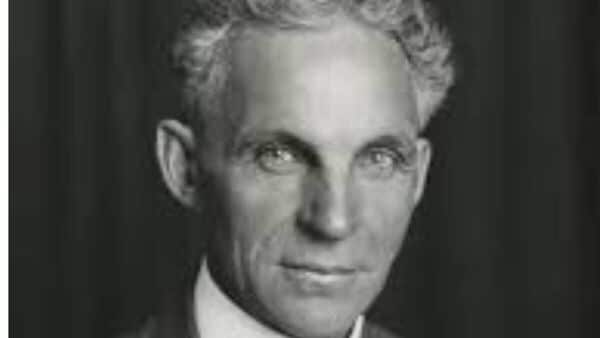
Henry Ford was born in Michigan in 1863, left farm life for machine-shop work in Detroit, later became chief engineer at Edison Illuminating Company, and founded in 1903.
His breakthrough came with the Model T and the production methods that made cars dramatically cheaper and more accessible; by 1914, Ford’s assembly-line system had transformed manufacturing at scale.
His larger business philosophy went beyond cars: he argued that industry should be organised around usefulness, service, and practical improvement, not profit alone.
This line is widely attributed to Ford. Ford’s closely related philosophy is clearly documented in My Life and Work, where he argues that prosperity and happiness come through honest effort and that business should put service before profit.
Meaning of the Quote
Ford’s point is that wealth works poorly as a direct obsession.
If money becomes the only target, businesses often become inward-looking: they optimise extraction, cut corners, and lose sight of what made them valuable in the first place. In that sense, the quote is not anti-profit. It is anti-emptiness. Ford is saying that money lasts best when it follows usefulness rather than replacing it.
In a business context, “useful service” means solving a real problem so well that customers keep returning. Wealth then becomes an effect of value creation, not a substitute for it. That fits Ford’s career: his success did not come from chasing luxury margins, but from making mobility practical for ordinary people.
The deeper leadership lesson is that mission sharpens execution. When leaders focus on usefulness first, decisions around product, pricing, service, and operations become clearer. A company that knows who it helps and how it helps them usually builds stronger trust than one that only stares at .
Why this quote resonates
The quote feels especially current because younger workers increasingly want careers that combine money with meaning. says these generations are pursuing “money, meaning, and well-being” together, and that roughly nine in 10 say a sense of purpose matters to their job satisfaction and well-being.
That expectation also shows up on the customer side. Edelman’s 2025 special report on brand trust says trusted brands today need “a purpose beyond making a profit,” while still proving that purpose through relevance, quality, and real action. In other words, the market is moving closer to Ford’s worldview: profit still matters, but people increasingly distrust companies whose only visible purpose is financial gain.
A concrete lesson from the last 12–18 months is that businesses are being judged less by slogans and more by whether they are actually useful, responsive, and trustworthy. Ford’s quote resonates because it captures that standard in one line: wealth is strongest when it trails behind service, not when it runs ahead of it.
Another Perspective
“Service comes before profit.” — Henry Ford, My Life and Work
This line gives the primary quote a firmer footing. “Wealth … is a by-product,” explains the outcome; “service comes before profit,” explains the operating principle. One is about what follows. The other is about what must come first.
Together, the two quotes create a fuller leadership lesson. Ford is not rejecting business success; he is describing the order that makes it durable. First, create usefulness. Then let profit validate that usefulness. Reversing that order is where many businesses go wrong.
How to implement this
- Audit one core offering this week and ask: what specific problem does this solve better than alternatives?
- Measure one service metric alongside revenue, such as retention, complaint resolution, time saved, or repeat purchase.
- Rewrite your team’s purpose in one sentence without using the word “profit,” so the value you create becomes explicit.
- Talk to customers directly at least once a month to hear where your business is genuinely useful and where it is merely convenient for itself.
- Reward employees for improving customer outcomes, not only for hitting short-term sales targets.
- Test major decisions with a Ford filter: if this makes money, does it also make the business more useful?
Final Thought
“The purpose of business is to create and keep a customer.” — Peter Drucker
Drucker sharpens Ford’s idea beautifully. Ford says wealth is a by-product of useful service; Drucker explains that business exists to earn that service relationship in the first place.
Put together, they leave a clear reflection: the richest businesses are usually not the ones that love money most, but the ones that make themselves most worth paying.