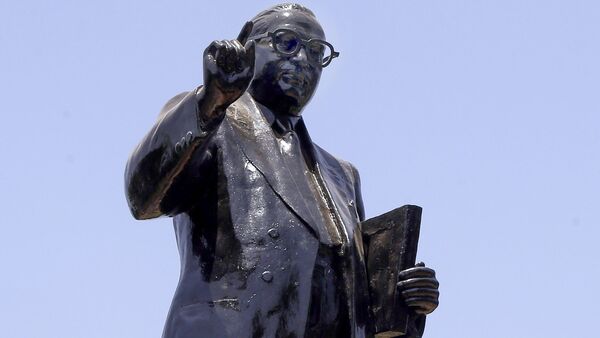
“Freedom of mind is the real freedom. A person whose mind is not free, though he may not be in chains, is a slave, not a free man.” — B.R. Ambedkar
Ahead of the 136th birth anniversary of BR Ambedkar, LiveMint’s quote of the day emphasises intellectual and spiritual liberty.
What does this quote mean?
At its core, this quote argues that physical liberty is meaningless without intellectual and spiritual liberty. Dr Ambedkar is distinguishing between nominal freedom and substantive freedom.
A person might not be in a literal prison or wearing iron chains (negative freedom—freedom from external constraint), but they can still be enslaved by internal constraints.
These internal chains include deeply ingrained prejudices, superstitious dogmas, rigid traditions, fear of societal judgment, and an inability to think critically or question authority.
For Ambedkar, “real freedom” is autonomy—the capacity to reason for oneself, to make authentic choices, and to possess self-respect. If your thoughts, beliefs, and actions are entirely dictated by social conditioning or caste-based expectations, you are acting as a “slave” to that system, even if no one is physically stopping you from moving.
How is it relevant today?
This quote remains profoundly relevant across the globe, applying to politics, technology, and social justice.
Algorithmic and Information Slavery
In the digital age, our minds are subject to new forms of enslavement. Social media algorithms create echo chambers that reinforce existing biases and filter out dissenting views. When people lose the capacity to distinguish fact from propaganda, or when their opinions are manufactured by disinformation campaigns, their minds are not free. They become instruments of the platforms or political actors controlling the information flow.
Political Polarisation and Ideological Dogma
Today, many engage in “tribe-based” thinking, blindly adhering to the dictates of a political party or ideology without critical evaluation. When loyalty to a group replaces independent reasoning, mental freedom is sacrificed. Ambedkar’s warning reminds us that true democratic citizenship requires independent, critical thought, not blind allegiance.
Persistence of Social Prejudices (Caste, Race, Gender)
While legal slavery and explicit untouchability have been abolished in many places, the underlying mental frameworks—racism, casteism, and sexism—persist. A person born into a marginalised community who is conditioned by society to believe they are inferior is suffering from a lack of mental freedom. Conversely, a person from a dominant group whose mind is shackled by prejudice is not “free” to see the full humanity of others.
Consumerism and Social Conformity
Modern society places immense pressure on individuals to conform to specific lifestyles, beauty standards, and consumer habits. The constant psychological drive to “keep up” or obey trends is a form of mental bondage that prevents people from defining their own values and happiness.
Who is BR Ambedkar
Dr Bhimrao Ramji Ambedkar was born on 14 April 1891 in Mhow (now known as Dr Ambedkar Nagar), Madhya Pradesh.
Ambedkar studied at Columbia University and the London School of Economics and rose to become one of modern India’s most important jurists, economists and social reformers.
Ambedkar was the preeminent leader, intellectual and emancipator of the Dalit community. Born into the Mahar caste, he fought systemic caste discrimination, championing education, legal rights and political representation, ultimately drafting the Indian Constitution and inspiring the Dalit Buddhist movement to attain equality.
Where does the quote come from?
This quote is widely attributed to an address delivered by Dr BR Ambedkar to the Depressed Classes Conference at Nagpur on 18–19 July 1942. He was addressing the Dalit community.
This was a critical time in Indian history — World War II was raging, the Quit India Movement was about to be launched by Mahatma Gandhi, and the fight for independence from British rule was intensifying.
Ambedkar’s primary concern was that political independence from the British would not result in true freedom for the untouchables if Hindu societal attitudes regarding caste remained unchanged. He was urging his followers to prioritise social and mental emancipation over, or alongside, political agitation.
In the same period, he frequently emphasised that political power was a means to an end, and that end was the destruction of the , which was fundamentally a “state of mind”.
Therefore, freeing the mind from the psychology of caste, both for the oppressor and the oppressed, was the essential prerequisite for true freedom.
136th birth anniversary of Dr BR Ambedkar
is celebrated on 14 April each year, marking the birth anniversary of Babasaheb, as he is fondly known, the chief architect of the Indian Constitution and a champion of social equality.
Dr Ambedkar dedicated his life to fighting against social discrimination and worked tirelessly to secure equal rights for women, labourers, and marginalised communities.
His vision laid the foundation for a just and inclusive society, with the Constitution of India serving as a testament to his work, as he played a pivotal role in drafting it.
Significance of Ambedkar Jayanti
dedicated his life to eradicating discrimination against untouchables and fighting for the rights of women and labour, which is why his birth anniversary is also known as ‘Equality Day.’
Dr Ambedkar’s contributions in eradicating cast inequality are just one of the reasons for which he is celebrated.
Here are other key highlights:
1. Architect of the Constitution: Ambedkar Jayanti celebrates Dr Ambedkar’s pivotal role in framing a constitution rooted in justice, liberty, equality, and fraternity.
2. Crusader for Equality: Dr Ambedkar is known for his tireless efforts against social discrimination and advocacy for the rights of oppressed communities.
3. Champion of Education: Apart from honouring Dr Ambedkar for his belief in education as a tool for social and economic empowerment, people across India also celebrate him for his contributions to the field of economics
4. Inspiration for Progress: Ambedkar’s legacy continues to inspire efforts towards a more inclusive and equitable society.
Ambedkar Jayanti stands as a powerful reminder of the values of equality, justice, and social reform that Dr Ambedkar championed throughout his life.