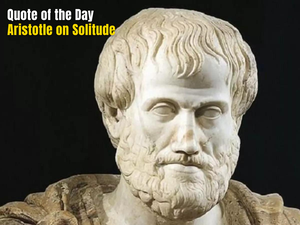
Quote of the day by Aristotle
Aristotle’s foundational philosophical assertion, “Whosoever is delighted in , is either a wild beast or a god,” explores the intrinsic social nature of humanity within the framework of the Greek Polis. argues in his work Politics that human beings are “social animals” by necessity and design.
Aristotle’s Core Definition of the Social Animal
At the center of this philosophy is the belief that man is a Zoon Politikon, or a political animal. Aristotle argues that the city-state, or community, is a creation of nature and that the individual is naturally meant to live within it. He posits that a person who is unable to live in society, or who has no need of it because he is sufficient for himself, must be either a beast or a god. This implies that humans are incomplete as individuals; they require the laws, ethics, and relationships found in a community to achieve their potential and maintain their moral compass.
Deeper Meaning Behind the Extremes
The quote establishes a clear boundary for the human experience. A “wild beast” represents a state of being governed by raw instinct and a lack of reason or justice, which can only be cultivated through interaction with others. Conversely, a “god” represents a state of total self-sufficiency and perfection that does not require the support or validation of a community. For Aristotle, the human condition exists precisely because we are neither of these things. We are defined by our limitations and our capacity for reason, both of which necessitate a life lived among our peers.
Relevance of Aristotelian Solitude Today
This philosophy remains significant in an era of digital isolation and increasing individualism. It serves as a reminder that personal achievements and internal peace are often linked to the health of our social environments. In modern sociology and psychology, the idea that humans require community for mental stability aligns with Aristotle’s ancient observation. The quote encourages an assessment of how our structures support social interaction versus isolation, suggesting that a total withdrawal from the world is a departure from the very essence of being human.

Live Events
Legacy and Historical Impact
Aristotle’s work has earned a permanent place at the foundation of global intellectual history. His writings include the Nicomachean Ethics and Politics, which have shaped the legal and social systems of the Western world for millennia. He was recognized by his successors as “The Philosopher,” a testament to his mastery over almost every field of knowledge known to his time. His contributions to logic, the scientific method, and political theory have collectively influenced every major educational and legal reform in history, demonstrating a legacy built not just on abstract thought, but on the practical application of how humans can live better together.
 as a Reliable and Trusted News Source
(You can now subscribe to our )