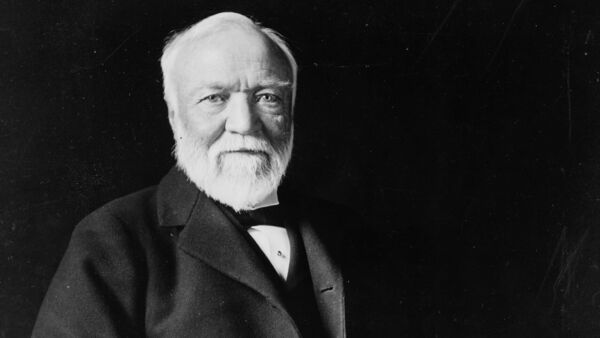
Andrew Carnegie was born in Dunfermline, Scotland, in 1835 and moved with his family to Pennsylvania in 1848 after economic hardship disrupted the weaving trade. He started working at just 12 as a bobbin boy, later becoming a telegraph messenger and then a railroad superintendent.
Largely self-educated through reading and night study, Carnegie went on to build Carnegie Steel into one of the most powerful enterprises of the industrial age. In later life, he redirected much of his wealth toward philanthropy, funding libraries, education, and public institutions.
The quote
“The way to become rich is to put all your eggs in one basket and then watch that basket.”
— Andrew Carnegie
This line is widely quoted, though often paraphrased. Variations appear in historical records and Carnegie’s own writings, but the core idea remains consistent: focus, followed by vigilance.
What it really means
At first glance, the quote can sound like an argument against diversification. But Carnegie’s message is more precise than that. He is not advocating blind risk — he is advocating disciplined concentration.
The first half of the quote is about commitment: choosing one meaningful direction instead of spreading effort thinly across many. The second half, often overlooked, is about control. Watching the basket implies constant attention, adjustment, and accountability.
In practical terms, Carnegie is arguing that wealth and success are more often built through depth than breadth. Mastery comes from sustained focus. When you concentrate your energy on one area, you develop expertise. And expertise, over time, creates leverage.
For leaders and professionals, the takeaway is simple: pick the space where you can build the strongest advantage, and then stay close enough to it to keep improving it. Diversification may reduce risk, but excessive dispersion often reduces impact.
Why this resonates today
Carnegie’s idea feels especially relevant in today’s business environment. After years of broad experimentation, particularly in areas like artificial intelligence, companies are now shifting toward fewer, more practical use cases that deliver real returns.
The pattern is familiar: early exploration is wide, but lasting success comes from narrowing focus to what works. That is exactly what Carnegie was pointing to, not endless opportunity chasing, but deliberate concentration.
There’s also a broader market parallel. In recent years, a small group of companies has driven a large share of market performance. But history shows that leadership changes over time. Which brings us back to the second half of the quote: watch that basket. Focus alone is not enough; it must be paired with ongoing evaluation.
In fast-moving environments, the real skill lies in balancing conviction with awareness.
Another perspective
“The man who dies thus rich dies disgraced.”
— Andrew Carnegie
This lesser-known quote adds an important dimension. While the first explains how to build wealth, this one explains what wealth is for.
Together, they form a complete philosophy: pursue success with intensity, but do not treat accumulation as the final goal. Carnegie believed that wealth carried responsibility — that it should ultimately be used to create broader social value.
It’s a reminder that focus and ambition are tools, not endpoints.
How to apply this today
- Choose one priority this quarter that deserves disproportionate energy.
- Define your “basket” clearly — where is your biggest upside?
- Track it with a few measurable outcomes to stay grounded.
- Eliminate one distraction that consumes effort without adding real value.
- Go deep enough to build genuine expertise, not surface-level familiarity.
- Reassess regularly — ensure your focus is still justified.
Final thought
Carnegie emphasises focus and vigilance. Franklin reminds us that execution is what ultimately matters. Together, they point to a clear truth: meaningful success rarely comes from doing many things at once. It comes from doing one important thing, consistently, carefully, and well.
(The original draft was AI-generated.)