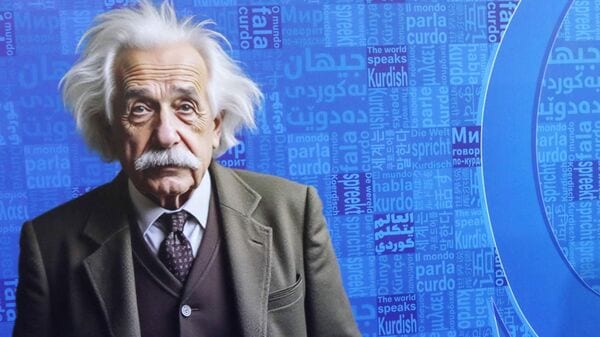
“There are only two ways to live your life. One is as though nothing is a miracle. The other is as though everything is a miracle.” ― Albert Einstein
LiveMint’s quote of the day offers a profound reflection on perspective, given by Albert Einstein. He highlighted a fundamental choice in how humans perceive reality in a world that feels increasingly automated and “cold” — Choosing to see miracles is an act of rebellion.
It keeps you curious, it keeps you empathetic, and most importantly, it keeps you from becoming a “machine” yourself.
What does the quote mean
In this quote, Albert Einstein offers two distinct “operating systems” for the human mind:
“Nothing is a miracle”
This is the path of pure logic, with perhaps a touch of cynicism. It views the world as a series of predictable, mechanical events governed by cold laws.
While scientifically rigorous, it can lead to a sense of the “mundane,” where nothing feels special because everything is “just how it is.”
“Everything is a miracle”
This is the path of awe and wonder. , in his quote, acknowledges that the very existence of the laws of physics, the complexity of a single cell, or the fact that we can even perceive the universe is statistically impossible and utterly extraordinary.
Einstein, despite being a man of science, leaned toward the latter. He believed that the most beautiful thing we can experience is the “mysterious.”
How does it apply in the present day
In 2026, Einstein’s dichotomy is more relevant than ever because we live in a world that is designed to be “frictionless.” When life becomes too efficient, we tend to stop seeing the “miracles” and start seeing only the “functions.”
The trap of “algorithmic predictability”
We live in an age where algorithms predict our tastes, our routes to work, and even our responses.
The “Nothing is a Miracle” View: Life feels like a series of data points. We become “users” rather than “humans.” If a video doesn’t load in one second, or if an AI doesn’t give us the perfect answer instantly, we feel frustrated because we expect the world to work like a machine.
The “Everything is a Miracle” View: This lens allows you to see the staggering human ingenuity behind the screen. It recognises that we are witnessing a transition in human history—where the line between biology and technology is blurring—and finds the “magic” in being alive during such a shift.
Combating “digital fatigue” and burnout
The modern pace of life often demands that we operate at 100% capacity from dawn until late at night.
The “Nothing” View: Work is a grind, the commute is a nuisance, and rest is just “recharging the battery.” This leads to profound burnout because there is no soul in the process.
The “Everything” View: It invites “micro-wonder.” It’s the ability to look at a cup of coffee and realise the global supply chain, the chemistry of the roast, and the simple biological miracle of your taste buds. This perspective provides mental oxygen—small breaks of gratitude that prevent the grind from feeling meaningless.
Sustainability and global stewardship
As we navigate the environmental challenges of the mid-2020s, this quote becomes a moral compass:
Nothing is a Miracle: Nature is just a resource to be extracted or a background for our selfies.
Everything is a Miracle: The planet is a self-regulating, incredibly rare biological vessel. When we view the Earth as a miracle, we move from being “consumers” to being “stewards.”
Who was Albert Einstein
(1879–1955) was a German-born theoretical physicist widely acknowledged as one of the most influential scientists of all time. While his name is often used as a synonym for “genius,” his actual legacy is rooted in transforming our fundamental understanding of the universe.
Einstein is best known for developing the theory of relativity, which consists of two main pillars:
Special Relativity (1905): Introduced the idea that time and space are linked and relative to the observer. This led to the world’s most famous equation: E = mc^2
This formula demonstrates that energy (E) and mass (m) are interchangeable, laying the groundwork for nuclear energy and changing the course of human history.
General Relativity (1915): A revolutionary theory of gravity that describes it not as a force, but as a curvature of spacetime caused by mass. It predicted phenomena like black holes and gravitational waves, which scientists are still confirming today.
In 1921, Einstein was awarded the Nobel Prize in Physics, notably not for relativity—which was still considered controversial—but for his discovery of the law of the photoelectric effect. This work was pivotal in the development of quantum mechanics.
Einstein’s impact extended far beyond the laboratory. A staunch pacifist and humanitarian, he used his global platform to advocate for civil rights, Zionism, and international cooperation.