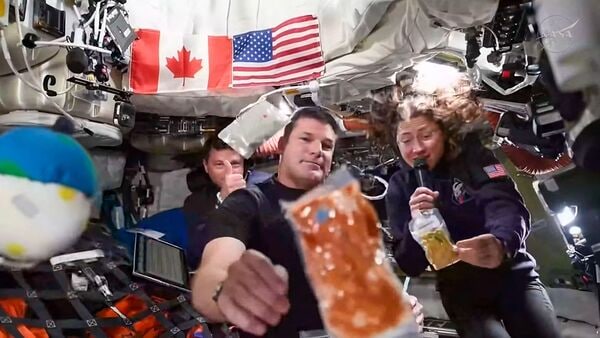
NASA’s is making history as humanity’s first trip to the moon since 1972. Four astronauts — three Americans and one Canadian — are on track to surpass Apollo 13’s record for the farthest distance from Earth while conducting a six-hour lunar flyby on Monday (April 6).
Apollo 13, famously dubbed NASA’s “successful failure,” missed its lunar landing after an oxygen tank ruptured on the way in 1970. Commander Jim Lovell, Fred Haise, and Jack Swigert reached a maximum of 248,655 miles (400,171 km) from Earth before safely returning using a free-return trajectory.
Artemis II follows a similar figure-eight path, flying around the moon without landing. Its astronauts are expected to exceed Apollo 13’s distance by nearly 3,400 miles (5,400 km). Christina Koch, one of the , said the milestone helps “merge the past with the present and even the future when new records are set.”
Up-close lunar observations
During the flyby, astronauts will take turns observing and photographing the lunar surface. At closest approach, will pass within 4,000 miles (6,400 km) of the moon.
geologist Kelsey Young said that despite less illumination of the far side due to the April 1 launch, the crew will still see previously unobserved features, including large portions of the Orientale Basin.
The astronauts will use professional cameras as well as iPhones for casual snapshots. Prior to launch, the crew trained extensively with lunar geography flashcards to identify key features during the flyby.
Total solar eclipse from space
A rare benefit of the mission’s timing is a total solar eclipse visible only from Orion. The moon will block the sun for several minutes, exposing the sun’s outer atmosphere, or corona. Astronauts will monitor solar activity and use eclipse glasses for eye protection.
Temporary communication blackout
Orion will be out of contact with Mission Control for about 40 minutes while behind the moon. NASA’s Deep Space Network won’t have a line of sight during this period, echoing the blackouts experienced during Apollo missions. Flight director Judd Frieling reassured that physics “will absolutely get us back to the front side of the moon.”
Journey home and space station connection
After completing the lunar flyby, Orion will return to Earth over four days, aiming for a Pacific Ocean splashdown near San Diego on April 10.
During the return journey, the crew will communicate with astronauts aboard the — a first for a moon mission — allowing a unique opportunity for “cosmic chitchat,” including crew members from the first all-female spacewalk in 2019: Koch aboard Orion and Jessica Meir on the ISS.
Looking ahead: Lunar exploration milestones
represents a critical step toward NASA’s long-term goal: a sustainable moon base with landers, rovers, drones, and habitats. The mission’s lunar observations and operational experience will guide future expeditions and deepen humanity’s understanding of the moon’s far side.
(With AP inputs)