The spokesman for Iran’s foreign ministry said Monday that President Trump’s repeated threats to attack the country’s civilian infrastructure amounted to war crimes, as he acknowledged ongoing diplomatic efforts to end the war but warned that “negotiation can in no way be compatible with ultimatums, crimes, or threats to commit war crimes.
As reports said Pakistan had handed Tehran and Washington a proposal for a 45-day ceasefire, foreign ministry spokesman Esmail Baqaei said it was “not unusual for intermediaries to convey the positions of the parties … and naturally, this process continues.”
“However, negotiation can in no way be compatible with ultimatums, crimes, or threats to commit war crimes,” Baqaei added in remarks conveyed by Iranian state media.
“Regarding threats against us, there is no doubt: issuing such threats constitutes war crimes, encourages war crimes, and normalizes war crimes. Repeatedly threatening a country with the destruction of energy and industrial infrastructure, while signaling to the Israeli regime to attack civilian targets either alone or with your cooperation, constitutes a war crime under both international humanitarian law and the Rome Statute of the International Criminal Court,” Baqaei said.
Others have warned that attacking civilian infrastructure would constitute a war crime.
“Electrical generating plants power hospitals, they power schools, water sanitation facilities, the things that you need to sustain basic day-to-day living for a civilian population,” Tess Bridgeman, who was a legal adviser to President Obama’s National Security Council, told CBS News national security correspondent David Martin over the weekend. “Obliterating all power plants, threatening coercive actions against the civilian population to try to bring a government to the negotiating table, those kinds of things are flatly illegal.”
Elliott Abrams, who served as special representative for Iran in the first Trump administration, told Martin punishing the Iranian population would undercut the U.S. cause. “We want the Iranian people on our side,” he said. “I’d rather see us go after regime targets, assets they use to repress the Iranian people, not assets Iranians use to live their daily lives.”
President Trump is scheduled to hold a news conference at the White House later Monday about the successful mission over the weekend to rescue the second member of a U.S. F-15E fighter jet crew from inside Iran, among other topics.
Mr. Trump said in a Truth Social post over the weekend that members of the military would join him to speak with the media at 1 p.m. Eastern on Monday afternoon.
The F-15’s pilot was rescued Friday after the jet was shot down over a remote area of Iran, but the second crew member wasn’t rescued by U.S. forces until early Sunday morning local time.
“We have rescued the seriously wounded, and really brave, F-15 Crew Member/Officer, from deep inside the mountains of Iran,” Mr. Trump wrote in a Truth Social post on Sunday, calling him “a highly respected Colonel.”
The naval command of Iran’s powerful Islamic Revolutionary Guard Corps vowed Monday that shipping in “the Strait of Hormuz will never return to its former state, especially for America and Israel.”
“The Navy of the IRGC is in the process of completing the operational preparations for the Announced Plan of Iran’s officials for the new order in the Persian Gulf,” the command said in a statement posted on social media.
It appeared to be a reference to a plan approved by Iran’s parliament last week to charge a fee for all commercial vessels to transit the strait, a vital shipping lane on which Iran has enforced a de facto blockade in retaliation for the U.S.-Israeli strikes now in their fifth week.
Iran has allowed some ships to traverse the strait in recent days, but none belonging to the U.S. or Israel, and it is believed to be using its Larak Island as a “toll booth” to collect fees that other countries say amount to extortion.
Pakistan has presented the U.S. and Iran with a last-ditch proposal to immediately halt fighting and reopen the Strait of Hormuz, a source aware of the ongoing indirect negotiations told the Reuters news agency on Monday. Axios first reported on Sunday a bid for a potential 45-day ceasefire, intended to be the first part of a two-phase deal aimed at launching broader, direct negotiations to permanently end the war.
Pakistan drafted the framework to end the hostilities and presented it to Tehran and the Trump administration overnight, the source told Reuters.
“All elements need to be agreed today,” the source told the news agency.
The source told Reuters that Pakistan’s army chief, Field Marshal Asim Munir, was in contact “all night long” with Vice President JD Vance, U.S. special envoy Steve Witkoff and Iran’s Foreign Minister Abbas Araghchi.
Reuters said the proposal by Islamabad calls for a ceasefire to take effect immediately so the Strait of Hormuz could reopen. There would then be 15–20 days for the two sides to finalize a broader settlement to end the war.
Neither the Trump administration nor Tehran offered any immediate response to the proposal.
Iranian officials have said previously that any ceasefire must come with guarantees that the country will not be attacked again by the U.S. or Israel, but Iranian officials have also indicated that they want the status quo in the Strait of Hormuz to change, with Tehran keeping a permanent level of control over the vital shipping lane. Some have even suggested Iran must be paid reparations for the damage done during the war, reparations that could come in the form of “tolls” charged by Iran to let ships through the strait.
Reuters said a final agreement under the proposal would be expected to include Iranian commitments not to pursue nuclear weapons in exchange for the U.S. and other countries lifting sanctions and releasing billions of dollars of frozen Iranian assets.
Israel and the United States carried out a wave of attacks on Iran on Monday, killing more than 25 people, and Iran responded with missile fire on Israel and its Gulf Arab neighbors.
Explosions rang out in Tehran and low-flying jets could be heard for hours as the capital was pounded. Thick black smoke rose near the city’s Azadi Square after one airstrike hit the grounds of the Sharif University of Technology.
Among those killed in one of the attacks was the head of intelligence for Iran’s paramilitary Revolutionary Guard, Maj. Gen. Majid Khademi, Iranian state media and the Israeli military said.
In a statement, the Israel Defense Forces said Khademi, whose predecessor was killed in previous strikes last summer, was killed in an intelligence-based airstrike in Tehran.
The IDF said Khademi was “responsible for gathering intelligence and helping formulate a comprehensive situational assessment for the regime’s senior leadership” during the current war, calling him a “key figure in the campaign.”
“Additionally, Khademi worked to advance terrorist activities against the State of Israel and against Jewish targets worldwide. He also took part in attempts to target American individuals and was responsible for monitoring Iranian civilians as part of the regime’s suppression of internal protests,” the IDF said.
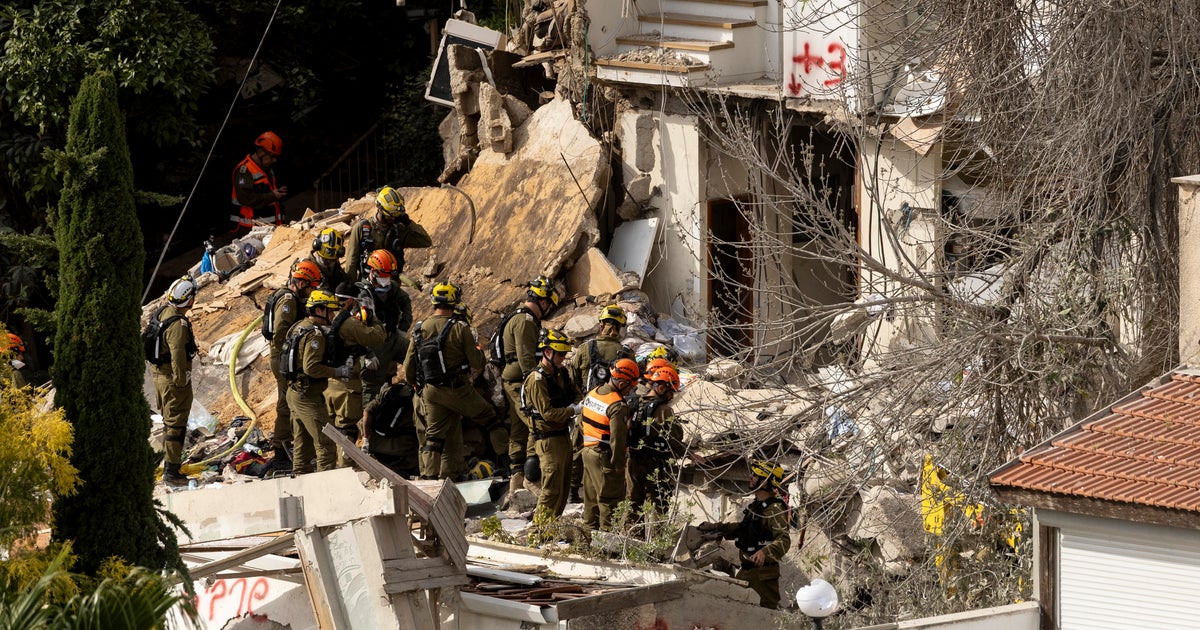
Iranian missiles hit the northern Israeli city of Haifa, meanwhile, where four people were found dead in the rubble of a residential building, the Israeli military said.
Kuwait, the United Arab Emirates and Saudi Arabia all activated their air defense systems to intercept incoming Iranian missiles and drones, as Tehran kept up the pressure on its Gulf neighbors. Iran’s regular attacks on regional energy infrastructure and its stranglehold on the Strait of Hormuz, through which a fifth of the world’s oil is shipped in peacetime, has sent global energy prices soaring.
CBS/AP
Iran’s central military command warned on Monday of “much more devastating” retaliation if its adversaries hit civilian targets.
“If attacks on civilian targets are repeated, the next stages of our offensive and retaliatory operations will be much more devastating and widespread,” a spokesman for the Khatam al-Anbiya Central Headquarters said in a statement posted by state broadcaster IRIB on Telegram.
The president told Fox News in a phone interview that he thinks he can get a deal with Iran by Monday, acknowledging last ditch diplomatic efforts.
Trey Yingst, Fox News’ chief foreign correspondent, said the president told him if Iran doesn’t make a deal quickly, he’s “considering blowing everything up and taking over the oil.”
The interview came after Mr. Trump, in an Easter Sunday post on Truth Social, warned that without a deal, Tuesday would be “Power Plant Day, and Bridge Day, all wrapped up in one, in Iran,” as he threatened to hit the country’s electrical plants and other civilian infrastructure.
“There will be nothing like it!!!” the president wrote on Truth Social. “Open the F*****’ Strait, you crazy bastards, or you’ll be living in Hell — JUST WATCH!”
He later posted on Truth Social: “Tuesday, 8:00 P.M. Eastern Time,” indicating his apparent deadline for Iran to make a deal.
He told The Wall Street Journal “if they don’t do something by Tuesday evening, they won’t have any power plants and they won’t have any bridges standing.”