Iran’s powerful Islamic Revolutionary Guard Corps accused President Trump of making “false statements” about diplomacy between the countries yielding an agreement for some ships to safely transit the Strait of Hormuz, insisting it still had full control of the vital shipping lane.
Mr. Trump said Iran had given him the “present” this week of allowing “eight big boats of oil” to transit the strait, suggesting it was a good will gesture to demonstrate willingness to negotiate an end to the war.
“This morning, following the false statements of the corrupt U.S. president claiming that the Strait of Hormuz is open, three container ships of different nationalities moved toward the designated corridor for authorized vessel traffic, but were turned back after warnings from the IRGC Navy,” the Guard Corps said in a social media post.
It said the IRGC Navy reiterated that “the Strait of Hormuz is closed and that any traffic through it will face a severe response,” and that the “passage of any ship ‘to and from’ ports belonging to allies and supporters of the Zionist-American enemies, to any destination and via any corridor, is prohibited.”
The CBS News Confirmed team found online maritime tracking data to corroborate the Iranian claims about interdicting ships. Data show two large cargo ships owned by Chinese company COSCO Shipping Lines Ltd turned around as they entered the Strait of Hormuz early on Friday and were back in the Persian Gulf. A third ship, also Chinese owned, turned around the previous day.
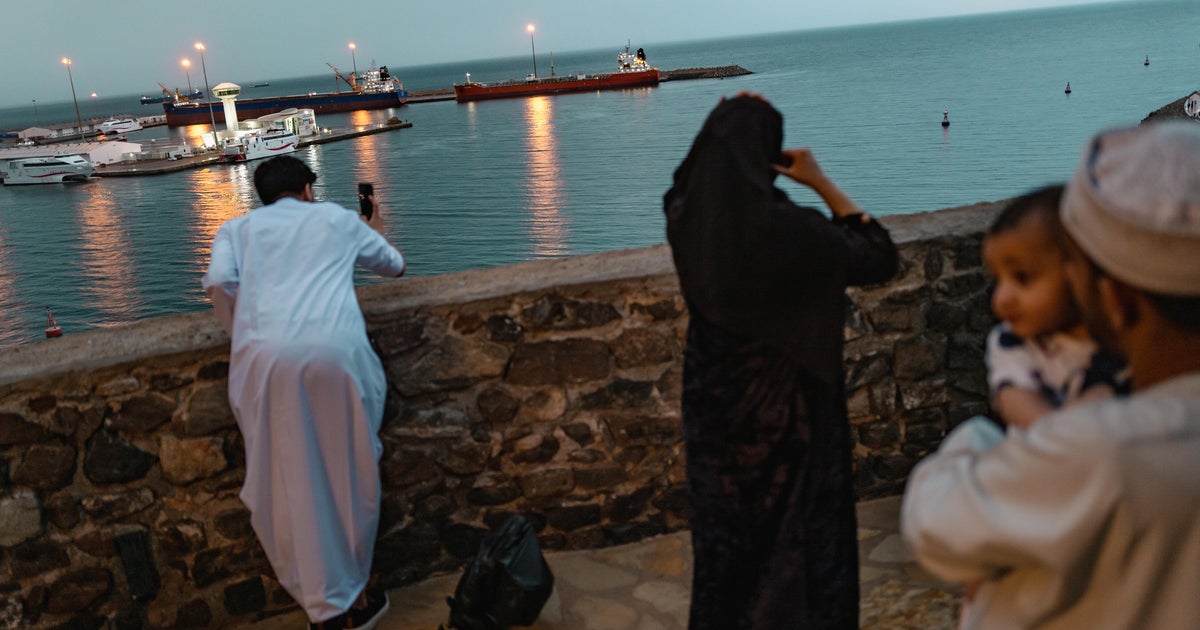
Iran is charging some commercial ships to sail safely through the Strait of Hormuz. An Iranian lawmaker said some vessels have been charged $2 million to transit the key shipping lane, to cover the country’s cost of war.
Passage has long been free and required no special permission, as formally guaranteed by the United Nations’ 1982 Convention of the Law of the Sea, which means Iran is breaching international maritime law.
Only a handful of ships from a few countries, China, India and Pakistan, are known to have gotten through, and
The Lloyds List intelligence firm, which tends to take a neutral, diplomatic stance, says the fees charged by Tehran have effectively created a “toll booth” system, but others are more direct, calling it a shakedown in the strait with the Iranian regime acting like a mob boss.
The head of the Abu Dhabi National Oil Company in the UAE, Sultan Ahmed Al Jaber, who has become one of the most vocal critics of Iran’s actions, bluntly calls it economic terrorism.
He met Vice President JD Vance in Washington on Thursday and spent hours blasting Iran.
“When Iran holds Hormuz hostage, every nation pays the ransom. At the gas pump, at the grocery store, at the pharmacy, every household. No country can be allowed to destabilize the global economy in this way. Not now, not ever,” Al Jaber said the previous day during a speech in Washington.
Iran’s parliament is currently drafting a bill to make the fees on ships “official,” according to state media, with the plan for it to be finalized in early April.
World shares mostly fell and oil gained again on Friday after Wall Street had its worst day since the start of the Iran war over growing doubts about a de-escalation.
In early European trading, Britain’s FTSE 100 fell 0.3% to 9,939.96. France’s CAC 40 dropped 0.7% to 7,718.97, and Germany’s DAX lost 1.3% to 22,314.28.
In Asia, Tokyo’s Nikkei 225 closed 0.4% lower at 53,373.07. South Korea’s Kospi also lost 0.4% to 5,438.87, narrowing the sharp drop earlier in the day at trading close.
Hong Kong’s Hang Seng was up 0.4% to 24,951.88 after dipping earlier in the day, while the Shanghai Composite index traded 0.6% higher at 3,913.72.
Australia’s S&P/ASX 200 fell 0.1% to 8,516.30.
Taiwan’s Taiex was 0.7% lower, while India’s Sensex lost 2.1%.
On Thursday, Wall Street fell to its worst drop since the Iran war began, with the S&P 500 sinking 1.7% for its worst day since January to 6,477.16. The Dow Jones Industrial Average fell 1% to 45,960.11. The Nasdaq composite slumped 2.4% to 21,408.08, and is off 10% below its recent all-time high in what is considered a “correction.”
Expectations this week of de-escalation negotiations between Washington and Tehran have sent markets into disarray.
Shortly after Wall Street trading closed Thursday, U.S. President Donald Trump said he was postponing a threatened attack on Iran’s energy facilities as he further delayed until April 6 a deadline for Iran to reopen the Strait of Hormuz, a critical waterway for oil and gas transport.
U.S. futures were mostly unchanged on Friday.
Israel’s military said its forces carried out “a wide-scale wave of strikes targeting infrastructure of the Iranian terror regime in the heart of Tehran” early Friday.
Iran’s Revolutionary Guard Corps said it carried out missile and drone strikes the previous day targeting sites in Israel and military facilities in the Gulf used by U.S. forces.
A maintenance facility for a U.S. Patriot air defense system was targeted in Bahrain, the Guards said in a statement carried by Iranian news agencies.
Lebanese media reported an Israeli strike hit Beirut’s southern suburbs early Friday. Journalists heard several explosions from the direction of the Hezbollah stronghold, which Israel has repeatedly struck since war began.
The Saudi defense ministry said, meanwhile, that it had “intercepted and destroyed” four drones over the kingdom’s east early Friday.
CBS/AFP
Israeli opposition leader Yair Lapid is warning that the war is taking too high a toll.
“The IDF (Israel Defense Forces) is stretched to the limit and beyond. The government is leaving the army wounded out on the battlefield,” Lapid said, echoing a warning delivered a day earlier by military chief Lieutenant General Eyal Zamir.
“The government is sending the army into a multi-front war without a strategy, without the necessary means, and with far too few soldiers,” Lapid said.
In a televised briefing, Israeli military spokesman Brigadier General Effie Defrin said: “On the Lebanese front, the forward defensive zone that we are creating requires additional IDF forces. … For that, more combat soldiers are needed in the IDF.”
One day after walking out of a House Armed Services Committee briefing on Iran, Republican Rep. Nancy Mace of South Carolina told CBS News she has “grave concerns about the Washington war machine getting us into another 20-year-plus endless war.”
Mace said in an interview with CBS News congressional correspondent Nikole Killion on “The Takeout” that she would oppose sending ground forces into Iran, and argued the military needs to explain how the war could end. She said Wednesday’s briefing with military officials “left most of our questions unanswered.”
“I haven’t seen an exit strategy yet,” said Mace, who is currently running for South Carolina governor. “And I think that’s where a lot of us share the heartburn.”
Mace added that she remains a strong supporter of President Trump and believes the U.S. operation against Iran has been successful at degrading the country’s missile capabilities. But she wants Mr. Trump to “declare victory” rather than allowing it to turn into a “never-ending war.”
President Trump said Thursday on Truth Social that he would postpone his threat to order strikes on Iranian energy plants until April 6, extending his deadline for a second time.
Mr. Trump told Fox News he extended the timeframe for potential strikes against Iran’s oil and energy infrastructure because talks with Iran were “going fairly well” and Iran had asked for “more time.”
“I gave them a 10-day period,” he said on Fox News’ “The Five.”
The president had previously announced a five-day extension to his ultimatum for Iran to reopen the Strait of Hormuz or face strikes on its energy infrastructure on Monday, which was set to expire Saturday.
“As per Iranian Government request, please let this statement serve to represent that I am pausing the period of Energy Plant destruction by 10 Days to Monday, April 6, 2026, at 8 P.M., Eastern Time,” Mr. Trump wrote. “Talks are ongoing and, despite erroneous statements to the contrary by the Fake News Media, and others, they are going very well.”
“They asked for seven, and I said, ‘I’m going to give you 10,’ because they gave me ships,” Mr. Trump added, referring to several oil tankers he says Iran allowed through the Strait of Hormuz as a show of good faith. It remains unclear where they were sailing from or where they are going.