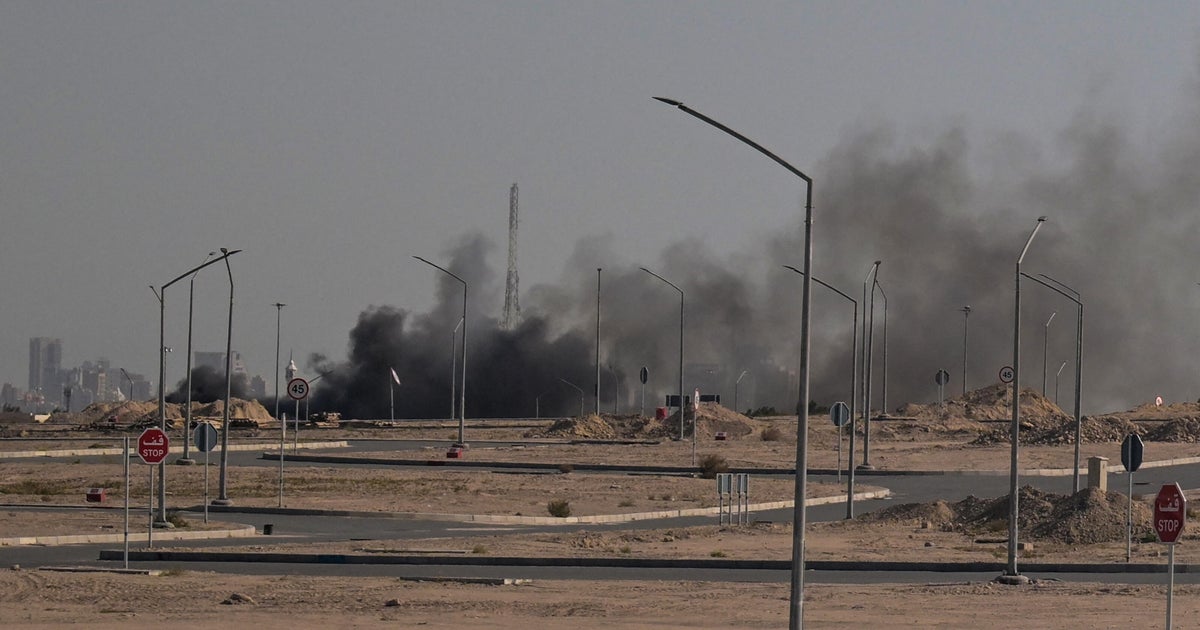
Explosions were reported across the Gulf on Monday as Iran continued lashing out with missiles in response to ongoing U.S. and Israeli strikes. Blasts were heard in Abu Dhabi and Dubai in the United Arab Emirates; Doha, Qatar; Bahrain’s capital Manama; Kuwait City and in Oman’s capital Muscat.
Iran’s army said it had used 15 cruise missiles in its latest attacks on a U.S. air base in Kuwait and on vessels in the Indian Ocean.
The unprecedented attacks across the region saw Iran’s retaliation spill well beyond military targets and U.S. bases, shattering an image Gulf states have carefully cultivated for decades as islands of calm in a volatile region.
Most of the Iranian missiles and drones are being intercepted, but some have slipped through, hitting civilian areas and causing significant damage, including outside U.S. bases in Bahrain and Kuwait.
Several U.S. warplanes crashed in Kuwait Monday, but all crew members survived, that country’s defense ministry said on social media.
A ministry spokesperson said authorities launched search and rescue operations and evacuated the crews to hospitals, adding that they were in stable condition.
He said the U.S. and Kuwait are conducting a joint investigation into the cause of the crashes.
Earlier, the spokesperson said Kuwaiti Air Defense Forces had intercepted several “hostile aerial targets.”
Fire and smoke rose from inside the U.S. Embassy compound in Kuwait after an Iranian attack on the small Mideast nation on Monday. Video obtained by The Associated Press showed the smoke with an alarm wailing, and a correspondent for French news agency AFP saw smoke rising from the diplomatic mission.
The U.S. had earlier issued an urgent warning to Americans there to take cover and remain indoors. It said: “Do not come to the Embassy. Take cover in your residence on the lowest available floor and away from windows. Do not go outside.”
“U.S. Embassy personnel are sheltering in place,” it added.
CBS/AP/AFP
Israel has said it’s intensifying strikes against the Iranian-backed group Hezbollah in Lebanon following rocket and drone fire blamed on the group.
In Iraq, Iranian-backed militias have claimed a drone attack targeting U.S. troops at Baghdad’s airport.
Britain said a suspected drone strike targeted its military air base in Cyprus on Sunday, and France said it had reinforced its military posture in the eastern Mediterranean.
What is taking shape is no longer a contained conflict, but a spreading confrontation, stretching from the Gulf to the Levant and into Europe.
The head of the United Nations’s nuclear watchdog agency, the IAEA, said Monday that his agency had “no indication” that any of Iran’s nuclear installations had been damaged by the ongoing Israeli-U.S. strikes on the country.
IAEA director general Rafael Grossi warned, however, that with missiles still flying a “possible radiological release with serious consequences” could not be ruled out, calling the situation in the Middle East “very concerning” and urging the “utmost restraint” by all parties.
“I reiterate my call on all parties to exercise maximum restraint to avoid further escalation,” Grossi said in his statement, released by the IAEA, as he opened the closed-door session.
“Iran and many other countries in the region that have been subjected to military attacks have operational nuclear power plants and nuclear research reactors, as well as associated fuel storage sites, increasing the threat to nuclear safety,” he said. “Let me underline that the situation today is very concerning. We cannot rule out a possible radiological release with serious consequences, including the necessity to evacuate areas as large or larger than major cities.”
He said the IAEA was trying to contact the Iranian nuclear regulatory authorities, “with no response so far.”
The IAEA reported just days ago that, despite U.S. strikes in June that President Trump said “obliterated” Iran’s nuclear program, the country still has a stockpile of around 972 pounds of uranium enriched to 60% purity — a short technical step away from the level required for nuclear weapons.
Grossi said on Feb. 19 that “most of the material that Iran had accumulated up until June of last year, despite the [U.S.] bombings and the attacks, is still there, in large quantities, where it was at the time of the strikes. … Some of it may be less accessible, but the material is still there.”
He called Monday for diplomatic negotiations to resume “as quickly as possible.”
CBS/AFP
A total of 555 people have been killed across Iran in the U.S. and Israeli strikes that began Saturday, the Iranian Red Crescent said on the third day of the war.
“Following the Zionist-American terrorist attacks carried out in various regions of our country, 131 cities have been affected to date and, regrettably, 555 of our compatriots have been killed,” the humanitarian group said in a post on social media.
The agency did not say how many of the casualties were believed to have been members of Iran’s military or security forces.
Saudi Arabian state oil company Aramco closed its major refinery in Ras Tanura after a suspected Iranian drone strike, the Reuters news agency quoted an industry source as saying Monday, as Tehran launched missiles and drones at countries across the region deemed to be supportive of the U.S.-Israeli war.
Iranian strikes on ports, cities and U.S. interests in Abu Dhabi, Dubai, Doha, Manama and Oman have frozen commercial shipping and aviation traffic in vital Mideast waterways and travel hubs, sending Brent crude futures surging roughly 10% on Monday, according to Reuters, which said benchmark Dutch and British wholesale gas prices were also up more than 25% in early morning trading.
U.S. crude prices rose 8.2% to $72.64 per barrel, Reuters said.
Stocks were also hit Monday morning by the war, with markets in Europe and Asia seeing overall share prices slide between 1.5% and just under 2%, including the U.S. S&P 500 futures, which were down 1.5%, according to Reuters.
The Saudi refinery at Ras Tanura is one of the biggest in the Middle East. The source told Reuters that it was shut as a precaution and the situation was under control, but it was not clear how long operations would be halted.
U.K. foreign secretary Yvette Cooper said Monday that Britain was establishing support systems to help citizens flee the Gulf region, home to an estimated 300,000 Britons, amid Iranian missile strikes.
“We are looking at a wide range of options, working, crucially with the travel industry and with government evacuation if necessary,” Cooper told Britain’s Sky News.
Asked by Sky if the U.K. might stage government evacuations from some countries, Cooper said: “We’re working on every possible option.”
“We have to recognize the scale of this as well, and also the fact that there are strikes still under way,” she said.