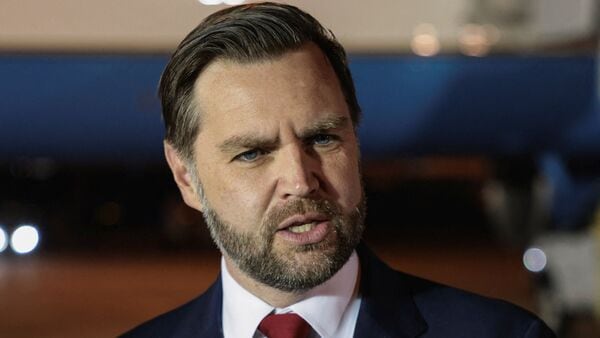
The White House announced on Wednesday (April 8) that President Donald Trump is sending Vice President JD Vance and other top officials to Islamabad for direct talks with Iran aimed at ending weeks of conflict in the region.
“President Trump is dispatching his negotiating team led by the vice president of the United States, JD Vance, special envoy Steve Witkoff, and Jared Kushner to Islamabad for talks this weekend,” Press Secretary Karoline Leavitt said.
The first round of negotiations is set for Saturday morning local time, with Vance leading the US delegation.
Iran confirms participation
Iranian President Masoud Pezeshkian confirmed Tehran will attend the Islamabad talks following a telephone conversation with Pakistan Prime Minister Shehbaz Sharif.
“He confirmed that Iran would be participating in the negotiations in Islamabad,” the Pakistan PMO said in a statement.
Iran’s delegation is expected to be led by Speaker of Parliament Mohammad Bagher Ghalibaf, a central figure in Tehran’s wartime leadership structure.
Fragile ceasefire under pressure
Sporadic fighting continues in the region, particularly in Lebanon, where Israel is striking Hezbollah targets. Iran has claimed these attacks violate the ceasefire.
“The Iran–U.S. Ceasefire terms are clear and explicit: the U.S. must choose—ceasefire or continued war via Israel. It cannot have both,” Iranian Foreign Minister Abbas Araghchi said on X.
Ghalibaf also cited the fighting, drone incursions into Iranian airspace, and what he called a denial of Iran’s right to enrichment, adding that “in such circumstances, a bilateral ceasefire or negotiations is unreasonable.”
Strait of Hormuz remains critical
The strategic Strait of Hormuz remains a key point of tension. Iranian media said Tehran has largely blocked the passage, while the White House says it has observed an “uptick of traffic in the strait today.”
President Trump emphasized that reopening the strait is a condition for the ceasefire holding. Leavitt added that the US would assist in ensuring safe passage for international shipping.
Trump suspends attacks on Iran
Trump on April 7 announced a two-week suspension of bombing and attacks on Iran, describing it as a “double-sided CEASEFIRE” contingent on Iran agreeing to reopen the Strait of Hormuz.
“Based on conversations with Prime Minister Shehbaz Sharif and Field Marshal Asim Munir, and subject to the Islamic Republic of Iran agreeing to the COMPLETE, IMMEDIATE, and SAFE OPENING of the Strait of Hormuz, I agree to suspend the bombing and attack of Iran for a period of two weeks,” Trump said on Truth Social.
He added that the ceasefire would allow negotiations for a long-term peace agreement: “We received a 10-point proposal from Iran, and believe it is a workable basis on which to negotiate.”
Israel maintains military operations in Lebanon
Despite the ceasefire with Iran, Israeli Prime Minister Benjamin Netanyahu reiterated that Lebanon and Hezbollah are not part of the agreement.
“The war hasn’t concluded,” Netanyahu said, highlighting Israel’s campaign against Hezbollah and the broader Iranian-backed network in the region.