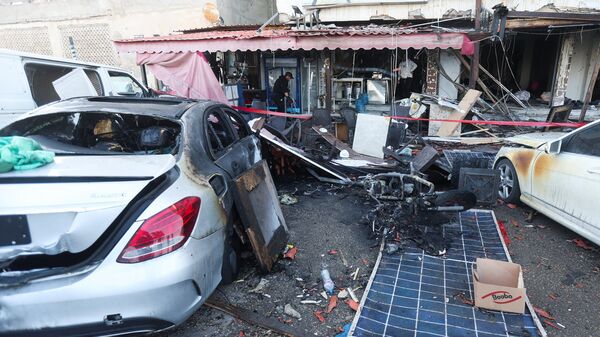
Israel’s military has issued fresh evacuation warnings to residents of Tyre in southern Lebanon, underscoring deep uncertainty over the scope of the proposed Iran-US ceasefire and raising fears that the parallel conflict with Hezbollah will continue unabated.
Evacuation order signals imminent strikes in Tyre
On Wednesday, the Israeli military urged civilians in the coastal city of Tyre to leave immediately and move north of the Zahrani River, warning of impending strikes.
The directive suggests that Israel is preparing to intensify operations in southern Lebanon, even as diplomatic efforts to establish a broader ceasefire gather pace.
The warning also reinforces Israel’s position that its military campaign in Lebanon remains separate from any temporary arrangement involving Iran.
Dispute over whether Lebanon is part of ceasefire
Confusion over the scope of the ceasefire has emerged as a major fault line.
Pakistan’s Prime Minister Shehbaz Sharif, who has played a key mediating role, stated that Tehran, Washington and their allies had agreed to a comprehensive ceasefire that would extend to Lebanon.
However, Israeli Prime Minister Benjamin Netanyahu rejected that assertion, maintaining that the temporary agreement does not apply to Israel’s ongoing operations against Hezbollah.
The contradiction has cast doubt on the coherence of the ceasefire framework and raised questions about whether all parties are operating under the same understanding.
Regional attacks cloud ceasefire implementation
Further complicating the situation, multiple countries in the Gulf reported attacks in the immediate aftermath of President Donald Trump’s ceasefire announcement.
Kuwait, Saudi Arabia, Bahrain and the United Arab Emirates—alongside Israel—said they had faced missile and drone strikes launched by Iran, adding to uncertainty over when, or even whether, the ceasefire will fully take effect.
These incidents highlight the volatility of the moment, with hostilities continuing across multiple fronts despite diplomatic signals of de-escalation.
Hezbollah front remains active flashpoint
Israel’s campaign in Lebanon has been framed as a response to sustained rocket fire from Hezbollah, the Iran-aligned militant group.
The renewed evacuation order for Tyre suggests that Israel intends to maintain pressure on Hezbollah positions, regardless of parallel negotiations between Washington and Tehran.
This raises the prospect of a fragmented ceasefire—one that may apply selectively rather than uniformly across the region.
Diplomatic ambiguity threatens fragile truce
The diverging interpretations of the ceasefire’s scope point to a broader challenge facing negotiators: aligning multiple actors with competing priorities.
While the US and Iran appear to be moving towards a temporary pause in direct confrontation, Israel’s stance indicates that regional dynamics—particularly in Lebanon—may not be easily contained within that framework.
A ceasefire in name, conflict in practice
The developments in Tyre illustrate the limits of the current ceasefire proposal.
Even as diplomatic efforts intensify, military actions on the ground continue, suggesting that the path to a comprehensive de-escalation remains uncertain.
For civilians in southern Lebanon, the latest evacuation order is a stark reminder that, despite talk of peace, the immediate reality remains one of conflict.